

A full call log can still hide an empty pipeline. Cold calling for real estate wholesalers works when seller conversations give you enough context to choose a next step, not when callers simply rack up dials.
If you’re making plenty of calls but getting few useful conversations, the issue may be the operation behind the calls: loose lead standards, thin notes, or no clear view of what callers actually said. More volume alone won’t fix that.
This 2026 guide shows you how to build a repeatable campaign with clear inputs, practical measures, and a consistent standard for qualifying seller leads. You’ll learn what context to capture, how to review call activity, and how to move leads into your pipeline without losing the thread. We’ll also cover how recorded, QA-reviewed leads delivered to your CRM make caller activity easier to inspect, and when outsourced cold calling may fit. The goal is simple: fewer mystery leads, clearer next steps, and a process you can manage.
Key Takeaways
- Make cold calling for real estate wholesalers a defined campaign, with target criteria and lead standards set before callers start.
- Track calls, conversations, qualified leads, and appointments separately. Dial volume alone won’t show whether the campaign is producing useful opportunities.
- Give callers a clear process for recording seller context and routing each lead to the right next step.
- Before launching outreach, review current federal and state calling requirements and assign clear ownership for messaging and records.
- Outsource calling when caller capacity or time is the bottleneck, while keeping control of acquisition criteria and deal decisions.
Cold Calling for Real Estate Wholesalers: What It Can, and Cannot, Do
Cold calling is direct outbound outreach to property owners who haven’t asked to speak with you. The caller starts the conversation, and the owner decides whether to engage. For background on the sales technique, see What is Cold Calling? In real estate wholesaling, the goal is to learn whether an owner may consider selling, then decide whether the opportunity deserves a closer look.
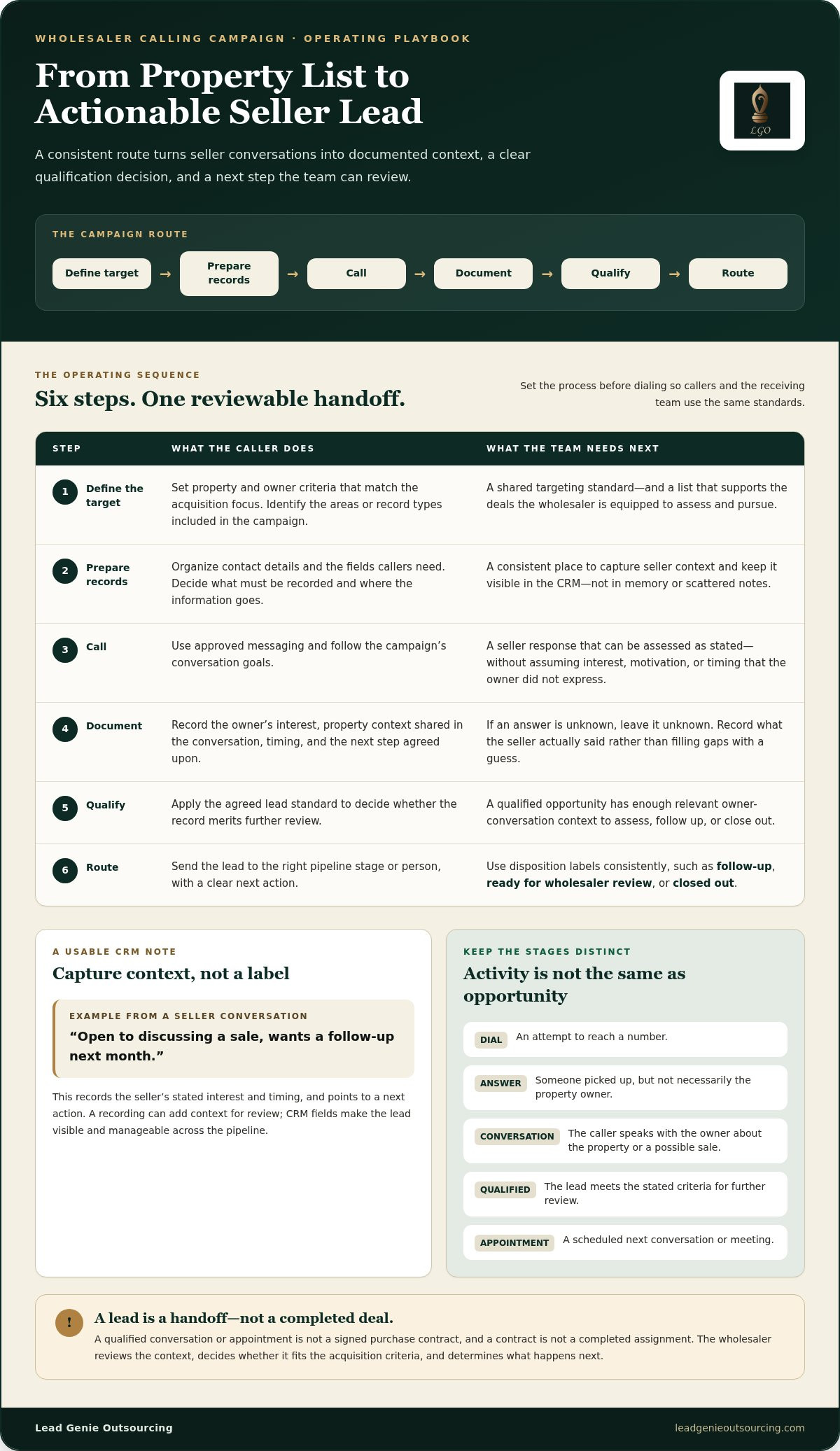
Keep the stages separate. A dial is an attempt to reach a number. An answered call means someone picked up, but not necessarily the property owner. A seller conversation happens when the caller speaks with the owner about the property or a possible sale. A qualified lead meets your stated criteria for further review. An appointment is a scheduled next conversation or meeting. Each stage tells you something different about the campaign.
Why wholesalers use direct seller outreach
A property list can show which owners fit your targeting criteria. It can’t tell you whether an owner is open to a conversation, what they’re weighing, or whether the timing is worth a follow-up. A call can surface that context. For example, an owner might say they’re not ready to discuss a sale now but would consider speaking again later. That response may call for a dated follow-up, not an immediate appointment.
That’s the practical role of cold calling for real estate wholesalers: it’s one acquisition channel for finding and assessing possible off-market seller opportunities, not a guaranteed source of contracts. A useful conversation should help you choose a next step: assess the opportunity, follow up at an agreed time, or close it out because it doesn’t fit.
What a cold-calling campaign cannot promise
A qualified conversation or an appointment is not a signed purchase contract. A contract is not a completed assignment. Deal execution still depends on what happens after the call, including your review of the property and terms, your follow-up, and your ability to move the transaction forward.
Results also depend on campaign inputs and execution. A list that misses your target sellers, inaccurate contact records, poor timing, or a caller who fails to capture key details can weaken the path from first attempt to useful lead. Seller responses vary, too. Treat each stage as a signal to inspect, not proof that the next stage will happen.
A qualified seller opportunity is an owner conversation with enough relevant context to decide whether to assess, follow up, or close out the lead. That definition keeps the bar clear. It doesn’t imply that the owner will sell or that the numbers will work. It gives callers and acquisition teams a shared standard for what counts as a useful handoff.
How a Wholesaler’s Cold-Calling Campaign Moves from List to Lead
A campaign needs a clear path from the first record to the next action. Without one, callers may use different standards, notes may miss key details, and leads can sit without an owner. For cold calling for real estate wholesalers, set the process before dialing, then make every handoff easy to review.
Set campaign inputs before the first call
Start with your acquisition strategy and capacity. Define the property and owner traits callers should prioritize, along with the areas or record types included in the campaign. Don’t assume one list source or targeting approach fits every wholesaler. A useful list supports the deals you’re equipped to assess and pursue.
Next, decide what callers must record and where the information goes. Keep fields simple enough to use on every conversation, but specific enough to guide the next step. A practical sequence looks like this:
- Define the target: Set the property and owner criteria that match your acquisition focus.
- Prepare records: Organize the contact details and fields callers need to work consistently.
- Call: Use approved messaging and follow the campaign’s conversation goals.
- Document: Record the response and relevant seller context in the CRM, not in memory or scattered notes.
- Qualify: Apply the agreed lead standard to decide whether the record merits review.
- Route: Send it to the right pipeline stage or person, with a clear next action.
Set disposition labels before launch, too. For example, a record might be marked for follow-up, ready for wholesaler review, or closed out. Use labels that mean the same thing to callers and the person receiving the lead.
Turn a conversation into a usable handoff
A lead record should capture what the seller actually said, not a caller’s guess about what the seller meant. Give callers a consistent place to note the owner’s interest, property context shared during the conversation, timing, and the next step agreed upon. If an answer is unknown, leave it unknown rather than filling the gap with an assumption.
For example, “open to discussing a sale, wants a follow-up next month” gives the acquisition team more to work with than “motivated.” The first note records the seller’s stated interest and timing. It also points to an action. A recording can add context for review, while CRM fields make the lead visible and manageable across the pipeline.
A seller lead record documents a possible opportunity and its next step; it is not a completed real estate deal. The wholesaler reviews the context, decides whether it fits the acquisition criteria, and determines what to do next. If you need caller capacity to run this process, outsourced cold-calling support connects outreach with recorded seller leads delivered to your CRM.
How to Judge Cold-Calling Lead Quality and Caller Performance
Caller performance isn’t measured by dial count alone. For cold calling for real estate wholesalers, measure how activity moves toward seller conversations and leads that meet your criteria. A high number of dials may show effort, but it can’t tell you whether the list reached the right owners, whether conversations were useful, or whether the leads merit follow-up.
Separate activity metrics from useful outcomes
Track each stage as its own measure. Use the same campaign period when comparing results, and look at movement between stages rather than relying on a single headline number. These are categories to track, not industry benchmarks.
| Activity measures | Conversation and lead-quality measures |
|---|---|
| Dials: Call attempts made. | Conversations: Discussions with owners that provide relevant seller context. |
| Connections: Calls answered by a person. | Qualified leads: Seller records that meet the campaign’s agreed criteria for review. |
| Attempts by caller or list segment: Helps show where activity is coming from. | Appointments: Scheduled next conversations or meetings, tracked separately from qualified leads. |
Compare stages over a consistent span. If callers make many attempts but few owners answer, review contact data and list fit. If calls connect but rarely turn into substantive conversations, inspect timing and caller approach. If conversations happen but few leads meet your standard, check whether the targeting criteria and qualification rules match. The numbers point to where to investigate, but they don’t explain the cause on their own.
Use call review to inspect lead context
CRM notes give you a quick read. Recordings can help you check whether those notes match what the seller said. QA review lets you inspect the conversation and the handoff, but it doesn’t prove that a deal will close. Match a sample of calls against the CRM record and ask:
- Does the recording support the seller’s stated interest and timing?
- Are property details recorded as the owner gave them, without added assumptions?
- Does the qualification label fit the campaign’s agreed standard?
- Is the next step clear, with the right follow-up action recorded?
If the seller asked for a later follow-up, the record should show that timing and the assigned next step. If the call doesn’t support the note, correct the record and clarify the caller standard. That keeps the pipeline grounded in what was actually said.
Lead Genie Outsourcing delivers recorded, QA-reviewed seller leads to your CRM, giving you call context to review alongside campaign activity. See how Lead Genie Outsourcing handles recorded seller leads.
How to Set Up a Responsible, Repeatable Wholesaler Calling Operation
A calling campaign needs an owner, clear instructions, and a clean handoff. Without them, callers make their own choices about who to call, what to say, and where a lead goes. Set the operating rules before launch, then review them as the campaign or its messaging changes.
For cold calling for real estate wholesalers, responsible setup includes checking current federal and state calling requirements before outreach begins. Rules can vary and change. Review current requirements with appropriate legal guidance rather than relying on old scripts or assumptions about what is allowed.
Prepare the list, message, and calling workflow
Your business should set the target criteria and own the approved message. Give callers a clear, respectful introduction that identifies who’s calling and why. Define what they can answer, what they must not promise, and when to pause and escalate a question or concern. Keep the guidance practical so callers can follow it during a real conversation.
Before launch, agree on the list criteria, required CRM fields, and lead-routing rules. Make sure callers know where to record a seller’s stated interest, property context, timing, and requested next step. Also tell them how to handle a record that doesn’t fit the target or needs review. Campaign messaging and contact practices must follow applicable current rules.
- Campaign owner: Names the person responsible for targets, caller guidance, and process updates.
- Approved messaging: Gives callers a consistent opening and clear boundaries for the conversation.
- Escalation path: Shows where unusual questions, objections, or requests should go.
- Lead destination: Identifies who reviews each lead and what happens after handoff.
Keep records visible and next steps assigned
A CRM entry should let the next person understand the call without tracking down the caller. Use consistent fields for seller interest, property details shared, timing, disposition, and next action. Keep the notes factual. “Asked for a follow-up next month” is more useful than “very motivated” if that label isn’t backed by what the owner said.
Assign each actionable record to a person or pipeline stage. A note without an owner can stall, and a note without a next step leaves the team guessing. Set a regular review rhythm for call recordings, lead notes, and assigned actions. Check whether the recording supports the CRM entry, whether the disposition fits the campaign standard, and whether follow-up is clear. Correct gaps and update caller guidance when the same issue appears more than once.
Lead Genie Outsourcing’s calling support includes trained callers, recorded seller leads, and QA review before delivery to your CRM. Explore Lead Genie Outsourcing’s calling support to see how that outreach can fit into a wholesaler’s workflow.
When Outsourced Cold Calling Fits a Real Estate Wholesaler
Outsourcing makes sense when reaching owners keeps competing with the work only you can do: reviewing opportunities, deciding whether terms fit, and moving potential deals forward. It gives caller activity a dedicated owner, but it doesn’t hand off your acquisition judgment.
Before making the shift, look for a recurring bottleneck. Are target lists waiting untouched? Does calling stop whenever you get busy? Are seller conversations missing from the CRM, or arriving without notes you can act on? Those are signs your current setup may not have enough time or capacity to keep outreach consistent.
Signs the calling workload may need support
Compare the time your team spends calling with the time it needs to review leads and handle follow-up. If the same person must do both, one side can get pushed aside. Outsourced callers can take on property-owner outreach while you keep control of the target criteria, qualification standard, and deal decisions. Delegation won’t repair weak criteria, missed follow-up, or poor execution after a lead reaches your pipeline.
- Lists keep aging: Records sit because no one has protected time to work them.
- Calling is inconsistent: Outreach starts and stops around other tasks, making activity hard to assess.
- Seller context goes missing: Notes are thin, delayed, or difficult to connect to a caller’s conversation.
- Leads have no clear owner: The team can’t tell who should review or follow up next.
Use these signals to pinpoint the problem. If your team can’t review and act on incoming leads, adding more calls may only increase the backlog. Set the handoff and follow-up process first.
What the Lead Genie Outsourcing handoff looks like
Lead Genie Outsourcing provides trained callers who contact property owners in your market. Qualified seller leads are recorded, reviewed through QA, and delivered to your CRM. That gives you call context and a visible handoff to assess against your own acquisition criteria. You decide whether to pursue an opportunity and what the next deal step should be.
Plans include follow-up support, and disposition outreach is included in applicable plans. Lead Genie Outsourcing also guarantees 30 qualified seller appointments a month. Keep ownership clear: callers handle outreach, while you retain control of acquisition decisions and pipeline priorities.
If caller capacity is the bottleneck and you have a clear process for reviewing leads, talk with Lead Genie Outsourcing about your calling pipeline.
Make Your Next Campaign Easier to Manage
Before you add more calls, choose one part of your operation to tighten. Set a clear standard for what callers should capture, decide who reviews each lead, or make the next action visible in your pipeline. Then use that standard for a full campaign cycle. You’ll have a better basis for deciding what to adjust than you would from dial totals alone.
That’s the practical next step for cold calling for real estate wholesalers: build a process your team can run, inspect, and improve without losing sight of seller context. If caller capacity is holding that process back, consider whether outsourced support fits the way you want to manage your pipeline.
Talk with Lead Genie Outsourcing about your seller pipeline and explore an approach that keeps outreach moving while your team stays in control of acquisition decisions. Start with a clear standard, keep the handoff visible, and build from there.
Frequently Asked Questions
Is cold calling legal for real estate wholesalers?
Cold calling may be lawful, but calling property owners as a wholesaler doesn’t automatically make every campaign compliant. The rules can depend on where you call, who you contact, and how you place the calls. Before launching, review current federal and state requirements with qualified legal guidance. Don’t assume that describing yourself as a buyer settles the issue; check that your list, message, and calling method fit the rules that apply.
How many calls should a real estate wholesaler make each day?
There isn’t one daily call count that fits every wholesaler. Set a target your team can sustain while leaving time to prepare records, handle conversations, and complete follow-up. Then review the results over a consistent campaign period. If callers rush through notes to hit a dial target, or your team can’t work the responses, reduce or reshape the workload. The useful number is one your operation can support and assess.
What makes a cold-call lead useful to a wholesaler?
A lead is useful when it gives you enough reliable information to make a next decision. For example, a seller may say they’re considering a sale after a tenant leaves, share relevant property details, and agree to a follow-up. That doesn’t mean the property fits your deal criteria. It gives you a concrete reason to review the record, decide whether to follow up, or set it aside.
Can real estate wholesalers outsource cold calling?
Yes. Outsourcing can add caller capacity while you keep ownership of acquisition criteria and deal decisions. Lead Genie Outsourcing provides trained callers who contact property owners, with qualified seller leads recorded, reviewed through QA, and delivered to your CRM. That gives you a record to inspect as you decide what to do next. Outsourcing supports outreach, but your team still needs a clear process for reviewing and acting on leads.
Should wholesalers use a script for cold calling?
Use a script as a guide, not a speech to recite. It can help callers introduce themselves, explain why they’re calling, ask consistent questions, and capture the seller’s answers. Leave room for a natural response. If an owner asks something the caller can’t answer or the conversation moves beyond the approved guidance, the caller should follow the campaign’s escalation process rather than guess or make promises.
What should a wholesaler track to know if cold calling is working?
Track activity and pipeline movement together. Along with attempts and answered calls, monitor seller conversations, leads accepted for review, appointments, and follow-up actions completed. Look for changes across campaign periods and by list segment or caller. If appointments rise but your team doesn’t advance those leads, the bottleneck may be after the call. Use the records to find where progress slows, then adjust one part of the process at a time.