

More leads won’t fix a broken handoff. If your day disappears into dialing owners and chasing old conversations, outsourced lead generation for wholesalers can give seller outreach a consistent process. Callers can start conversations and pass along qualified leads or appointments, but your team still decides whether a property is worth pursuing.
That distinction matters. A raw lead count doesn’t tell you whether a seller is motivated, what they said, or what should happen next. To make a handoff useful, agree on qualification criteria, review recorded conversations, and route each lead to someone responsible for follow-up.
This guide explains what an outsourced calling workflow covers, what callers handle, and what stays with your team. You’ll learn how to set lead-quality standards, review calls, route seller leads and appointments into your CRM, and judge whether monthly calling fits your operation. The goal is a steadier flow of seller conversations, with deal decisions still in your hands.
Key Takeaways
- Outsourced lead generation for wholesalers covers seller outreach, but a conversation or appointment is not a closed deal. Keep property and deal decisions with your team.
- Set target criteria and lead ownership rules before outreach begins, so every relevant conversation has a clear next step.
- Compare outsourced calling, in-house outreach, and purchased lead records by the work each option handles and the follow-up it leaves to your team.
- Lead Genie Outsourcing’s monthly plans use trained callers to contact property owners, with qualified, recorded seller leads delivered to your CRM.
What outsourced lead generation for wholesalers actually handles
Outsourced lead generation for wholesalers means an external team carries out seller outreach under an agreed process. Callers contact property owners, start conversations, and identify people open to discussing a property. The resulting seller leads or appointments give your team a chance to assess fit. Outreach alone does not produce a signed contract or a closed deal.
Lead generation is the work of finding and attracting potential prospects. In wholesaling, distinguish each stage so you know what a reported result represents:
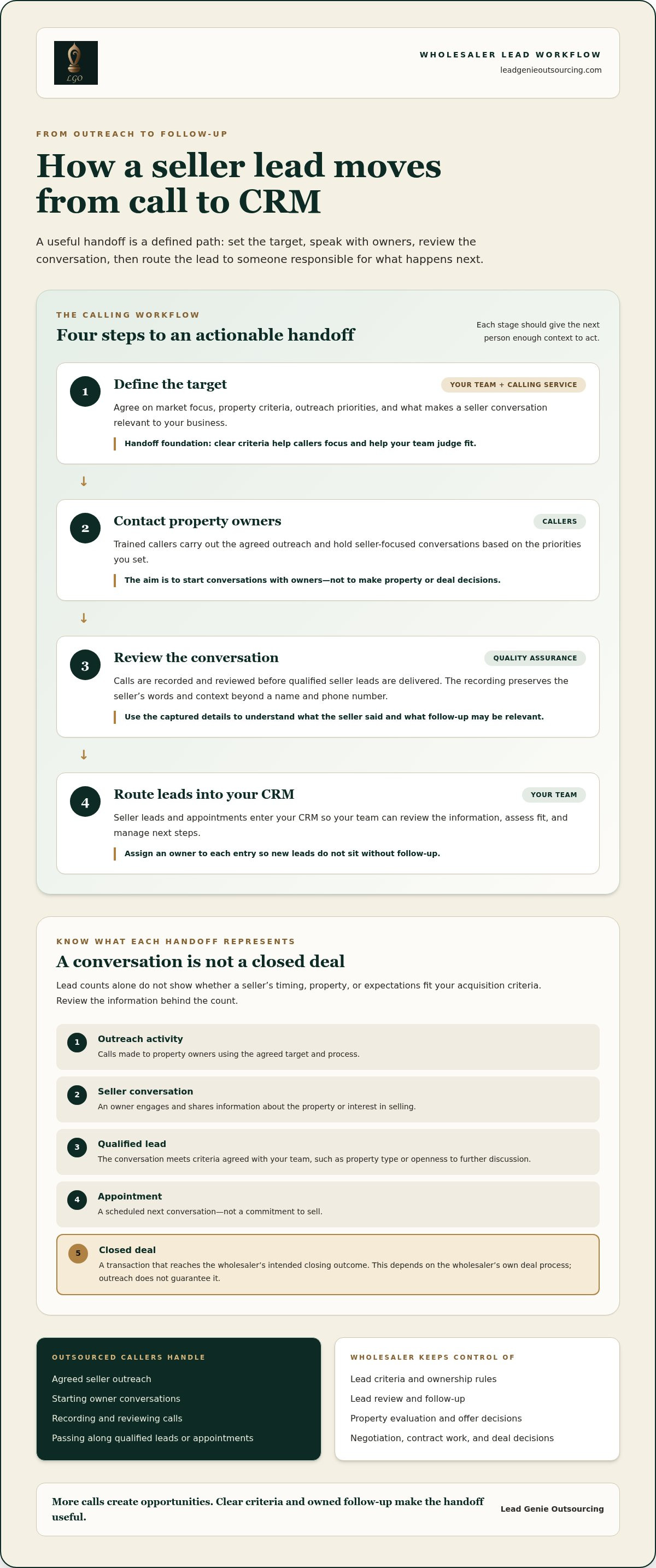
- Outreach activity: Calls made to property owners using an agreed target and process.
- Seller conversation: An owner engages and shares information about the property or their interest in selling.
- Qualified lead: A conversation meets criteria agreed with your team, such as the right property type or a seller open to further discussion.
- Appointment: A scheduled next conversation, not a commitment to sell.
- Closed deal: A transaction that reaches the wholesaler’s intended closing outcome.
A lead count tracks activity or handoffs. It doesn’t show whether a seller’s timing, property, or expectations fit your acquisition criteria. Review the information behind the count: what the owner said, which details were captured, and what action your team should take. For example, a conversation may meet your property criteria but still need a follow-up because the seller isn’t ready to discuss next steps. Without that context, a large number can hide a thin pipeline.
What the outsourced team does, and what stays with the wholesaler
Callers handle the agreed outreach and look for owners willing to talk. The process can include recording and passing along qualified seller conversations or appointments. Your team sets the criteria for a relevant lead, reviews the information, and decides whether to pursue it.
A seller lead is a potential opportunity surfaced through conversation; a closed real estate deal is a transaction completed through the wholesaler’s own deal process. Property evaluation, offer decisions, negotiation, and contract work stay with the wholesaler. Outreach creates an opportunity to assess a seller’s situation, not a promise of a signed contract.
Why wholesalers outsource seller outreach
Repeated calls and follow-up can take time away from acquisitions and active deal work. Outsourcing moves that outreach into a defined workflow without requiring the wholesaler to build every calling role in-house. It separates the work of starting seller conversations from the judgment needed to decide whether a property fits.
The handoff still needs an owner on your side. Before calls begin, set the target, define what makes a conversation relevant, and assign someone to review new leads and follow up. The list, the fit of the criteria, and your team’s response all affect what happens next. If criteria are vague or promising conversations sit untouched, more calls alone won’t fix the process.
How outsourced wholesaling lead generation moves from call to CRM
A useful calling process has a clear path from targeting to a lead your team can act on. Each step should give the next person enough context to do their job. That turns outreach into a working process rather than a disconnected stream of calls, and gives your acquisitions team a practical handoff.
- Define the target. Set the market focus, property criteria, and outreach priorities with the calling service. Agree on what makes a seller conversation relevant to your business.
- Contact property owners. Trained callers make the outreach and hold seller-focused conversations based on the agreed priorities.
- Review conversations. Calls are recorded and reviewed through quality assurance before qualified leads are delivered. This creates a review point before a lead enters your workflow.
- Route leads to your CRM. Seller leads and appointments are delivered into your CRM, where your team can assess them and manage next steps.
From target market to seller conversation
The target is the starting point, not an afterthought. Tell the calling team what kinds of properties and seller situations align with your acquisition strategy. Set priorities that help callers focus their conversations, then refine those criteria as your team learns which leads fit. Clear direction gives the outreach a purpose and makes it easier to assess the handoff.
Keep the target practical. If your strategy focuses on a particular property type, say so. If seller interest or timing affects your next step, define how the conversation should capture it. Don’t assume callers can infer your buying criteria from a broad description. The more clearly you explain what matters, the more useful the resulting handoff can be.
Call review, recordings, and lead handoff
Lead Genie Outsourcing reviews calls through quality assurance before delivering qualified seller leads. Recordings let you hear the seller’s own words and understand the context behind a lead instead of relying only on a short note. A recorded, reviewed lead gives the wholesaler context beyond a name and phone number. Use that context to decide what follow-up is relevant.
CRM delivery makes the handoff part of your working pipeline. Your team can review the seller information, assess fit, and decide what happens next. Assign someone to review each entry so a lead doesn’t sit in a separate inbox without an owner. Use the call context to prepare for the next conversation rather than starting cold.
That’s the operating value of outsourced lead generation for wholesalers: calls, review, and routing form one defined workflow, while your team retains control of acquisition decisions. Seller calling and CRM delivery work together as parts of that handoff, not as disconnected tasks.
Outsourced callers, in-house teams, or purchased leads: what fits?
These options address different parts of outreach. Outsourced calling brings callers into the process. An in-house team keeps the work within your business. Purchased lead records provide contact details, but your team still has to make contact and manage the response. Compare the work each option handles and leaves to you, not just the number of names it produces.
Outsourced calling
- Outreach: An external calling team contacts property owners.
- Conversations: Callers handle seller discussions under agreed priorities; qualified leads can be reviewed and handed over.
- Follow-up: Your team assesses fit and manages acquisition steps. Follow-up support depends on the plan.
In-house calling
- Outreach: Your employees make the calls.
- Conversations: Your team manages discussions and decides how to capture details.
- Follow-up: Your team owns the next step and oversees the calling work.
Purchased lead records
- Outreach: The records supply contact information; your team initiates contact.
- Conversations: Your callers handle responses and determine whether a seller is open to talking.
- Follow-up: Your team manages responses and decides which contacts merit further attention.
Outsourced calling versus building an in-house team
Outsourcing can suit an operator who needs steady outreach but doesn’t want to create and manage a caller role internally. It shifts the calling activity to an external team while leaving deal judgment with the wholesaler. An in-house team may fit better when the business wants direct control over calls and has the capacity to manage the people and daily work behind that outreach.
Outsourced calling versus purchasing lead records
A record is contact data, not a seller conversation. It doesn’t tell you whether the owner will engage, share useful details, or meet your criteria. Purchased records still need someone to call, manage responses, and decide what qualifies for follow-up. Outsourced calling covers active outreach, with a handoff that can include a reviewed seller conversation rather than contact details alone.
There’s no universal winner. Match the approach to the work your team can take on and the visibility it needs. If you already have callers and want to direct every interaction, in-house outreach may fit. If you need contact details to work through, records may suit that task. If repetitive calling is crowding out acquisition work, outsourced lead generation for wholesalers can add outreach capacity without making call volume the only measure of progress.
Track what happens after outreach: whether conversations match your criteria, whether your team takes the next step, and whether opportunities progress through your pipeline. A high lead count without useful seller context or follow-through is activity, not proof of deal progress.
Set up outsourced lead generation for active seller leads
Good outreach starts with clear working rules. Before calls begin, decide what callers should focus on, what information your team needs, and who acts on each handoff. This gives callers direction and keeps your team in control of the decisions that move a seller conversation into deal work.
- Target: State the property criteria and market priorities tied to your acquisition strategy.
- Seller context: Name the details that help your team judge relevance, such as the owner’s stated interest or timing.
- Routing: Agree how appointments, questions, and conversations needing review should reach the right person.
- Ownership: Assign someone in-house to review new CRM entries, listen to recordings, and handle the next step.
Base the criteria on how you actually make decisions. If property type matters, define it. If seller timing affects your response, explain what callers should capture. Don’t treat every contact as a ready seller. The goal is to give your team a clear basis for sorting and acting on conversations, not to assume every call will become an opportunity.
Agree on targets and working rules before outreach
Set priorities with the calling team before outreach starts, then make routing rules just as clear. Assign an owner to every scheduled appointment. Decide who handles seller questions. If a conversation doesn’t fit the agreed criteria, specify whether it should go to your team for review rather than trigger an automatic next step. These rules reduce guesswork and make handoffs easier to manage.
Build a client-side response routine
Assign someone to check CRM entries and review recorded conversations. That person can route each handoff to the right next step: seller follow-up, internal review, or a decision about whether to make an offer. Record the outcome so your team can see what moved forward and where the process stalled. This creates visibility without requiring the wholesaler to manage every call directly.
Choose a review cadence your team can sustain, and make lead ownership visible in the CRM. A status or assigned owner helps prevent a new handoff from sitting untouched. If the caller’s notes and the recording point in different directions, use the call context to decide what to do instead of relying on a count or label alone.
Control comes from agreed targets, reviewable recordings, and a named owner for each next step. Lead Genie Outsourcing delivers qualified, recorded seller leads to the client’s CRM; follow-up support and disposition outreach are available when included in the selected plan. Set up outsourced seller outreach around the way your team works.
What outsourced lead generation looks like with Lead Genie Outsourcing
Lead Genie Outsourcing provides monthly cold-calling plans for real estate wholesalers and investors. Trained callers contact property owners and focus on seller conversations. Qualified seller leads and appointments are recorded, reviewed through quality assurance, and delivered to the client’s CRM. Your team can then review the conversations and decide what fits its acquisition process.
The roles are clear: Lead Genie handles seller outreach and the lead handoff. The wholesaler evaluates the property, makes offer decisions, and manages deal work. Callers can surface an opportunity, but the wholesaler decides whether it makes sense to pursue.
A seller-lead workflow with recordings and CRM delivery
Recorded calls let clients hear the context behind a delivered lead. Quality assurance takes place before delivery, adding a review step before the lead reaches your CRM. Rather than receiving only a name and number, your team can use the conversation to understand what the seller shared and plan a relevant follow-up.
The CRM handoff keeps seller information in your workflow. Lead Genie delivers seller leads and appointments to the client’s CRM, where the team can review them and manage next steps. LGO CRM is also available and free for 30 days. It’s an option for managing the handoff, not a requirement for every workflow.
Lead Genie focuses on real estate seller conversations. It does not buy properties or make acquisition decisions for the wholesaler. That separation keeps the roles clear: callers open conversations, while your team decides whether an opportunity fits and what to do next. For businesses considering outsourced lead generation for wholesalers, recorded calls and CRM delivery make the outreach process more visible than a lead count alone.
Monthly support for the next steps
Some plans include follow-up support to help carry seller conversations forward. Disposition outreach is also available when included in the plan. These supports can extend the workflow, but they don’t replace the wholesaler’s role in judging fit, setting offer terms, or managing deal decisions. The handoff is most useful when your team knows who owns the next action.
Lead Genie’s website advertises a guarantee of 30 qualified seller appointments a month. That appointment guarantee is one part of the monthly service. The practical fit still depends on how your team sets criteria, reviews calls, and acts on leads in the CRM.
For a monthly calling process built around recorded seller conversations and CRM handoff, learn how Lead Genie supports wholesaler outreach.
Make your next outreach step easier to manage
Before adding outreach, decide what capacity should help your team do. Do you need more time for acquisition work, a steadier flow of seller conversations, or fewer follow-ups slipping through the cracks? Choose the operational pressure you want to ease, then track whether the process is helping by reviewing lead fit, handoff ownership, and follow-up outcomes.
That gives you a practical starting point for outsourced lead generation for wholesalers. Set the handoff rules, assign someone to own new conversations, and keep deal decisions with your team. Start with a clear workflow, see how it runs, and adjust the criteria and follow-up routine as you learn what your pipeline needs.
To put a recorded seller-calling and CRM handoff workflow in place, explore Lead Genie Outsourcing’s monthly calling plans.
Frequently Asked Questions
Is outsourced lead generation a good fit for real estate wholesalers?
It can be a good fit if you need consistent seller outreach and have someone ready to handle the leads that come back. Outsourcing supplies outreach capacity, not acquisition execution: your team still decides whether to evaluate a property, make an offer, or pass. Before starting, assign a lead owner, set a review cadence, and make sure your follow-up routine can handle new conversations. That’s the practical test for outsourced lead generation for wholesalers.
Can outsourced callers find motivated sellers for wholesalers?
Callers can contact property owners and find people willing to discuss a possible sale, but motivation and timing vary from seller to seller. A conversation alone doesn’t establish that the property fits your criteria or that the owner will accept an offer. Review what the seller said, including their stated timing and situation, then decide whether to follow up, gather more details, or close out the lead.
How much does outsourced lead generation cost for wholesalers?
Monthly service fees vary by provider, plan scope, and included support, so there isn’t one reliable price for every wholesaler. Compare what the fee covers: who makes calls, how leads are reviewed and delivered, whether recordings are available, how CRM handoff works, and whether appointments are part of the commitment. Then weigh those responsibilities against your internal workload instead of comparing headline fees alone.
What happens if a seller lead is not ready to make an offer?
Don’t force an offer just because a lead was delivered. Review the seller’s recorded comments and decide whether the property and circumstances fit your strategy. You might set a future check-in, request more information, or mark the lead as a poor fit. Follow-up support may be included in a plan, but your team remains responsible for choosing the next step and assessing any later change in the seller’s situation.
Do wholesalers still need to follow up when they outsource lead generation?
Yes. Outsourcing calls doesn’t remove your responsibility to review delivered leads, make offer decisions, or manage deal steps. Assign someone to own each handoff and record the next action, so a seller isn’t left waiting while your team assumes someone else will respond. A plan may include follow-up support, but that support doesn’t take over your acquisition decisions or negotiations with the seller.
Is outsourced cold calling subject to telemarketing rules?
Outbound calling requirements can depend on applicable federal and state rules, who is contacted, and how the call is made. Don’t assume that using an outside caller removes your responsibilities or that one process fits every campaign. Review the current requirements that apply to your outreach and vendor arrangement, and use qualified legal guidance where needed. Keep responsibility for those decisions clear before calls begin.
How can a wholesaler judge lead quality beyond the number of leads?
Check whether each lead gives your team enough information to choose a sensible next action. Track whether the seller context is useful, whether a recording supports the handoff, and whether someone reviews the entry and follows up. Then assess how often conversations match your acquisition criteria. Keep these process measures separate from closed deals, which also depend on property fit, seller decisions, negotiation, and other parts of your operation.
Ready to build a consistent seller-calling workflow with recorded leads and CRM delivery? Explore Lead Genie Outsourcing’s monthly plans.