

Learning how to find motivated sellers starts with spotting a possible reason to reach out, then asking questions to confirm whether the owner is open to selling. A list can point you toward owners, but it can’t tell you who’s ready to have a conversation.
If you’ve spent time and money contacting people who have no interest in selling, the problem may not be a lack of leads. It may be that the lead source, outreach, or follow-up process isn’t focused enough. The right sourcing method depends on your budget, your team’s time, and how many seller conversations you can handle. More outreach isn’t always better. A clear process is.
This guide compares practical lead sources, explains how to assess signals, and shows how to build a repeatable pipeline without chasing every list. You’ll see how public activity, referrals, inbound marketing, and cold calling can fit different operations. You’ll also learn how to track seller conversations and give your acquisition team useful information to review in its CRM.
Key Takeaways
- Seller motivation is a reason to explore, not proof of a discount or a deal. Ask about the owner’s plans and timing.
- Learn how to find motivated sellers by comparing public activity, referrals, inbound marketing, and direct outreach.
- Choose lead sources based on the time, control, conversation volume, and follow-up capacity your operation can support.
- Build a sourcing workflow that tracks each lead’s source, contact date, response, and next action.
- Outsourced cold calling can support consistent owner outreach. Your team remains responsible for reviewing leads and making offers.
What Does It Mean to Find a Motivated Seller?
A motivated seller is an owner whose circumstances, willingness to sell, and timing create an opening for a conversation. Motivation isn’t proof of property distress, a promise to sell, or a guarantee of a below-market price. It describes the seller’s situation, not the deal an investor hopes to make.
That distinction matters. A property may look neglected while its owner has no plans to sell. Another owner may have a well-kept home and a practical reason to consider an offer. The property can provide context, but it can’t confirm intent. To find out whether a sale makes sense, you need to hear from the owner.
Investors still need to weigh a potential seller’s plans against their own buying criteria and real estate investing principles. A public signal can help you decide whom to contact. It can’t make the decision for the owner or tell you what terms they’ll accept.
Active and passive seller signals are not the same
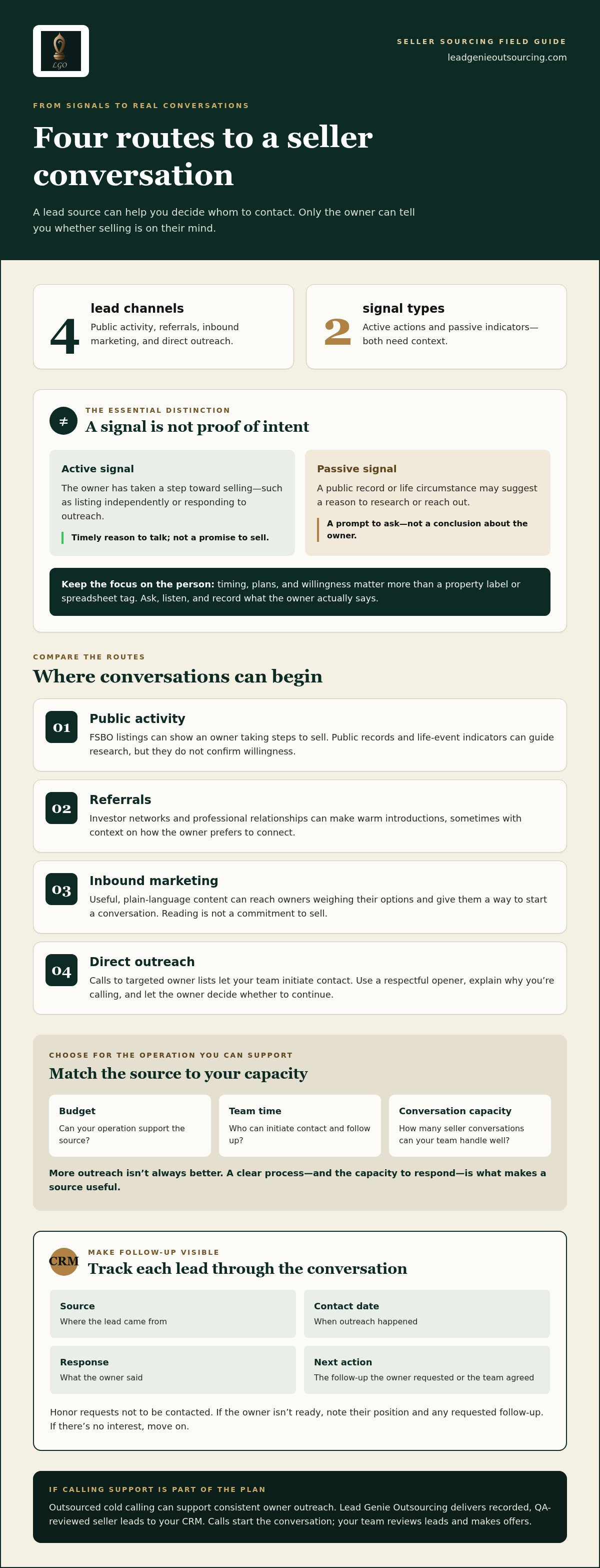
Active signals show that an owner has taken a step toward selling. For example, an owner may list a property independently or respond to buyer outreach. That makes a conversation timely, but it doesn’t tell you the owner’s price, flexibility, or readiness to move forward.
Passive signals suggest possible interest without a firm decision. An owner may appear on a public list or have a circumstance that could affect their plans. Treat that as a reason to ask, not as a conclusion. One data point can’t explain a person’s full situation.
Why a seller’s situation matters more than a label
Labels can help sort leads, but they leave out the details that shape a real conversation. An owner’s timing, property plans, and preferred next step matter more than a tag in a spreadsheet. Ask what they’re considering and when they might act. Let the owner explain what they want and set the pace.
Probate, divorce, financial hardship, or another life change may appear in a lead record. None proves that an owner wants to sell. Don’t treat a difficult circumstance as permission to assume intent or push for a deal. Start with a respectful question, listen to the answer, and record what the owner actually says.
That’s the practical test for how to find motivated sellers: use signals to choose where to focus, then verify interest through direct conversation. If the owner isn’t ready, note their stated position and any requested follow-up. If there’s no interest, move on. The goal isn’t to force every lead into a deal. It’s to distinguish a possible opening from a real opportunity based on the owner’s own words.
How to Find Motivated Sellers Across Multiple Lead Sources
Build your search around how owners enter a conversation. Some are already signaling interest. Others come through people they trust, find your content while weighing options, or hear from you first. Each channel has different strengths and demands. Use more than one when your team can follow up well, but don’t treat every name or signal as a ready seller.
- Public activity: FSBO listings can surface owners taking steps to sell. Public records and life-event indicators can guide research, but they don’t prove an owner wants an offer.
- Referrals: Investor networks and professional relationships can create warm introductions, sometimes with context about how the owner prefers to connect.
- Inbound marketing: Useful content can reach owners researching their options and give them a clear way to start a conversation.
- Direct outreach: Calls to targeted owner lists let you initiate conversations with people who haven’t contacted an investor.
Use visible activity, referrals, and inbound interest
FSBO activity gives you a visible reason to reach out, while an owner inquiry shows they chose to make contact. Neither tells you exactly how soon they’ll sell or what terms they’ll accept. Ask what they’re hoping to do next, then tailor follow-up to their answer.
Referrals work differently. Investor groups and professional relationships can connect you with owners who may be open to a discussion. Educational content, such as a plain-language guide to sale options, can help owners who are still weighing choices. Make the material useful first. A reader’s interest in an article isn’t a commitment to sell.
Use direct outreach to start more seller conversations
Cold calling gives investors a way to start conversations with owners who haven’t raised their hand. A targeted list helps focus the work, but it’s a starting point, not a verdict on the owner’s plans. Public records and life-event indicators can suggest whom to research; they can’t establish willingness. Use a respectful opener, explain why you’re calling, and let the owner decide whether to continue.
Before launching calls or other outreach, understand the federal and state rules that apply to your approach. Keep your process consistent and honor an owner’s request not to be contacted. More attempts won’t help if they lead to poor conversations or leave your team unable to respond to interested owners.
To decide how to find motivated sellers across these channels, match each source to the work your operation can sustain. Referrals and inbound interest may bring owners to you, while direct outreach requires your team to initiate contact. If consistent calling is the gap, outsourced cold calling for real estate investors can support owner outreach. Lead Genie Outsourcing delivers recorded, QA-reviewed seller leads to your CRM. The calls start the conversation. Your team still needs a clear next step for each response.
Which Motivated Seller Lead Source Fits Your Investing Operation?
The best source on paper may be the wrong source for your team. A channel helps only if you can run it steadily, respond to owners, and work the conversations it creates. Compare each option by the time it takes, how much control you have, how directly you reach owners, and how much follow-up your operation can handle.
| Lead source | Time demand | Control and access | Operating fit |
|---|---|---|---|
| Referrals and networking | Ongoing relationship work | Introductions bring context, but depend on others | Fits investors who can build and maintain professional relationships |
| Inbound content | Steady effort to create useful material | Owners initiate contact, but timing varies | Fits teams that can publish consistently and respond to inquiries |
| Public activity | Research and follow-up | Offers visible signals, not confirmed intent | Fits investors who can review leads and make careful contact |
| Direct calling | Regular list work and live outreach | Creates direct conversation, with control over who is contacted | Fits teams prepared to call, document responses, and follow up |
Match the channel to your time and team capacity
Self-managed calling takes focused time. Someone needs to prepare the list, make calls, note outcomes, and handle next steps. Networking takes a different kind of effort: building trust over time rather than working through a call list. Content also requires steady input before it can bring in inquiries, and those inquiries may arrive unevenly.
A small team doesn’t need to run every channel. Pick one primary source and one supporting source you can keep active. For example, a team with limited calling hours might build referral relationships while testing a manageable outreach routine. Track conversations and useful follow-ups, not just names added to a spreadsheet. A bigger list isn’t automatically a better pipeline.
Compare control, context, and conversation access
Direct calling gives you a chance to hear an owner’s plans in real time, but it takes trained, disciplined outreach and a clear handoff for interested sellers. Inbound leads arrive after an owner takes the first step, which provides useful context. Their timing and readiness can still differ. Referrals may bring personal context, but access depends on relationships and introductions.
Keep lead volume separate from lead quality. A channel can produce plenty of names but few useful conversations. Another may bring fewer leads with more context. Review whether the source creates conversations your acquisition team can assess and follow up on, rather than judging it only by list size.
The right source depends on capacity, consistency, and access to sellers. That’s the practical answer to how to find motivated sellers without overloading your operation. Choose channels your team can manage from first contact through the next action. Add volume only when follow-up can keep pace.
How to Build a Repeatable Motivated Seller Sourcing Workflow
A sourcing plan should fit the operation you can run, not the one you hope to build later. Set limits before outreach starts: what properties fit your buying criteria, how many new conversations can your team handle, and who owns the next step when an owner responds? Those answers help prevent outreach from creating a pile of leads no one can work.
Set a focused sourcing plan before outreach starts
Choose a small mix of channels based on available time, staff, and acquisition goals. Give each channel a clear place in the routine. For example, a team could reserve regular work blocks for owner calls and review referrals as they come in. The exact cadence matters less than choosing one your team can keep and measure.
- Define capacity. Set target property criteria and decide how many seller conversations the acquisition team can review and act on. Be realistic about follow-up time, not just outreach time.
- Select channels. Choose sources that match your staff and goals. Start with a manageable mix, such as direct outreach paired with referrals, rather than launching every tactic at once.
- Set a cadence. Put recurring time on the calendar for outreach, inbound response, and lead review. Assign ownership so interested sellers don’t sit untouched between work sessions.
- Track each lead. In one consistent system, log the source, contact date, response, and next action. Include the person responsible for that action and any follow-up the owner requested. Keep the record clear enough for another team member to understand what happened and what comes next.
Review activity and adjust the channel mix
Review conversations and appointments by source on a regular schedule. Look for patterns across repeated effort rather than drawing a conclusion from one call or a quiet week. If a channel strains the team’s capacity, reduce or pause its workload. If it produces little useful engagement over time, shift effort to a source the team can work more consistently.
Keep the review focused on sourcing performance: which channel led to a conversation, whether the team could handle the response, and whether the next action was completed. Detailed seller qualification criteria and follow-up sequences belong in their own playbooks. Here, the goal is a clean handoff and a steady process for testing channel fit.
A CRM can keep this trail visible, especially when more than one person handles outreach and response. Lead Genie Outsourcing delivers seller leads and appointments to the investor’s CRM, and its team reviews call recordings through quality assurance before delivery. See how Lead Genie supports seller outreach if consistent owner contact is a gap in your workflow.
Use the results to refine how to find motivated sellers month after month. Keep the channels that fit your capacity, change what creates friction, and make each response traceable from first contact to next action. Consistency comes from a process your team can repeat, not from adding more names to a list.
When Outsourced Cold Calling Can Help Find Motivated Sellers
Outsourced cold calling can make sense when your team has a clear sourcing plan but can’t keep owner outreach moving consistently. In-house calling takes more than dialing. Someone has to prepare the work, speak with owners, record responses, and pass useful conversations to the acquisition team. If those tasks keep slipping behind other priorities, outside calling support can help maintain a steady outreach effort.
It isn’t the right fix for every operation. If your team already has enough conversations but struggles to respond or review them, adding outreach may only widen the bottleneck. First identify where the process stalls. The goal is to support the work your team needs done, not add volume no one can handle.
What outsourced calling changes in the sourcing process
Lead Genie Outsourcing provides trained callers who contact property owners in the investor’s market. Seller conversations are recorded and reviewed through quality assurance before leads are delivered. Qualified leads and seller appointments go into the client’s CRM, giving the acquisition team a clear handoff to review in its sales workflow.
That visibility matters. A lead record can show that an owner responded; the recording lets your team hear the conversation and understand the context behind the handoff. Staff can review what was said and decide what to do next, rather than treating every lead as an identical entry in a list.
Outsourcing changes who initiates the calls. It doesn’t replace the investor’s role. Your team still needs a clear process for reviewing incoming leads, deciding which conversations fit its criteria, and making any offer. If there’s no capacity for that work, address the handoff before increasing outreach.
How investors can assess fit without overpromising outcomes
Compare the time and staffing needed to manage calls in-house with the way your operation handles leads now. Consider whether your team can train callers, maintain a regular schedule, review conversations, and keep follow-up organized. Outsourcing shifts the calling work, but it doesn’t remove the need for investor oversight and timely decisions.
Lead Genie Outsourcing advertises 30 qualified seller appointments per month guaranteed. The appointment guarantee isn’t a promise that every appointment will meet your specific criteria or become a deal. Results still depend on your market, acquisition standards, seller conversations, and ability to act on opportunities.
Before choosing this route, make sure your team can review the CRM handoff, assess each opportunity, and manage the acquisition process. Outsourced callers start conversations. Investors evaluate opportunities and handle acquisitions. Explore Lead Genie’s cold-calling support if consistent owner outreach is the gap you need to address in how to find motivated sellers.
Turn Your Next Sourcing Decision Into Action
Your next move doesn’t need to be a bigger campaign. Pick one sourcing gap you can address now: too few owner conversations, uneven outreach, or no clear handoff when someone responds. Set a review point, decide who owns the next step, and use what you learn to shape the next round of work.
That’s how to find motivated sellers without letting lead generation run ahead of your acquisition team. Keep the goal practical: create conversations your team can review and act on. If initiating owner outreach consistently is the part holding your process back, explore Lead Genie’s cold-calling support.
Build the process one manageable step at a time. With a clear owner for each task and a steady way to review progress, your sourcing operation can keep moving and improve through real execution.
Frequently Asked Questions
What is the fastest way to find motivated sellers?
Contacting owners who have already taken a visible step toward selling can help you start a conversation sooner. For example, an owner advertising a property for sale may be easier to reach than someone identified only through a broad record search. Still, speed depends on reaching the owner and getting a response. Treat how to find motivated sellers as a process question: identify a reason to make contact, then ask whether selling is actually on the table.
Are motivated sellers always in financial distress?
No. An owner may consider selling for reasons unrelated to money, such as changing property plans, moving, or wanting to reduce responsibilities. Financial strain may be one factor, but it doesn’t establish willingness to sell. Keep assumptions out of the conversation. Ask open questions about the owner’s plans, then let their answers guide whether there’s a reason to continue discussing a sale.
Can real estate investors find motivated sellers without cold calling?
Yes. Investors can build conversations through referrals, networking, useful online content, inbound inquiries, and visible seller activity such as FSBO listings. Each route works differently. Referrals depend on relationships, while content takes ongoing effort to attract owners researching their options. Pick channels you can maintain and respond to. If you don’t use calls, make sure another reliable path gives owners a way to reach your team.
How do you find motivated sellers off market?
Start with owners who aren’t publicly advertising a sale, then choose a suitable way to make contact. Investors may research public records, seek introductions through their networks, publish useful information for owners, or call a targeted owner list. Treat research as a way to decide whom to approach, not proof that someone wants to sell. A direct, respectful question is still needed to learn whether the owner is open to a conversation.
Do probate or FSBO leads mean a seller is motivated?
No. A FSBO listing shows that an owner has taken a public step toward selling, but it doesn’t reveal their flexibility or timing. Probate information may identify a property or ownership situation to research, but it doesn’t establish that anyone involved wants to sell. Use either as a prompt for careful outreach. Avoid assumptions about personal circumstances, and let the owner explain their plans in their own words.
How can investors keep motivated seller leads organized?
Use one shared CRM or lead tracker and make every record easy to act on. Along with contact details, note the lead source, who owns the next task, whether the record duplicates an existing lead, and any request not to be contacted. Set a reminder only when there’s a clear reason to follow up. That keeps records useful, prevents conflicting outreach, and makes handoffs easier to review.
Is outsourced cold calling a good way to find motivated sellers?
It can be a practical option if your team has a clear owner outreach plan but lacks the staff time to call consistently. It’s less useful if interested owners already wait too long for a response or your team can’t review new conversations. Before outsourcing, define who handles incoming leads, how they’ll assess each opportunity, and how the team will take the next step. Lead Genie Outsourcing provides trained callers, recorded and QA-reviewed seller leads, and CRM delivery. Explore Lead Genie’s cold-calling plans.