

Booking 30 qualified seller appointments a month takes a working pipeline, not just a large lead list. Calls must reach property owners, uncover a reason to talk, and lead to a booked meeting.
Your target is clear. The right amount of outreach depends on your records, conversations, follow-up, and market. This article explains how to track those moving parts and build an appointment plan your team can manage.
Key Takeaways
- Match a seller plan to your actual monthly sales volume, not a target you may grow into later.
- Separate calls, leads, and booked appointments; each measures a different stage of your pipeline.
- Estimate the calling time needed by accounting for follow-up and lead qualification, not just first attempts.
- Use your market and team experience to set a workable appointment target, then adjust it as results reveal where the pipeline slows.
- Review the plan again when your sales pace changes so the cost structure still fits the way you operate.
Monthly sales thresholds for seller plans
A seller appointment target measures activity, not sales. Thirty booked appointments do not automatically mean thirty offers, signed contracts, or closed deals. Keep these stages separate in your monthly plan so you can judge whether the outreach target fits your follow-up and acquisition capacity.
Start with the work your team must handle after booking an appointment. Who reviews the seller’s situation? Who decides whether to make an offer? Who follows up if the owner needs time? Assign clear owners to each next step. If appointments pile up without follow-through, the bottleneck may be beyond outreach.
Treat the monthly target as a planning threshold. Below it, you may need more consistent outreach or stronger follow-up. At the target, assess whether appointment quality matches your acquisition capacity. Above it, extra meetings help only if your team can respond promptly and keep seller conversations moving. The right operating level depends on your process, not a universal sales cutoff.
Track appointments alongside what happens next. Record which meetings lead to another conversation, require follow-up, or move toward an offer. Use these stages to assess whether your target supports your acquisition plan. A booked slot is not a closed transaction. Each milestone reflects a different decision and deserves its own record.
Lead and call requirements
Lead and call requirements describe the outreach needed to support your appointment target. The target depends on a working pipeline, not simply the number of records available. Compare outreach activity with appointments booked and downstream progress. If appointments rise but later stages stall, more leads may not address the real bottleneck.
Review lead source, record freshness, and follow-up ownership together. These factors affect whether a list can support consistent conversations. Use the same definitions across your team so a follow-up lead isn’t counted as a booked appointment. That gives the monthly target a clear meaning in your reports.
Time commitment for booking
The time commitment includes staff capacity for outreach and the work that follows each response. Appointment volume creates tasks beyond making calls. Your calendar needs room to review notes, manage callbacks, and prepare the acquisitions team for scheduled conversations.
Assign responsibilities by role before setting a target. A caller’s schedule and an investor’s appointment calendar serve different purposes. If one person handles both, protect time for each task so seller follow-up doesn’t crowd out new outreach. Review the schedule when meetings start competing with calls or acquisition work.
Use a monthly review to connect your plan with actual capacity. Compare scheduled appointments with completed meetings and the next action assigned to each seller. Note where delays build, then adjust ownership or calendar time. This shows whether the target fits your workflow without assuming a specific appointment count produces a specific sales result.
A seller plan should define what happens at each stage, how progress is recorded, and who owns the next step. That makes the appointment target useful for planning rather than a standalone number. Tie it to your capacity to act on each conversation, and revise the workflow when the evidence points to a clear constraint.
Capacity planning should also account for variation across periods rather than treating every month as interchangeable. Small businesses increased their Amazon sales by more than 55% year over year from April 15, 2020, to January 15, 2021. One seasonal-sales example describes a seller selling 300 items per month during peak periods.
Use these figures to plan for seasonal workload, not as a promise of results. A monthly plan can account for changing demand while keeping outreach, follow-up, and seller conversations within your team’s capacity.
How many calls or leads are needed to generate 30 seller appointments per month?
There’s no fixed call count that produces 30 booked seller appointments. The number depends on how often your team reaches property owners, how many conversations qualify, and how many qualified sellers agree to meet. Track those stages separately. A list of leads is not the same as completed calls, and completed calls aren’t the same as appointments.
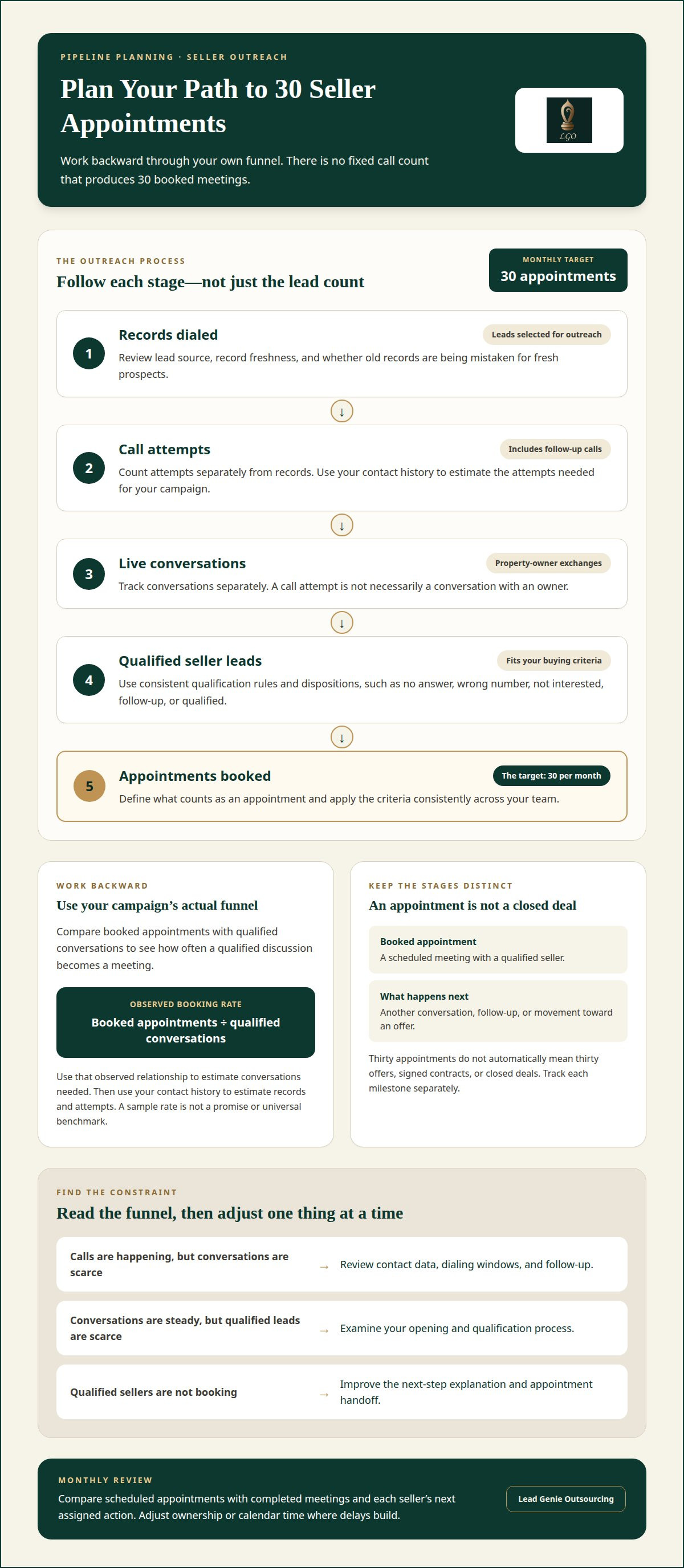
Start with your own funnel, not an industry average. Count records dialed, live conversations, qualified seller leads, and appointments booked. Calculate conversion at each stage using your actual activity. For example, divide booked appointments by qualified conversations to see how often a qualified discussion becomes a meeting. Use that rate to estimate the conversations your team needs.
Work backward from the target. If your records show how many qualified conversations typically produce one booked appointment, use that relationship to estimate the conversations needed. Then use your contact history to estimate the required records and call attempts. Keep the calculation grounded in your campaign. A sample conversion rate is not a promise or universal benchmark.
- Records dialed: Leads selected for outreach.
- Attempts: Calls placed to those records, including follow-up.
- Conversations: Live exchanges with property owners.
- Qualified leads: Sellers whose situation fits your buying criteria.
- Appointments: Meetings booked with qualified sellers.
These stages show where the pipeline slows. If calls are happening but conversations are scarce, review contact data, dialing windows, and follow-up. If conversations are steady but qualified leads are scarce, examine your opening and qualification process. If qualified sellers aren’t booking, improve the next-step explanation and appointment handoff. Change one thing at a time so your next review shows what shifted.
Lead quality also affects your estimate. A disconnected number cannot become a conversation, while a reachable owner may have no reason to sell. Use consistent dispositions, such as no answer, wrong number, not interested, follow-up, or qualified. Clear labels make weekly comparisons useful and prevent old records from appearing to be fresh prospects.
Define what counts as an appointment before dialing, then apply the criteria consistently. A seller’s reason for considering a sale, timeline, property condition, and price expectations can help determine whether a meeting is worth booking. Record the answers and agreed next step. This gives the acquisitions team useful context instead of a calendar entry without seller details.
For a practical view of the work behind each stage, review this real estate cold-calling guide. Use your own campaign records to set the call and lead volume. Revisit the estimate when list quality, follow-up, or qualification changes. That keeps the target tied to actual seller conversations, not assumptions.
Weekly hours to set 30 seller appointments per month?
Weekly hours depend on how the work is divided across calling, follow-up, and appointment handling. For a target of 30 seller appointments a month, count the time spent on each task rather than estimating from call volume alone. A caller focused on outreach has a different schedule from an investor who also handles appointments and acquisition decisions.
Start by reviewing the calendar. Mark time for calls, callbacks, notes, and appointment handoffs, then compare the plan with the work completed. If callbacks regularly spill into calling time, the schedule may not leave enough room for both. If meetings take longer than expected, set aside separate time rather than letting them disrupt outreach.
Use a simple workload model: dialing, conversations, follow-up, and recordkeeping. Keep these categories separate to see whether time is going to unanswered attempts, longer conversations, or delayed follow-up. The target doesn’t determine the weekly schedule. The tasks required to support it do.
For example, when a seller asks for a later callback, log it as a scheduled task, not a completed appointment. Assign an owner and a calendar due date. When the caller follows up, record the outcome. This keeps follow-up from disappearing into general calling time and gives the team a clearer view of its weekly workload.
Break the schedule into practical work blocks:
- Calling: Set aside focused time for new outreach.
- Callbacks: Reserve a separate block for sellers expecting another conversation.
- Notes: Record outcomes while each conversation is fresh.
- Handoffs: Pass appointment details to the person responsible for the next step.
- Review: Compare planned work with completed tasks before setting the next schedule.
This division helps your team see whether caller hours are being used as planned and makes shared workloads clearer. If one person handles calling and follow-up, show both responsibilities on the calendar. If different people handle them, assign the handoff explicitly so no seller response is left without an owner.
Review hours alongside appointment outcomes. If outreach time stays steady but fewer meetings are booked, examine the path from conversation to scheduling. If callbacks are accumulating, adjust the follow-up block or its ownership. If appointment handling interrupts calling, move those tasks into a defined calendar window. Make one schedule change at a time, then compare the next review period.
Use the monthly goal as a planning marker, not as a shortcut for estimating labor. Booking 30 seller appointments a month requires a schedule that accounts for the actual work surrounding each meeting. Track where time goes, protect the blocks that keep the pipeline moving, and adjust the calendar when the team’s workload changes. That gives investors a more useful basis for staffing and planning.
How do seller appointment targets vary by market and agent experience
A monthly target can mean different things across U.S. markets. A wholesaler working a compact area may reach a different mix of owners than an investor calling across several counties. Property types, seller motivations, list accuracy, and follow-up all affect how many conversations become appointments. Set the target against your actual market and pipeline.
First, define the market you’re measuring. A single city, nearby towns, and a broad multi-county campaign represent different outreach pools. Property age, ownership patterns, and the types of sellers you seek also shape conversations. A campaign focused on inherited properties may need different messaging from one aimed at landlords with vacant rentals.
Market size alone doesn’t determine appointment volume. The key question is whether your records connect you with owners who can make a decision and have a reason to talk. A broad list can generate activity without relevant conversations. A tighter list may produce fewer dials but better context for each call. Track both activity and appointment quality.
Caller experience affects each stage. A new caller may need practice opening conversations, listening for motivation, and recording seller details. An experienced caller may handle these tasks more smoothly, but still needs accurate records and a clear follow-up plan. Experience helps execution; it doesn’t eliminate the effects of list quality or market fit.
Use the same definitions across callers before comparing results. Count an appointment only when it meets your team’s criteria, and label follow-up separately from a booked meeting. Otherwise, one caller’s “qualified lead” may mean something different from another’s. Consistent labels make performance reviews useful rather than subjective.
Compare market and caller performance with a simple review:
- Market: Record the area, property type, and seller segment.
- List: Note whether records produce valid owner conversations.
- Caller: Review openings, listening, qualification, and note quality.
- Outcome: Separate interested sellers, follow-ups, and appointments.
- Next move: Adjust one factor, then review the next reporting period.
For example, if one area produces owner conversations but few appointments, review qualification and the meeting handoff. If another produces few conversations, inspect the records and outreach approach before changing the target. If a newer caller books fewer meetings, review call notes and practice the points where conversations stall. These comparisons identify specific fixes.
Keep the monthly goal visible, but use market-level evidence to manage it. A target of 30 appointments can guide planning; it shouldn’t hide differences between areas or callers. Review each market separately, then compare like with like. That means matching property segments, lead sources, qualification rules, and reporting periods before drawing conclusions.
As the campaign develops, record what changes. Note when a list segment, call approach, or caller assignment shifts, then compare the following results with the earlier baseline. This helps investors and wholesalers assess whether the market, caller, or process affected appointment quality.
Before lowering the target because meetings have slowed, review the call stages. Check whether the caller is reaching the right owners, asking consistent qualification questions, and offering a clear next step. Pair coaching with the same appointment definition used for other callers, then assess whether qualified meetings improve. This keeps experience in view without treating it as the only explanation for market results.
Marketplace scale offers context, not a direct appointment benchmark: Amazon had 2.2 million marketplace sellers, and Amazon operates 19 marketplaces worldwide. Those figures describe a broad selling environment, not the number of property owners available to a local campaign. For appointment planning, keep the comparison grounded in the specific area, seller segment, records, and caller process. A large pool may support more outreach, but it does not establish how many owners will respond or book a meeting. Set targets from observed pipeline results, then revise them when market conditions, list quality, or caller experience changes.
Lead Genie Outsourcing
Lead Genie Outsourcing handles cold calling for real estate investors and wholesalers who need steady seller outreach. Dedicated callers work 40 hours a week, and the service guarantees 30 qualified seller appointments a month or keeps dialing free until it reaches the target.
Each appointment is qualified around the seller’s reason to sell, timeline, property condition, and asking price, with a call recording for review. That structure helps your team judge whether the conversation fits its pipeline before the appointment. See how the calling process works to understand the handoff.
If consistent outreach is the gap in your pipeline, book a free 30-minute call with Lead Genie Outsourcing.
Turn the target into your next operating decision
Make your appointment goal useful beyond a monthly report. Treat 30 seller appointments a month as a planning target, then use your pipeline records to decide what to adjust next. A weak handoff calls for a different fix than missed connections or unqualified conversations. One clear diagnosis keeps your team focused on the part of the process that needs work.
Choose a review rhythm your team can sustain. Assess appointment quality alongside volume, and record changes in the market, list, or caller workflow. This creates a useful baseline for future decisions. Keep the target tied to your acquisition capacity: more meetings help only when your team can follow through with each seller.
If consistent seller outreach is the piece you want to strengthen, Lead Genie Outsourcing supports real estate investors and wholesalers with cold calling and the LGO CRM. Book a free 30-minute call to discuss your next step. Build the pipeline with a clear plan, then keep improving it from real conversations.