

The cheaper caller on paper can cost more to operate. Choosing outsourced callers vs. an in-house team means comparing total operating costs, not wages alone. An in-house team also requires recruiting, training, supervision, technology, and coverage planning. Outsourcing moves more of the calling operation to a provider, but your team still needs to oversee the campaign.
Both approaches can work. An in-house team gives you direct day-to-day control, while outsourcing can add calling capacity without requiring you to build and manage the entire operation. The right fit depends on call volume, management capacity, quality requirements, and how soon you need to start.
This comparison examines the cost factors behind each model, along with quality, scalability, compliance, and startup time. It explains when in-house calling, outsourcing, or a hybrid setup may fit, so you can decide based on the operation you need rather than a headline rate.
Key Takeaways
- Build the comparison around the cost of productive calling, not wages or vendor rates alone. Include the time and resources needed to keep calls moving.
- Choose in-house calling when direct oversight and steady management capacity matter most; consider outsourcing when you need a defined calling program without building the operation internally.
- A hybrid setup can keep sensitive or complex seller conversations close while using outside calling capacity for a separate, well-defined program.
- Before choosing, weigh how the team will be supervised, how call quality will be reviewed, and how quickly you need calling to start or scale.
- For real estate calling, clear seller qualification criteria and call recordings can make lead quality easier to assess.
Comparison of quality, scalability, compliance, and launch time
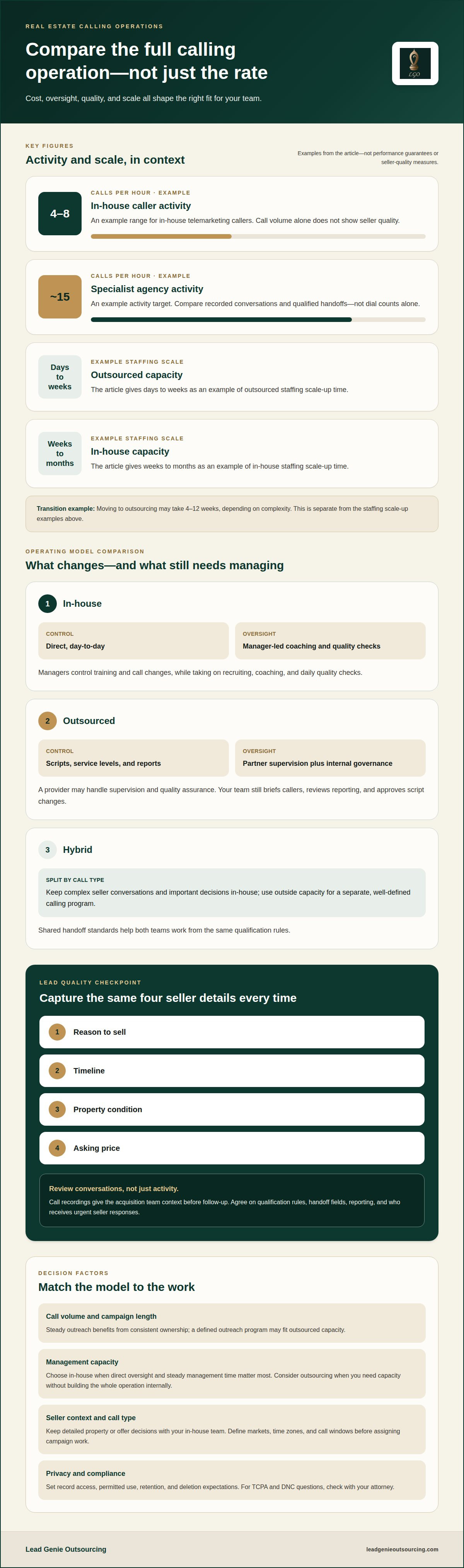
In-house callers give managers direct control over training and daily coaching. Outsourced callers work from approved scripts and are monitored through quality checks and reporting. Either way, a manager must brief callers, review results, and adjust the campaign.
Quality Control and Operational Oversight
In-house oversight keeps coaching and call changes close to the team. As examples only, in-house telemarketing callers might make 4 to 8 calls an hour, while a specialist agency might work toward around 15 calls an hour. Those figures describe activity, not seller quality. Review conversations and qualified lead handoffs, not just dial counts.
Outsourcing changes how you manage the work, not the need for oversight. Approve scripts, define service expectations, and review calls and reports regularly. A useful seller handoff should capture the reason for selling, timeline, property condition, and asking price. For real estate, a recording gives your acquisition team context before follow-up.
Vendor Management and Quality Assurance
An outsourced provider may handle supervision and quality assurance, but your team still manages the relationship. Assign an internal owner to brief callers, review reports, and approve script changes. Clear expectations and regular reviews make missed targets visible. With an in-house team, managers avoid vendor coordination but take on recruiting, coaching, and daily quality checks.
Quality can vary between outsourced installation teams, just as execution can vary across calling teams. Use shared work standards and review samples against them. For calling, compare recorded conversations with qualification rules; for installation, inspect completed work against the job scope. The work differs, but clear expectations and feedback reduce avoidable variation.
Compliance applies to both staffing models. For TCPA and DNC questions, check with your attorney. Real estate cold-calling compliance also depends on how the campaign is run. A 31-day interval is included here as an example only, not as guidance.
Scale and launch time affect seasonal operations. As examples only, in-house staffing might take weeks to months to scale, while outsourced staffing might scale in days to weeks. A transition to outsourcing might take 4 to 12 weeks, depending on complexity. Start with one defined program, review its results, then decide whether to expand.
A hybrid team can keep complex seller conversations in-house while an outsourced group handles a defined calling program. This adds capacity while preserving direct control over important decisions. The in-house team can review qualified leads and decide which sellers need prompt follow-up.
| Option | Training and oversight | Scalability | Control | Quality checks |
|---|---|---|---|---|
| In-house | Managed internally | Weeks to months | Direct, daily | Manager-led coaching |
| Outsourced | Partner supervision; internal governance | Days to weeks | Scripts, service levels, reports | Monitoring and regular reviews |
| Hybrid | Shared across teams | Capacity can flex | Split by call type | Common handoff standards |
Choose the model that fits your need for direct control, flexible capacity, and available management time.
Choosing a team based on business needs and location
Choose based on call volume, campaign length, management capacity, and where sellers live. Sharing seller records with an offshore partner creates privacy risks; restrict access, define permitted use, and set clear retention and deletion steps.
Call Volume and Business Needs
Call volume affects whether a dedicated in-house caller stays productive or has gaps between campaigns. An investor may need steady outreach, while a wholesaler testing a new market may start with a focused campaign. Match the model to the work: ongoing campaigns benefit from consistent ownership, while a defined outreach program can be handled through outsourcing.
Plan the next step for each call, too. If a seller shares a reason to sell and a timeline, route the handoff to the person responsible for acquisitions. If conversations often involve detailed property or offer questions, keep those decisions with your in-house team.
Location affects coverage and context. A local caller may recognize neighborhood names or regional phrasing, while a nearshore or offshore caller can work from an approved script and seller profile. For a campaign across several states, define the markets, time zones, and call windows before assigning work. The real estate cold-calling guide can help frame the campaign’s calling needs.
Outsourcing Partner Selection
A strong provider should explain its caller training, supervision, reporting, and lead handoff process. Ask how it handles script changes, requests for no further calls, and sellers who need prompt follow-up. These practical examples reveal how daily operations work beyond a sales pitch.
Agree on what counts as a qualified lead before calls begin. Set the fields the team must capture, how call outcomes are reported, and who receives urgent seller responses. A client should also define who can access records and how long the partner retains them. Those steps make data handling and accountability part of the operating plan.
A short campaign and an ongoing program call for different commitments. A focused campaign can have a defined market and endpoint. Ongoing calling needs regular feedback, a named campaign owner, and time to update scripts as seller responses change. Don’t treat a short test as proof of long-term fit. Assess whether the same process can support future campaigns.
For a wholesaler, the choice might be to keep strategy and complex seller decisions in-house while outsourcing a defined calling campaign. An investor with steady volume may prefer one model across repeated campaigns. Either way, set the boundaries before launch: call types, record access, escalation steps, and who owns each handoff.
Choose based on the work and oversight you can provide, not location alone. An in-house caller can suit close daily coaching; an outsourced provider can suit a scripted campaign with clear oversight. A hybrid model can combine the two. The right fit handles your volume and seller handoffs while maintaining control of records.
What is the difference between an in-house and outsourced call center?
To compare an in-house and outsourced call center, consider the caller’s role and the management, training, and technology each model requires.
A hybrid setup divides calling by the kind of interaction. An in-house specialist can handle sensitive seller conversations, unusual property questions, and decisions that require investor judgment. An outsourced team can manage a defined script, initial outreach, and routine follow-up. Callers can gather seller details and pass qualified conversations to the acquisitions team.
This model works only when the handoff is clear. Set the fields callers must capture, the conditions for escalation, and who owns the next step. A seller who shares a reason to sell, timeline, property condition, and asking price can reach the right person with useful context. Consistent call outcomes also help managers see which conversations need attention.
Keep the work split by task, not by vague labels like “easy” or “complex.” An outsourced caller might introduce the business and ask approved questions. An in-house team member might discuss a seller’s specific concerns or decide whether to pursue the property. If an outside caller encounters a request beyond the script, the escalation route should identify a person who can respond.
Set clear responsibility, too. The outsourced team handles its assigned calls and reports results; the in-house owner sets campaign priorities, approves script changes, and acts on seller handoffs. Without that owner, leads may go without timely follow-up. A shared scorecard can track calls, conversations, qualified leads, and handoffs accepted by the acquisitions team.
A hybrid setup can also protect in-house capacity during busy periods. An investor might keep negotiations and seller decisions with the core team while assigning a defined outreach campaign to outside callers. The internal lead reviews results and adjusts the target market or script, leaving specialists focused on work that needs their judgment.
There are tradeoffs. A hybrid setup adds coordination among managers, systems, and callers. If both teams contact the same seller, the experience can feel disjointed. Assign each record one owner, document the last contact, and define when responsibility transfers. These steps help prevent duplicate calls and keep the seller’s history visible.
Choose a hybrid setup when the work can be divided and handoffs tracked. Keep more calling in-house when nearly every conversation requires specialist judgment. Outsource repeatable outreach when internal staff can review results and handle escalations. Base the split on the seller conversation, not the org chart.
In-house salaries, benefits, training, and equipment
An in-house caller’s wage is only one operating cost. Hiring, payroll taxes, training, tools, supervision, and coverage all affect the total.
Hiring, Turnover, and Training
In-house hiring means recruiting candidates, onboarding them, and teaching them your seller process. Training should cover the script, property terms, lead criteria, and how to pass a seller conversation to acquisitions. The Internal Revenue Service states that the U.S. employer share of Social Security and Medicare payroll taxes is 7.65% of wages.
Replacing a caller takes more than changing a name on the schedule. A departing caller takes campaign familiarity with them, and a replacement needs time to learn your records, approach, and follow-up rules. Lead Genie Outsourcing provides trained callers and caller staffing for real estate campaigns. Its team reviews calls before delivering leads, and replacement callers are provided at no additional onboarding cost when an assigned caller does not meet quality standards.
Staffing and Caller Coverage
In-house staffing gives you direct control over schedules and coaching, but coverage is your responsibility when a caller leaves or is unavailable. Plan who handles seller callbacks and lead review during those gaps. Without a named backup, a promising conversation can go unattended.
A professional provider manages caller staffing and may arrange backfills when needed. Define how coverage changes are reported and who owns open seller follow-ups. For example, if a caller is replaced, the next caller needs the current script, market focus, and lead status. That handoff protects continuity without giving up your control over campaign priorities.
In-House Salaries, Benefits, and Equipment
An in-house budget can include wages, benefits, payroll administration, workspace, computers, headsets, phone systems, and calling software. Add the time a manager spends reviewing calls and coaching. These costs support direct control but remain part of the operating load when call volume slows.
With Lead Genie Outsourcing, callers work within LGO’s managed operation. Your team provides campaign knowledge, approves the caller voice sample and script before dialing begins, and reviews seller outcomes. Compare the responsibilities on both sides rather than treating a provider’s service as a wage substitute. Confirm which calling tools and reports are included, then account for any internal work that remains.
For a real estate investor, the practical question is who can own the work. If you want daily coaching and can manage hiring, training, and backup coverage, an in-house caller may fit. If you need calling handled without building those staffing functions internally, a provider may fit better. In either case, assign someone to review lead quality and keep seller follow-up moving.
When in-house or outsourced calling makes sense
The choice depends on who can keep the calling operation productive. An in-house team fits when you have steady work, a manager who can coach callers, and a need for direct control. Outsourcing fits when you need a defined campaign without recruiting and managing every caller yourself.
In-house calling can suit a seller process that requires detailed knowledge of your acquisition criteria. An internal manager can train callers and adjust their approach as needed. This model can also work for ongoing outreach when the business can keep callers focused, review calls, and act on seller responses. Without that management time, direct control can become an added responsibility rather than an advantage.
Outsourcing can fit a focused campaign, a new market test, or a seasonal increase in outreach. Lead Genie Outsourcing provides trained callers who contact property owners and deliver qualified, recorded seller leads to your CRM. Your team defines its priorities, approves the voice sample and script before dialing, and acts on qualified opportunities. The provider handles the calling work, but you still need an owner to review results and make decisions.
Use this decision guide:
- Choose in-house when calling is ongoing, the seller process needs close coaching, and a manager has time to run it.
- Choose outsourced when the campaign is clearly defined, internal recruiting would slow launch, or call volume changes with the season.
- Choose a hybrid model when callers can handle repeatable outreach, but your acquisition team must own negotiations or complex seller questions.
Scale matters, but headcount alone does not decide the answer. Outsourcing typically becomes cheaper than in-house operations when a company needs more than 10 to 15 full-time agents. For a real estate investor who needs less capacity, compare the total management burden and campaign continuity, not just the number of callers. If the internal team can keep one caller busy and review leads, in-house may still suit the operation.
Before starting with a provider, map the handoff from the first call to seller follow-up. Define the target market, caller responsibilities, qualification fields, reporting, and who responds to a ready seller. Then review call quality and lead fit. These steps help you assess whether the setup produces useful conversations, not just activity.
For real estate cold calling, the best fit is the model your team can govern. If internal hiring and daily coaching compete with acquisitions work, outsourcing can free that capacity. If seller conversations need constant in-house judgment, keep more control inside. Explore how a real estate calling program works before deciding which workload to assign.
Lead Genie Outsourcing
Lead Genie Outsourcing can help real estate investors and wholesalers put an outsourced calling model into practice. It gives you a place to discuss how calling support could fit your operation and campaign priorities.
Use that conversation to outline your goals, the work your team wants handled, and how seller leads should fit your process. This keeps the next step tied to your actual operating needs.
Book a free 30-minute call with Lead Genie Outsourcing to discuss your calling needs.
Make the next move with a clear operating plan
The right calling setup can change as your acquisition strategy changes. Treat the choice between outsourced callers and an in-house team as an operating decision you can revisit, not a permanent label for your business. Changes in your target sellers or growth plans may call for a different structure.
When your needs change, reassess what your calling operation must support. Base the decision on current business priorities, not simply on how the team was built in the past.
Book a free 30-minute call with Lead Genie Outsourcing. A clear next step can help you move forward.
Frequently Asked Questions
Is outsourced cold calling cheaper than in house?
Sometimes, but compare equivalent work before deciding. Match calling hours, target records, qualification requirements, and reporting. Then account for internal time spent preparing lists, reviewing conversations, and acting on leads. An outsourced plan may seem less costly until internal work is counted; an in-house role may seem efficient until gaps in calling time are included.
Can you combine both?
Yes. Track each campaign separately so you can see which team produced each conversation and outcome. For example, use distinct campaign labels in your CRM and apply the same lead criteria to both. That gives you a clearer basis for deciding what to keep in-house or assign externally, without relying on a handful of calls.
How much does an in house cold caller cost?
There isn’t one fixed total. In-house costs depend on wages and benefits, recruiting and training, equipment, and management time. If the caller only makes calls, estimate those expenses separately from the time needed to review leads and follow up. That provides a more useful budget than salary alone.
What Are the Hidden Costs of Running an In-House Call Center?
Some costs sit outside a caller’s paycheck. Managers may spend time correcting incomplete records, coordinating callback ownership, or reconciling activity across calling and CRM tools. Include these tasks in your estimate. Also account for any paid tools or backup coverage needed to keep a campaign running when a caller is unavailable.
What about TCPA and Do Not Call compliance?
Compliance planning still matters with either staffing model. Document who handles opt-out requests, how campaign records are maintained, and how callers receive updated instructions. Keep a process for routing compliance questions rather than asking callers to make legal judgments. Rules can depend on the campaign and circumstances, so check TCPA and Do Not Call questions with your attorney.
What should I ask an outsourcing partner?
Ask how you’ll review call recordings, how lead notes reach your team, and how the provider handles a record that needs correction. Clarify who can access campaign data and what happens to it when the engagement ends. Request a sample report and lead handoff format. Those materials show how information will move from the first seller conversation into your team’s workflow.
What are the pros and cons of outsourced callers versus an in-house calling team?
In-house calling gives your team a direct line between caller feedback and changes to your process. Outsourcing can provide a managed calling operation without requiring you to build every staffing process internally. The tradeoff is where your attention goes: managing internal staff and continuity, or coordinating with a provider and setting shared expectations. Choose the model that fits the work your team can own well.
How much does it cost to outsource callers compared with hiring an in-house team in the US?
There’s no single like-for-like total. Outsourced calling prices depend on the case and are provided after a quote request; cost factors include campaign scope, caller capacity, and included support. In-house costs depend on compensation, hiring, training, tools, and management. Compare both against the same campaign requirements and follow-up workload, rather than comparing a vendor fee with wages alone.