

More dials don’t automatically mean more seller leads. Cold callers for real estate investors and wholesalers can turn conversations into useful opportunities when the list, call preparation, and follow-up fit the prospect. No single lead count applies to every campaign. Results depend on who is called, how well the caller qualifies interest, and what happens after the first conversation.
This guide breaks down how professional callers prepare records, open with a clear reason for the call, tailor scripts to different prospect types, and handle represented sellers with care. It also covers caller staffing and pricing. Pricing depends on the case and is given after a quote request; staffing setup, calling scope, and lead-handling needs shape the cost. The goal isn’t a polished script on paper. It’s a repeatable process that keeps each conversation relevant and gives your team a clear next step.
Key Takeaways
- Set a clear purpose for each campaign so callers can distinguish a useful seller conversation from a simple contact.
- Build a respectful response for represented sellers into the call process, with a clear point to stop or route the conversation.
- Prepare callers with relevant record details and a focused opening, then adjust the script to the prospect type.
- Assess caller staffing by the work involved, including dialing time, lead qualification, and how calls are reviewed.
- Use the seller’s reason to sell, timeline, property condition, and asking price to judge whether a conversation merits follow-up.
How professional cold callers handle sellers represented by another agent
A seller’s representation status changes the call. The Standards of Practice 16-2 and 16-3 caution against using an FSBO lead-generation approach when another agent represents the seller. A professional caller treats that information as a stop signal, not an opening for a competing pitch. The goal is to avoid pressing the seller for business through a route the standards address.
When a seller says, “I already have an agent,” the caller should acknowledge the relationship, avoid pitching listing or transaction services, and end or redirect the conversation. No debate and no attempt to undermine the seller’s agent. The caller records the seller’s representation status so follow-up does not repeat the same pitch.
A practical call workflow has three steps. First, ask a neutral question to clarify whether the seller is represented. Second, pause the sales script if the seller says yes. Third, record the answer and route the lead according to the campaign’s approved process. This gives the caller a clear action instead of leaving the decision to improvisation.
For example, a homeowner on an FSBO list might say, “My agent is handling the sale.” The caller should not continue with a script offering to find a buyer or win the listing. A brief acknowledgment and a clear close keep the conversation from becoming pressuring. The call record should reflect the seller’s words, not an assumption about the agent’s role.
U.S. Do Not Call, TCPA, and state telemarketing rules can affect real estate calls. Requirements depend on the campaign and calling method, so have your attorney review the plan before dialing; the TCPA and DNC compliance guidance covers related calling considerations.
There is no blanket yes for autodialers, prerecorded messages, or AI voice calls. These methods raise TCPA and state-law questions. Have an attorney review the specific campaign before using them.
Keep the record factual. Note that the seller reported being represented, capture any request to stop contact, and apply the campaign’s suppression process. Do not label a seller “unrepresented” just because they did not share an agent’s name. Missing information does not confirm that the seller has no agent.
That distinction matters when a list includes FSBO records, expired listings, and general homeowner contacts. Each record can have a different call purpose. If a caller hears “my agent is handling it,” they should stop the FSBO pitch, document the response, and follow the approved next step. Apply the same rule consistently across the campaign.
How a professional cold caller identifies the purpose of a call
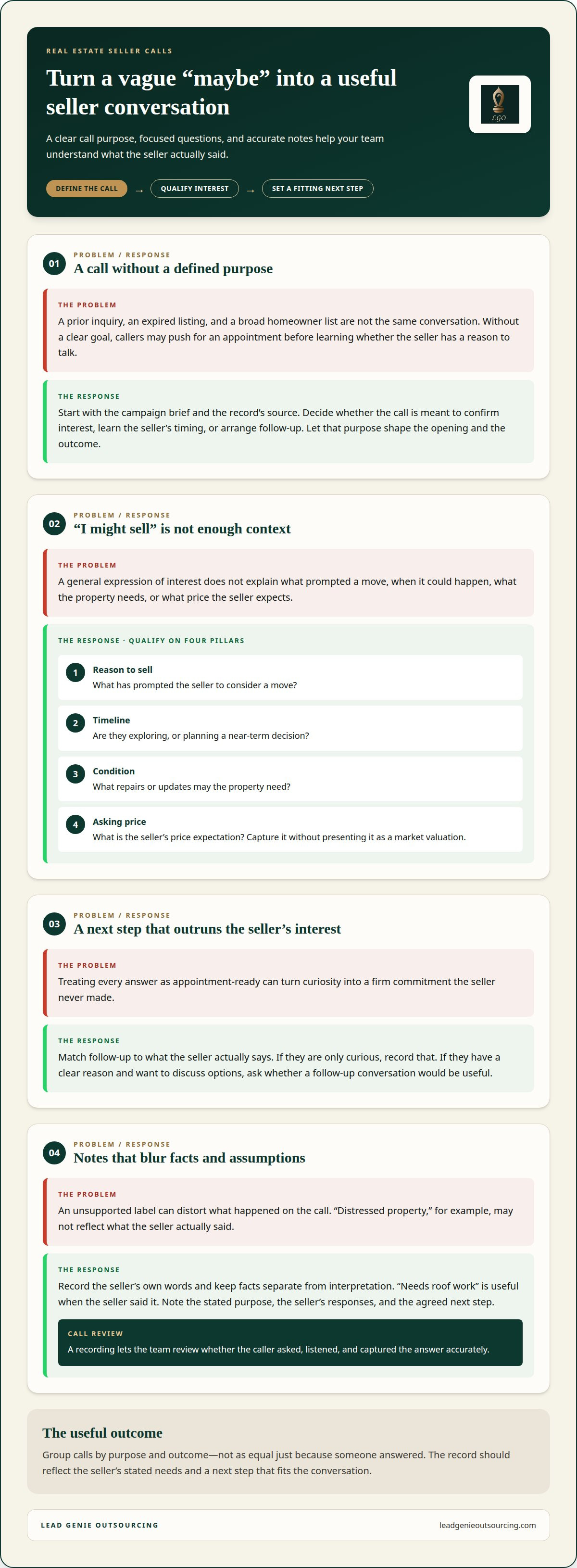
Each call needs a defined job before the caller dials. A neighborhood campaign may test whether homeowners have considered selling within 6 to 12 months. An expired-listing campaign may seek permission to discuss the seller’s next move. Those are different conversations, even when both records belong to homeowners.
The caller starts with the campaign brief and the record’s source. A prior inquiry, an expired listing, and a broad homeowner list each call for a different opening. The purpose also sets the right outcome: confirm interest, learn the seller’s timing, or arrange follow-up. Without that distinction, callers may push for appointments before learning whether the prospect has a reason to talk.
For a potential seller, qualification can follow four pillars: reason to sell, timeline, condition, and asking price. Each answer adds context. “I might sell” says little on its own. The caller needs to learn what prompted the thought, when a move could happen, the property’s condition, and the seller’s price expectation. Record the prospect’s own words rather than turning a vague answer into a firm commitment.
- Reason: Find out what has prompted the seller to consider a move.
- Timeline: Clarify whether the seller is exploring or planning a near-term decision.
- Condition: Ask what repairs or updates the property may need.
- Asking price: Capture the seller’s expectation without presenting it as a market valuation.
Match the next step to what the seller actually says. If the homeowner is only curious, record that and do not label the contact appointment-ready. If the seller has a clear reason and wants to discuss options, the caller can ask whether a follow-up conversation would be useful. Someone considering a move after a job change, for example, needs different follow-up from someone gathering information without plans to move.
Call notes should separate facts from interpretation. “Needs roof work” is useful when the seller said it; “distressed property” may be an unsupported label. A recording lets the team review whether the caller asked, listened, and captured the answer accurately. The record should show the stated purpose, the seller’s responses, and the agreed next step.
That discipline keeps campaign reporting meaningful. Calls can be grouped by purpose and outcome, rather than counted as equal simply because someone answered. A real estate cold calling guide can help frame the campaign flow, from the opening through qualification and follow-up.
How professional cold callers prepare for and open a cold call
Preparation starts with the campaign, not a memorized pitch. Before dialing, the caller reviews the list source, the target homeowner, and the call’s goal. A record tied to an expired listing needs a different opening from a general homeowner record. That context helps callers avoid asking questions the record already answers.
Next, the caller checks the available details and plans a short introduction. The first five seconds matter: state who’s calling, give a clear reason, then invite a response. For example: “Hi, this is Jordan with a local real estate team. I’m calling about your property on Oak Street. Have you considered selling?” The caller should pause and listen instead of racing into the next line.
A prepared caller also knows the next useful question. If a homeowner shows interest, the caller can ask what prompted the move and what timing they have in mind. If the homeowner is not interested, the caller should acknowledge that and follow the campaign’s process. The point is to open a relevant conversation, not push every contact toward an appointment.
Real estate cold callers need training in clear delivery, active listening, call notes, and prospect qualification. A sample call can show whether someone handles a pause, objection, or unexpected answer without losing sight of the call’s purpose. Training should also cover the campaign script and how to record responses consistently.
Hiring risks include paying for activity without useful call records or accepting lead claims that the caller cannot support with notes or recordings. Treat promises of guaranteed outcomes carefully, and define a qualified lead before work starts. For TCPA and Do Not Call questions, have an attorney review the campaign and calling method.
Before dialing, a caller can review three things: the record, the campaign goal, and the opening line. For an expired listing, the opening might ask whether the owner is still considering a sale. For a broad homeowner list, it can state the local real estate reason for calling. In either case, the caller should sound direct, not read the script word for word.
- Identify: Confirm the record and its source.
- Open: Give your name and a specific reason for calling.
- Listen: Let the homeowner answer before asking another question.
- Record: Capture the response and agreed next step.
A short practice session can test the opening before a campaign begins. Have the caller handle a willing seller, a rushed homeowner, and a firm “not interested.” Those examples reveal whether the script gives callers room to respond naturally. A real estate cold calling guide can help frame the full call flow.
How professional cold callers tailor scripts to different prospect types
One script will not fit every property owner. The caller adjusts the opening, question, and next step to the prospect type. A For Sale By Owner (FSBO) conversation differs from an expired-listing call. A neighborhood call needs a lighter opening because the homeowner may not be considering a move.
For an FSBO seller, the caller can begin with the property and the owner’s plans. For example: “I’m calling about your home for sale. Are you still handling the sale yourself?” If the owner is represented, the caller should stop the FSBO pitch and follow the campaign’s approved process. If the owner is open to talking, the caller can ask about their goals before suggesting a next step.
An expired listing calls for a different approach. The caller should recognize that the property was recently marketed, then ask whether the owner is still considering a sale. A sample script can offer a meeting of about 15 minutes to discuss the seller’s plans. That’s an invitation, not an assumption that the owner wants another listing conversation.
For a neighborhood campaign, the caller can lead with a local reason for reaching out. The suggested question is whether the homeowner has considered selling in the next 6 to 12 months. That wording gives the prospect room to share a real timeframe. If the answer is no, the caller shouldn’t force a meeting. If the owner is open, the caller can ask what might prompt a move.
A pitch that promises to find a suitable buyer within 30 days needs careful framing. It’s an example of a proposed sales message, not a result every caller can promise. The caller should use only claims the campaign can support and should not present an illustrative script as a guarantee.
Across these prospect types, keep the script’s structure steady while adapting its details:
- Opening: Name the property or campaign reason.
- First question: Ask about the owner’s current plans.
- Listening point: Follow the seller’s answer instead of jumping to a pitch.
- Next step: Offer a relevant conversation or close politely.
Call recordings help show whether a script fits the prospect. A reviewer can compare an FSBO call with an expired-listing call, then note where the caller followed the script or needed more flexibility. Review also helps keep claims consistent. The goal is a call that matches the record, respects the homeowner’s answer, and leaves clear notes about the next step.
5. Caller pricing and staffing costs
An in-house caller gives an operation direct control over daily work. That setup also means managing recruitment, training, payroll, call tools, and call review. A manager may need to handle those tasks alongside existing responsibilities. The real comparison is total workload, not just time spent dialing.
An outsourced service shifts some staffing and call execution to an outside team. The agreement should spell out what the caller handles, what records are supplied, and how leads reach the business. Clarify whether the work includes qualification, call notes, recordings where the setup allows, and follow-up. Those details affect how much internal time the arrangement still requires.
In-house and outsourced calling differ in control and operating responsibility. An employee works within the business’s own systems, while an outsourced team follows the agreed campaign scope. Both models need clear scripts, list handling, and review. The difference is who manages the daily staffing tasks.
For an outsourced campaign, price depends on the case and is given after a quote request; calling scope, record volume, and lead-handling needs shape it. Ask for a plain description of the work before comparing proposals. A low headline figure doesn’t tell you whether qualification, recordings, or reporting are included.
To assess a cold-calling service, look for operational detail rather than broad promises. Ask how the team defines a qualified lead, what information is recorded, and how call quality is reviewed. Then compare those answers with your campaign goal. If the goal is seller appointments, a dial count alone will not show whether conversations met your criteria.
- Scope: Confirm the caller’s tasks and your team’s tasks.
- Records: Define who supplies and manages the call list.
- Qualification: Set the required seller information and appointment criteria.
- Review: Establish how calls, notes, and results are shared.
Check the workflow with a sample record. Trace it from list entry to call outcome, then to the notes your team receives. If a caller marks a homeowner as interested, the record should show what the homeowner said and what follow-up was agreed. That example can expose gaps before they become routine.
Also weigh your internal capacity. If a manager can coach callers and review conversations, an in-house role may fit. If staffing and daily oversight compete with deal work, outsourcing can shift those tasks. Neither model removes the need for clear campaign goals and consistent lead handling.
Choose based on the work you need covered, not a vague promise of more leads. Define the output, review process, and handoff first. Then compare the staffing model with the time your team can commit.
Lead Genie Outsourcing
Lead Genie Outsourcing helps real estate investors and wholesalers put consistent seller calling in place without managing every dial themselves. Dedicated callers work 40 hours a week, using skip-traced, scrubbed records prepared for calling. Seller conversations are qualified on reason to sell, timeline, property condition, and asking price, with call recordings available for review.
The service is built for teams that need a steady calling process and clearer visibility into seller conversations. Lead Genie Outsourcing guarantees 30 qualified seller appointments a month, or keeps dialing free until reaching 30. The LGO CRM is free for 30 days.
To discuss whether this setup fits your operation, book a free 30-minute call with Lead Genie Outsourcing.
Set the next campaign in motion
Before adding calling capacity, decide who owns the handoff after a seller conversation. A caller can open the door, but your team still needs a clear path to review interest and act on it. Set that path in advance so every qualified conversation has somewhere to go.
Hiring cold callers for real estate agents is a practical step when prospecting needs steady attention and your team is stretched across other work. Lead Genie Outsourcing provides cold calling for real estate investors and wholesalers, plus the LGO CRM. The right setup starts with a clear view of the calling work and how it fits your operation.
Take the next step when you’re ready to talk through that fit. Start with your campaign goals, your lead handoff, and the work you need covered. Then build a process your team can run with confidence. Book a free 30-minute call.
Frequently Asked Questions
How Many Leads Could Real Estate Virtual Assistant & Cold Caller Generate?
There is no standard lead total for a virtual assistant or caller. Cold callers for real estate agents may produce different outcomes depending on how much time goes to dialing and other assigned tasks. For a useful forecast, start with your team’s capacity to respond and follow up. A campaign that generates more conversations than your team can handle may create a backlog rather than usable opportunities.
How much do real estate cold callers cost per hour or per lead?
There isn’t one hourly or per-lead rate that applies across services. Lead Genie Outsourcing provides a quote based on the case. To compare proposals, calculate the effective cost against the outcome you care about, such as a qualified seller conversation or appointment. Use the same outcome definition for each proposal; otherwise, the comparison may treat a raw contact and a qualified opportunity as equal.
Where can real estate agents hire cold callers or prospecting services?
Real estate agents can use a specialized prospecting service that works with property-owner records and seller conversations. Lead Genie Outsourcing provides outbound calling for real estate investors and wholesalers. Before starting, make sure the campaign’s target seller profile fits your business and that your team has a clear process for handling incoming conversations. That alignment keeps outreach connected to your acquisition goals.
What cold-calling scripts do professionals use for real estate prospecting?
Professional callers use scripts that leave room for a natural response. If an owner says, “I can’t talk now,” the caller might ask, “Would you prefer a callback, or should I close the loop?” That response respects the interruption and clarifies the next step. The caller should record the owner’s preference accurately so another call does not ignore the request.
How many calls and leads can a real estate cold caller generate?
Cold callers for real estate agents do not have one fixed call or lead output. A useful campaign report separates attempts from completed conversations and qualified opportunities. It should also show whether follow-up is pending, scheduled, or complete. That view helps an investor spot a stalled handoff, such as a qualified seller waiting for a response, instead of treating every recorded lead as equally actionable.