

A low cost per dial does not guarantee a low cost per contract. The average cost per contract for real estate cold calling is total campaign spend divided by the contracts signed from those calls. The result depends on the calling model, lead quality, follow-up, and how effectively appointments become deals.
For wholesalers, that is the key measure. Call volume and appointment totals matter only if they help move qualified opportunities to signed contracts.
This guide explains how to calculate cost per contract, assess campaign performance, and compare cold calling with other lead sources. Use deal outcomes, not dial volume alone, to decide whether calling belongs in your strategy.
Key Takeaways
- Measure campaign spend against signed contracts, not dials alone. That gives you a clearer read on what each deal costs to generate.
- Use dial-to-appointment benchmarks as a diagnostic, not a promise. Weak conversion can point to list quality, caller execution, or follow-up gaps.
- Compare in-house and outsourced calling by looking at the full workload, including caller time, data, tools, and lead follow-up.
- Judge cold calling by whether it builds a workable seller pipeline for your market and strategy, not by call volume alone.
- Keep outreach practices in view: the Federal Trade Commission advises calling between 8 a.m. and 9 p.m. in the prospect’s local time.
Dial-to-appointment and contract conversion rates
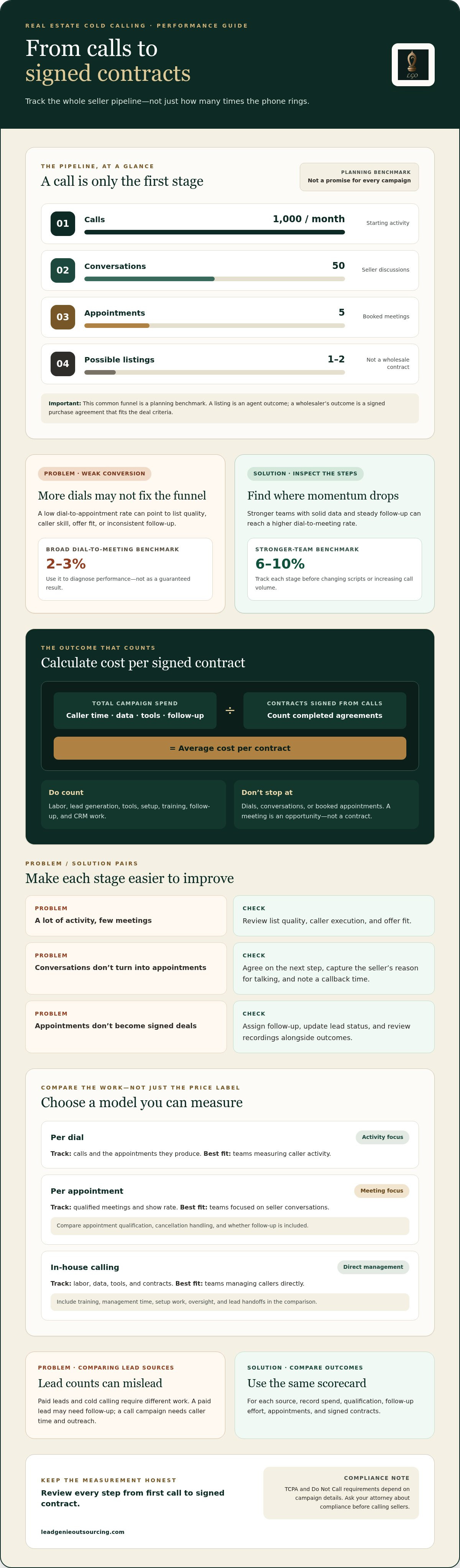
Dial volume is only the first stage of a seller pipeline. A useful benchmark tracks how cold calls become conversations, appointments, and signed contracts. One common funnel estimates that 1,000 calls per month produce 50 conversations, then five appointments. Those appointments may lead to one or two listings. Treat this as a planning benchmark, not a promise for every market or wholesaling campaign.
Dial-to-appointment conversion helps locate weak spots. A 2 to 3 percent dial-to-meeting rate is a broad benchmark. Stronger teams with solid data and steady follow-up can reach 6 to 10 percent. The gap can reflect list quality, caller skill, offer fit, and how consistently someone follows up. Track each stage separately before changing scripts or adding call volume.
A listing and a wholesale contract are different outcomes. An agent may count a listing as a conversion; a wholesaler needs a signed purchase agreement that fits the deal criteria. To calculate average cost per contract from real estate cold calling, divide campaign spend by the contracts signed from those calls. Do not count appointments as the final result: a booked meeting is an opportunity, not a contract.
Follow-up affects whether conversations become appointments. Before ending a call, agree on the next step, record the seller’s reason for talking, and note the callback time. Assign someone to follow up and update the lead status. A seller who is not ready today may become a qualified appointment later. Review recordings alongside outcomes to identify missed questions, weak handoffs, or unclear appointment confirmation.
Per-appointment pricing shifts more focus toward booked meetings than raw dials. Compare what counts as a qualified appointment, how cancellations are handled, and whether follow-up is included. Appointment pricing depends on list source, qualification standards, campaign scope, and the work included; the exact figure comes in a quote for your case.
| Model | What you track | Best fit |
|---|---|---|
| Per dial | Calls and resulting appointments | Teams measuring caller activity |
| Per appointment | Qualified meetings and show rate | Teams focused on seller conversations |
| In-house calling | Labor, data, tools, and contracts | Teams managing callers directly |
Choose a model that makes each step from call to signed contract trackable, then review the funnel every week.
Use 5 appointments from fifty conversations as a checkpoint. Agents committing to 20 calls daily achieve success rates between 10% and 20%; 80 percent of sales require five or more follow-up calls, and 68% of real estate professionals report successful follow-ups after cold calls.
Among the top 10% of cold callers, conversion to signed contracts is 5%+; agents dialing 100 or more calls per day are reported to close 18 cold-call deals per year.
Real Estate Cold Calling (2026): Is It Still Worth It?
Cold calling can fit a wholesaling plan when you measure the full campaign cost against signed contracts. Include caller time, lead generation, tools, follow-up, and compliance work.
In-House and Outsourced Calling Costs
An in-house caller gives you direct control over scripts, pitching, and follow-up. Your budget must account for labor, list data, calling tools, training, and management time. Outsourcing shifts caller management and daily dialing to a service, while campaign scope and included work shape the quote.
Compare both models using the same outcomes: qualified leads and signed contracts. Count setup work, ongoing oversight, and lead handoffs, not only caller hours. Map each cost to a task and assign someone to track the results.
DIY Calling Time and Opportunity Costs
With DIY calling, you spend your own time preparing lists, dialing, speaking with sellers, and following up. Each hour on the phone is an hour not spent reviewing offers, negotiating, or managing a property. List those competing tasks before deciding whether to call yourself or assign the work.
For a practical comparison, log calling time alongside completed seller tasks over the same period. Include missed callbacks and CRM updates, not just live conversations. This reveals the opportunity cost: work your team delays while someone is on the phone.
Cold Calling and Paid Lead Costs
Paid leads charge for access to prospects; cold calling puts more of the work into list selection and outreach. Conversion benchmarks differ by channel: Zillow or paid real estate leads average 1% to 3%, while Facebook ads average 0.2% to 2%. Compare qualified seller conversations and signed contracts, not lead counts alone.
For a fair comparison between lead sources, record spend, source, qualification, and follow-up effort. Track how many prospects reach an appointment and how many become contracts. A paid lead that needs extensive follow-up adds labor, just as a cold-calling campaign requires caller time.
Lead and Contract Costs and Hidden Risks
There is no single useful cost per cold-call lead for every real estate investor. Divide campaign spend by qualified leads to calculate cost per lead, then divide spend by signed contracts to calculate cost per contract. Include caller labor, data, tools, setup, training, follow-up, and CRM work in the campaign total.
TCPA and Do Not Call rules may affect how you build lists and run calls. List screening and process controls also add work. Requirements depend on campaign details, so ask your attorney about TCPA and Do Not Call compliance before calling sellers.
To compare an exact campaign cost, account for list quality, caller workload, tools, follow-up, and qualification standards; the figure for your case comes in a quote. A clear cold-calling workflow can make those tasks easier to track, from the first call through contract review.
Professional cold-calling service pricing
Professional cold-calling services use different billing models. Common structures include hourly billing, a charge per dial, payment per booked appointment, or a hybrid of a base fee and meeting charges. The model changes what your team pays for: caller time, activity, appointments, or a mix. Compare what each model measures before comparing proposals.
Hourly billing ties the invoice to time worked. It can suit a campaign with established scripts, target records, and appointment standards. Your team still needs to track dials, conversations, qualified leads, and next steps. Without that reporting, paid hours show activity but not whether callers are reaching the right sellers.
Per-dial billing ties charges to call volume. The activity is easy to count, but dials alone do not show seller interest. Ask how the campaign reports answered calls, useful conversations, and appointment outcomes. A script aimed at the wrong audience can generate plenty of activity without building a useful pipeline.
Per-appointment pricing centers the bill on booked meetings. Define a qualified appointment before comparing offers: specify whether the seller must meet your criteria, what information the caller records, and how cancellations are handled. A hybrid model combines a base charge with meeting charges, so separate fixed campaign costs from appointment-based costs.
| Pricing model | Billing basis | What to track |
|---|---|---|
| Hourly | Caller time | Calls, conversations, and outcomes |
| Per dial | Call activity | Useful conversations and appointments |
| Per appointment | Booked meetings | Qualification and attendance |
| Hybrid | Base charge plus meetings | Fixed costs and meeting results |
Setup charges and add-ons can increase the total beyond the core calling fee. Separate list preparation, CRM integration, script development, and reporting in the proposal. Confirm whether each item is included or billed separately, then compare the full campaign scope rather than the headline billing model.
Use the same reporting period for every proposal. Record the target list, call volume, qualified appointments, and contracts attributed to those appointments. This makes average cost per contract easier to compare and prevents booked meetings from being mistaken for closed deals. Keep attribution consistent, especially if paid leads or referrals reach the same seller.
Before committing, map the process from target records to scripts, appointment handoff, and outcome tracking. Match each charge to a defined task, then assess whether your team can manage the remaining work. A clear proposal spells out the billing basis and included work, letting you compare scope rather than labels.
Cold calling effectiveness
Cold calling starts direct conversations with sellers, but its effectiveness depends on the goal. Wholesalers should measure qualified seller conversations, follow-up opportunities, and signed contracts. Agents should measure listing conversations and appointments. These outcomes differ, so compare each channel with the result your business needs.
Sales Insights Lab reports that 41.2% of survey respondents named the phone as their most effective sales tool. That finding reflects respondents’ views, not a guarantee for every real estate campaign. A caller’s results still depend on the target records, the opening, the seller’s situation, and what happens after the first conversation.
Use a consistent review process. Label each prospect by source and call outcome. Record whether the seller has a reason to consider selling, a workable timeline, and a property that fits your criteria. Then link each follow-up and offer to the original call. This shows whether calling creates real opportunities or just activity.
For example, a wholesaler calls an absentee owner who is not interested now but mentions a future reason to sell. A useful call captures that detail and sets a specific follow-up step. A rushed pitch that ends without a recorded outcome gives the team little to act on. Caller notes should make the next conversation easier.
Script quality matters because prospects decide quickly whether to keep talking. Open with a clear reason for the call, then ask a focused question about the property or seller’s plans. Avoid turning the first exchange into a long pitch. Agents can adapt the same principle to listing conversations, while wholesalers should steer toward seller motivation and deal fit.
Follow-up is part of the process, not an optional extra. Assign someone to review open prospects, make agreed callbacks, and update each record after contact. A seller who declines an appointment may respond later if circumstances change. Without someone responsible for the next step, even a promising conversation can stall.
Compare cold calling with other lead sources using the same outcome rules. Move referrals, online inquiries, and cold-call prospects through consistent stages: contact, qualification, appointment, offer, and contract. Keep the source attached to each record so you can see which channels create conversations your team can turn into deals.
Review recordings alongside outcomes. Look for missed questions, unclear next steps, or prospects who do not fit your target. Change one part of the process, such as the opening or follow-up message, and monitor lead quality. Regular review makes cold calling a repeatable test rather than guesswork.
Cold calling for real estate wholesaling
Wholesaling calls should find owners with a reason to sell and properties that fit your buy box. The goal is not just to book a meeting. Qualify the seller, assess whether the deal could work, and move suitable opportunities through your pipeline.
Start with a focused target list. Choose owners and property types that match your market and acquisition criteria. Give callers a short opening that explains the reason for the call and invites a response. A clear first question beats a long pitch and gives the seller room to share what matters.
Use the conversation to qualify, not pressure. Ask why the owner might sell, what timeline they have in mind, and what they expect from the sale. Ask about property condition and asking price before marking the lead qualified. Those answers help you decide whether to book an appointment, follow up later, or close out the record.
Reach takes repeat attempts. Real estate cold callers make an average of 6-8 attempts to reach one prospect. Track each attempt and the result, then set a specific next action. If someone asks for a callback, record the requested time. If they decline, update the record so another caller doesn’t restart the same conversation without context.
Timing matters too. The Federal Trade Commission advises real estate cold callers to call between 8 a.m. and 9 p.m. in the prospect’s local time. Build calling schedules around the prospect’s time zone. For TCPA and Do Not Call questions, talk with your attorney before launching outreach.
Keep the handoff clear. After a qualified conversation, pass the caller’s notes and appointment details to the person handling offers. Include the seller’s reason, timeline, property condition, asking price, and agreed follow-up. That context prevents repeated questions and helps keep the pipeline moving.
Review results by lead source and stage. Track calls, conversations, qualified sellers, appointments, offers, and signed contracts separately. If calls produce appointments but no offers, review qualification and handoff notes. If owners are not engaging, revisit the target list and opening. Change one part at a time, then compare the next results.
Cold calling fits wholesalers who can act on seller conversations and follow up consistently. It fits less well when qualified leads sit untouched or no one owns the next step. Build a repeatable process with a real estate cold calling guide, then track whether each qualified seller advances toward an offer.
Lead Genie Outsourcing: Cold calling for real estate wholesalers
Lead Genie Outsourcing provides cold calling for real estate wholesalers who need consistent seller outreach and qualified appointments. Dedicated callers work 40 hours a week, using skip-traced, scrubbed records for outreach.
Each lead is qualified on four pillars: reason to sell, timeline, property condition, and asking price. You also get the call recording, so you can review the seller conversation and judge fit before moving the lead forward. The LGO CRM is free for 30 days.
Lead Genie Outsourcing guarantees 30 qualified seller appointments a month, or keeps dialing free until it reaches 30. This can suit investors who want a steady calling process without managing every dialing task themselves. Review how the calling process works to see how it fits your pipeline.
Book a free 30-minute call to discuss your cold-calling needs.
Turn the numbers into your next operating decision
Average cost per contract from real estate cold calling is useful when it informs your next decision. Use campaign records to decide whether to refine the target list, adjust seller conversations, or improve follow-up. Base the decision on contract outcomes, not activity alone.
Then choose the work you want to own. Lead Genie Outsourcing provides cold calling for real estate wholesalers and investors, along with the LGO CRM. If you want to compare that support with your current setup, bring your campaign goals and pipeline process into the conversation.
Book a free 30-minute call with Lead Genie Outsourcing to discuss your cold-calling plan. A clear next step can help you put your numbers to work.
Frequently Asked Questions
What is the average cost per signed real estate contract from cold calling?
No single average applies to every wholesaling campaign. The result varies with the billing model, target records, caller workload, and definition of a qualified opportunity. Compare lead sources over the same campaign period and use the same definition of a contract. Keep canceled agreements separate from signed contracts so the figure reflects agreements that entered your pipeline.
How do in-house cold calling costs compare with outsourced call centers and virtual assistants?
In-house calling gives you direct day-to-day control, while outsourcing shifts caller management to another team. A virtual assistant may suit a business with clear scripts and procedures and someone to manage the work. Choose based on your management capacity, how much control you need, and whether you can maintain outreach and follow-up without taking focus from acquisitions.
What conversion rates from cold calls to appointments and signed contracts are typical in real estate?
Results depend on what each campaign counts as a connection, qualified appointment, and signed contract. Keep those definitions consistent across callers and lead lists. Compare prospects by list type and campaign period, then identify where conversion slows: reaching owners, booking meetings, or signing agreements. This gives you a useful operating measure without treating a broad benchmark as a promise for your market.
How many calls does it usually take to get one real estate contract?
No fixed call count reliably produces a contract. Results vary with the records, answer rates, seller interest, and follow-up. Track each campaign group from its first call through its final outcome. Note how many prospects remain active, receive an offer, and sign. This helps you plan caller capacity without mistaking an early contact for a deal.
Book a free 30-minute call to discuss your cold-calling plan.
What is the typical cost per cold call lead in real estate investing?
There’s no single typical figure; calculate it by dividing campaign spend by the number of qualified leads.