

Motivated sellers aren’t simply property owners who might sell someday. They have a reason to sell and are willing to discuss a deal. The most costly mistakes in motivated seller lead generation begin when investors treat a name or property record as proof of motivation.
Broad targeting, weak qualification, and traffic that never leads to useful seller conversations can waste your budget. Define who you want to reach, verify each seller’s reason and timeline, and set goals your team can realistically handle.
This article covers mistakes that drain time and budget, then explains how to sharpen targeting, verify lead quality, set practical goals, and improve traffic and conversion. The focus is execution: fewer assumptions, clearer signals, and a lead process built around sellers who may be ready to act.
Key Takeaways
- Focus outreach on the property types and areas your team can realistically serve, rather than casting a broad net.
- Separate a name on a list from a qualified seller by looking for a clear reason to sell, a workable timeline, and a fit for your buying criteria.
- Set deal and capacity goals before you spend so your targeting and marketing match what your team can follow up on.
- Trace each lead from traffic source to seller conversation, then improve the step where prospects drop off.
- Use different follow-up for sellers already taking action and owners who may need a reason to engage.
1. Use precise geographic and property-type targeting
Avoid targeting mistakes by defining your buying area and property criteria before building a list. Use a specific geographic target that matches where your team can operate, rather than treating an entire county as one market.
Broad targeting can pull in owners whose properties fall outside your buying area or deal criteria. Filter by location, property type, and the signals you want to investigate. For example, a wholesaler focused on older single-family homes should separate those records from newer condos and rural acreage. Match ad geography to the same buying area. A focused target gives each message a clear audience and makes poor-fit leads easier to identify.
Property distress is a signal to investigate, not proof that an owner wants to sell. Note visible issues such as a neglected exterior, overgrown lawn, or long-standing for-sale sign, then research the owner and property before choosing an outreach approach. A targeted letter or cold call can start a conversation, but the property’s condition alone cannot reveal the seller’s reason, timeline, or asking price. Keep observations factual and don’t assume a distressed home means financial hardship.
Foreclosure records can point to properties worth researching, but a foreclosure indicator doesn’t establish the owner’s plans. Treat it as one data point, then verify the property details and ownership. Keep foreclosure prospects separate from owners identified through visible property distress. This makes it easier to tailor outreach and track which source leads to relevant conversations. Don’t combine every signal into one generic message.
Probate and inherited properties call for careful research because procedures vary by county. Start with the local judicial district court’s website, where probate records and court schedules may be available online. You can also review obituary notices and compare names with a county assessor’s searchable property-owner database. Confirm that the records identify the right owner and property before outreach. An obituary is a research lead, not evidence that the family wants to sell.
Handwritten letters work best when they show which property you’re contacting the owner about. Use the recipient’s name and a relevant property detail, then give a clear next step, such as calling you or visiting your website. Avoid copy-and-paste notes that could apply to any house. Track the area, property type, signal, and response for every source. This record helps you remove weak data and improve your next list.
2. Lead quality and basic verification
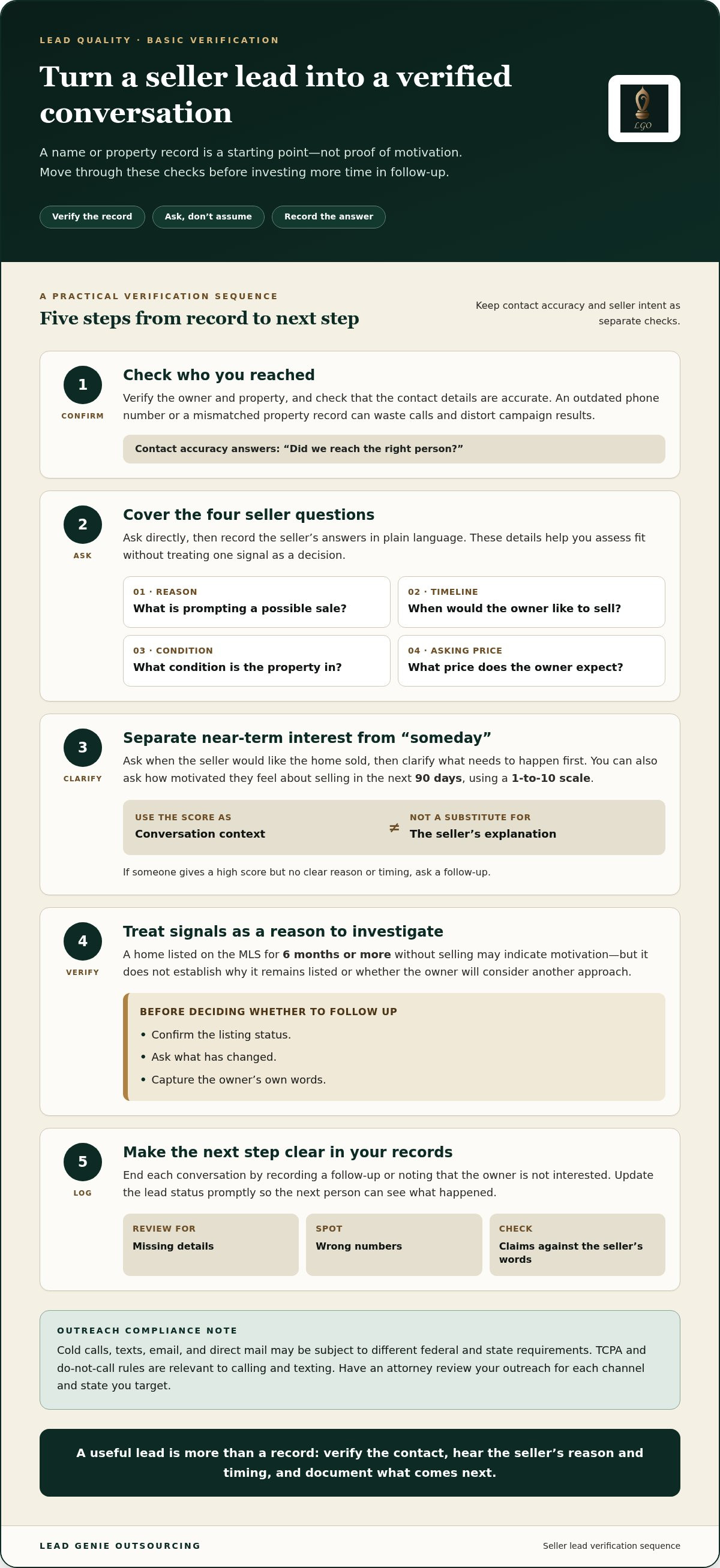
A seller lead is a starting point, not proof of motivation. Before investing time in follow-up, verify the owner and property, then ask about the reason for selling and likely timeline. An outdated phone number or mismatched property record can waste calls and distort campaign results. Treat contact accuracy and seller intent as separate checks. One confirms who you reached; the other indicates whether a useful conversation may follow.
Ask direct questions and record the answers plainly. What is prompting the possible sale? When would the owner like to sell? What condition is the property in? What price does the owner expect? These details help you assess fit without treating a single signal as a decision. An owner may have a property in poor condition but no plans to sell. Another may want to move soon while the home needs little work.
Use a timeline question to separate immediate interest from distant possibility. Ask when the seller would like the home sold, then clarify what needs to happen first. You can also ask how motivated they feel about selling in the next 90 days, using a 1-to-10 scale. Treat the score as conversation context, not a substitute for the seller’s explanation. If someone chooses a high number but gives no clear reason or timing, ask a follow-up.
Some signals deserve a conversation, not an assumption. A property listed on the MLS for 6 months or more without selling may indicate motivation. It doesn’t establish why the home remains listed or whether the owner will consider another approach. Confirm the listing status, ask what has changed, and capture the owner’s own words. That gives your team a better basis for deciding whether further effort makes sense.
Cold calls, texts, email, and direct mail may be subject to different federal and state requirements. TCPA and do-not-call rules are relevant to calling and texting. Have an attorney review your outreach for each channel and state you target.
To reduce misleading claims and privacy risks, use accurate scripts, protect seller information, and record the source of each contact. Don’t claim a sale is guaranteed, promise a specific offer, or imply knowledge of personal hardship unless the facts support it. Have an attorney review your process, including how your team handles opt-outs and stores seller details.
End each conversation with a clear next step, such as scheduling a follow-up or recording that the owner isn’t interested. Log the answer and update the lead status promptly. Review a sample of conversations for missing details, wrong numbers, and claims that don’t match the seller’s words. This quality check helps investors focus follow-up on accurate contact details and a clear reason to continue the conversation.
3. Set clear deal, geography, and capacity goals before marketing
Start with the deals your team can actually handle. Define the property type, buying area, seller situation, and work your team can take on. A wholesaler focused on single-family homes shouldn’t send the same message to owners of apartment buildings. Set a clear geographic target, too. If your team can handle leads in only part of a county, county-wide targeting can create follow-up work outside that area. Match each campaign to your buying criteria and capacity.
Choose channels based on your audience and your team’s ability to follow through. Direct mail can reach owners with a property-specific message, while cold calling can start a live conversation. PPC and Facebook ads can direct interested owners to a landing page, and SEO content can answer seller questions before they contact you. Give every channel a clear next step. Respond promptly to listing inquiries, and make sure an ad’s landing page explains what happens after someone submits their information.
Keep campaign content clear and consistent. Use the same terms for property type, area, and seller need across ads, landing pages, and follow-up messages. For AI-driven marketing, provide clear, structured details instead of vague claims. A page about inherited homes should explain the topic and the next step plainly. Avoid unsupported promises or saying “sell fast” without explaining what that means. Clear content helps people and tools understand who the message is for.
There is no single cost for motivated seller leads across direct mail, cold calling, PPC, and SEO. Costs vary with the market, list quality, campaign volume, content needs, and follow-up workload. Compare options by what the campaign includes and how qualified leads are delivered, rather than price alone.
Follow up promptly, then let the seller’s response guide the cadence. Real estate agents should aim to respond to seller inquiries within 5 minutes. For investor campaigns, assign an owner to each new inquiry, record the response, and set the next contact based on what the seller said. There is no universal follow-up count; the right cadence depends on seller interest, stated timing, and contact preference.
Use empathy without pressure. An owner facing a move, inherited property, or unsold listing needs a clear conversation, not a script that assumes distress. Ask what prompted the possible sale, listen, and tailor your next message. If the seller says they aren’t ready, record that and respect their preference. Follow-up should add context, not repeat the same pitch.
Review results by channel and by stage. Track inquiries, conversations, qualified opportunities, and closings separately. If Facebook brings inquiries but few conversations, inspect the landing page and response process. If direct mail gets replies from outside your buying area, narrow the geographic target. These checks connect marketing spend to team capacity and show where to adjust before expanding a campaign.
4. Traffic, conversion, and lead generation
More traffic won’t fix a weak path from click to conversation. Track each campaign by source, inquiry, contact, qualified lead, appointment, and closing. This sequence shows where prospects drop out. If Facebook ads bring inquiries but few conversations, review the form and follow-up process. If organic search brings visitors without inquiries, make the next step clearer. Use consistent stages across channels so results are comparable.
Use a simple source record for every seller lead. Note whether it came from direct mail, PPC, SEO, a referral, or another channel. Then review lead fit alongside volume. Investors report needing an average of 15 to 30 leads to close a deal, but raw lead counts don’t show whether those prospects match your buy box. Track qualified conversations and appointments, too. This helps separate useful traffic from names that never move forward.
Give each channel a fair test. Real estate investors are advised to commit four to six months to a PPC initiative before judging performance. The research also advises starting PPC or Facebook Ads once you consistently close one deal per month. During that test, avoid changing the audience, message, and landing page all at once. Change one part, then compare the next set of results with the prior campaign.
Build organic visibility with useful information for your market. Share updates or tips on your Google Business Profile, such as what sellers may want to prepare before discussing an inherited property. Keep the content accurate and point readers toward one clear next step. For PPC and Facebook campaigns, use a focused landing page where users can submit contact information or request details. A confusing page can waste qualified traffic.
Other lead sources can support a steady pipeline. Craigslist and EstateSales.net may surface estate sales that point to probate prospects. Investors can build relocation connections through movers and storage facilities. Real estate investment meetings and online forums can also lead to conversations with people who know potential sellers. Track each source separately. Don’t assume a channel works because it generates activity; check whether it leads to qualified conversations.
To fix underperforming campaigns, compare each stage and find the first clear drop-off. A low inquiry rate points toward the audience, message, or landing page; weak contact rates point toward the follow-up process. Make one targeted adjustment, then review the next reporting period. Agents and investors should keep notes on changes, so a campaign’s results don’t become guesswork.
Conversion depends on clear messaging and a relevant next step. A seller reading about an inherited home needs a page about that situation, not a generic investor pitch. Keep the ad, landing page, and follow-up aligned. Consistency helps sellers understand what to expect and helps you see which campaigns convert.
5. Active and passive motivated sellers
Active sellers have already taken steps toward a sale. They may have contacted an agent, called a wholesaler, approached a cash buyer, or listed the property themselves. Passive sellers may want or need to sell but haven’t acted yet. Treating both groups the same wastes effort: an owner who requested an offer needs a different next step from one who hasn’t considered selling.
For active motivated seller leads, ask what the owner has tried and what happened. A homeowner with an expired listing may say showings stopped or offers fell through. An owner who contacted a wholesaler may already understand the process and want to discuss timing. Use those details to guide the conversation. Don’t assume that taking action means the seller will accept any offer or has a fixed deadline.
Approach passive prospects more carefully. A property’s condition, an inheritance, or a relocation need can suggest a reason to consider selling, but doesn’t prove the owner is ready. Ask whether selling is under consideration, what would need to happen first, and when they might revisit the decision. If the answer is “not now,” record that preference. Don’t turn an early conversation into pressure.
Match the message to the seller’s situation and the channel. Direct mail can explain why you’re contacting the owner and invite a conversation. A phone call can ask what prompted the owner to consider selling. A landing page can outline the next step for someone researching options. Keep each message specific. “We buy houses” gives little context; the owner’s stated timeline gives the next contact a useful starting point.
Create separate CRM stages for active, passive, not interested, and follow-up requested. Record the seller’s own words, contact preference, and agreed next step. If an owner asks you to reconnect after reviewing an inherited property, for example, log the request instead of sending repeated generic messages. Review stages regularly. Active sellers may need a timely conversation; passive sellers need relevant follow-up that respects their situation.
Measure the groups separately. Compare how each source produces conversations, qualified opportunities, and appointments. If a platform creates many passive contacts but few near-term discussions, adjust the message or follow-up plan instead of labeling every contact a bad lead. For practical guidance on structuring seller calls, use this real estate cold-calling guide as a reference.
Lead Genie Outsourcing: Cold calling for real estate wholesalers
Lead Genie Outsourcing provides cold calling for real estate wholesalers and investors who need consistent seller conversations. Dedicated callers work 40 hours a week, and each caller receives 10,000 skip-traced, scrubbed records. Leads are qualified on four pillars: reason to sell, timeline, condition, and asking price. You also receive the call recording, so you can review the conversation and judge fit before deciding what comes next.
The guarantee is 30 qualified seller appointments a month, or dialing continues free until the target is reached. The LGO CRM is free for 30 days. This can fit investors who have defined their target market and need help keeping outreach and lead review moving. See how the cold-calling process works, then book a free 30-minute call with Lead Genie Outsourcing.
Make Your Next Campaign Easier to Measure
A better lead process starts with one decision: what will you change first? Choose one part of your campaign, such as the audience, message, or follow-up path. Keep the rest steady long enough to see whether the adjustment improves the conversations you want. Record what happened and use it to guide your next move.
Avoiding mistakes in motivated seller lead generation isn’t about adding more channels or chasing every new platform. Build a process your team can run, review, and refine. Set a clear next step for every seller conversation, and make sure someone owns it. Small, deliberate changes make it easier to see what’s working and where follow-up is falling short.
If consistent seller outreach is the part your team needs help carrying forward, book a free 30-minute call with Lead Genie Outsourcing. Start with the process you want to improve, then decide on the next move with a clear view of your options.
Frequently Asked Questions
What Are “Motivated Sellers”?
Look for an event or need that could make selling worth considering. An owner may have inherited a home they don’t plan to keep or be preparing to move for work. The event alone doesn’t tell you what the owner will choose. Ask what they want to do with the property and which options they’re weighing before deciding whether to follow up.
What are the most common mistakes in motivated seller lead generation?
Common mistakes include treating clicks as leads, relying on one unreviewed data source, and sending the same message to every owner. An ad click shows interest in a page, not readiness to sell. Duplicate contacts can inflate activity reports. Define what counts as an inquiry, qualified conversation, and appointment before comparing campaign results. This gives your team a consistent way to assess performance.
How can real estate investors identify and avoid low-quality motivated seller leads?
Verify that a contact record matches the person and property before spending time on repeated outreach. Flag duplicates, wrong numbers, missing ownership details, and contacts who have already declined. Then compare lead sources using consistent status labels, such as reached, wrong contact, not interested, or follow-up requested. This helps investors see whether a list produces real conversations or merely adds names to a database.
What are the best ways to qualify motivated seller leads without wasting time?
Use a short call flow and ask one clear question at a time. Confirm who is involved in the sale decision, what could delay a sale, and what next step the owner is comfortable taking. If another decision-maker needs to review an offer, note that before scheduling a follow-up. Recap the seller’s answers aloud so both sides can correct misunderstandings before the call ends.
What federal and state rules apply to cold calls, texts, email, and direct mail to motivated sellers?
Requirements can vary by channel and state. TCPA and do-not-call rules are relevant to calling and texting. Have an attorney review your outreach for each channel and state you target.