

A call script should open the door to a conversation, not force a yes. Effective cold calling property owners starts with a clear introduction, a reason for calling, focused questions about the seller’s situation, and a simple next step. It also helps the caller respond to objections without turning the conversation into a pitch.
A polished script is only part of the job. The caller still needs to sound natural, learn whether the owner has a reason to sell, and agree on a useful follow-up when appropriate. A script guides the conversation, but listening and judgment matter just as much.
This guide covers what to include in real estate cold-calling scripts, how to assess campaign activity, and how to respond when sellers push back. You’ll also see how to discuss relevant benefits while keeping the conversation focused on the owner’s needs and a practical next step.
Key Takeaways
- Build scripts around a clear opener, seller-focused questions, and a practical next step.
- Judge call performance by qualified conversations and appointments, not call volume alone.
- Use objection responses to understand the seller’s concern before explaining your value.
- Highlight benefits that match the owner’s situation instead of relying on a one-size-fits-all pitch.
- Keep follow-up organized so promising conversations don’t get lost after the first call.
1. What is a real estate cold calling script?
A real estate cold-calling script is a guide for talking with a property owner. It gives the caller a clear opening, a reason for reaching out, and questions to understand the owner’s situation. It also helps establish a next step, such as recording the owner’s interest for follow-up. The script should keep calls focused without making every conversation sound identical. For investors and wholesalers, the goal is to identify owners who may consider selling and capture details that inform the next decision.
Cold calling connects with owners through live conversations. Direct mail puts a message in the owner’s hands, texting depends on written replies, and door knocking starts a face-to-face interaction. Each method creates a different opening and pace. On a call, the caller can ask a question and respond in real time; with mail or texts, the owner chooses whether to reply. Door knocking involves an in-person approach. The right channel depends on the campaign, available property records, and the response the team needs.
A professional provider sets lead goals and lag goals before dialing. A lead goal tracks work or activity, such as making 100 calls this week or testing a new script on 50% of calls in a day. A lag goal tracks a result, such as scheduling 10 prospects for face-to-face meetings in a week. These are examples, not universal targets. The provider uses the campaign’s audience and purpose to set the measures, then reviews both. Call volume shows whether outreach happened; qualified conversations show what that work produced. If activity is strong but conversations are weak, the team can review the opening, list quality, and call handling.
State restrictions can differ, so local rules matter. Congress found that over half the States had statutes restricting telephone marketing, while interstate operations could evade those restrictions, according to the U.S. Government Publishing Office. Telemarketers covered by the National Do Not Call Registry have up to 31 days after a number is registered to stop calling it, according to the Federal Trade Commission. TCPA and Do-Not-Call requirements can depend on the call and the campaign. This is not legal advice; check with your attorney about applicable federal and state rules. A TCPA and Do-Not-Call compliance overview can help frame the issues for that discussion.
Cold calling property owners works best as a measured lead-generation process, not a one-call bet. Track attempts, conversation outcomes, seller details, and agreed follow-up. These records help distinguish an owner who was unavailable from one with a reason to sell. They also give the investor a useful handoff, rather than a name without context.
2. Cold-calling effectiveness and conversion rates
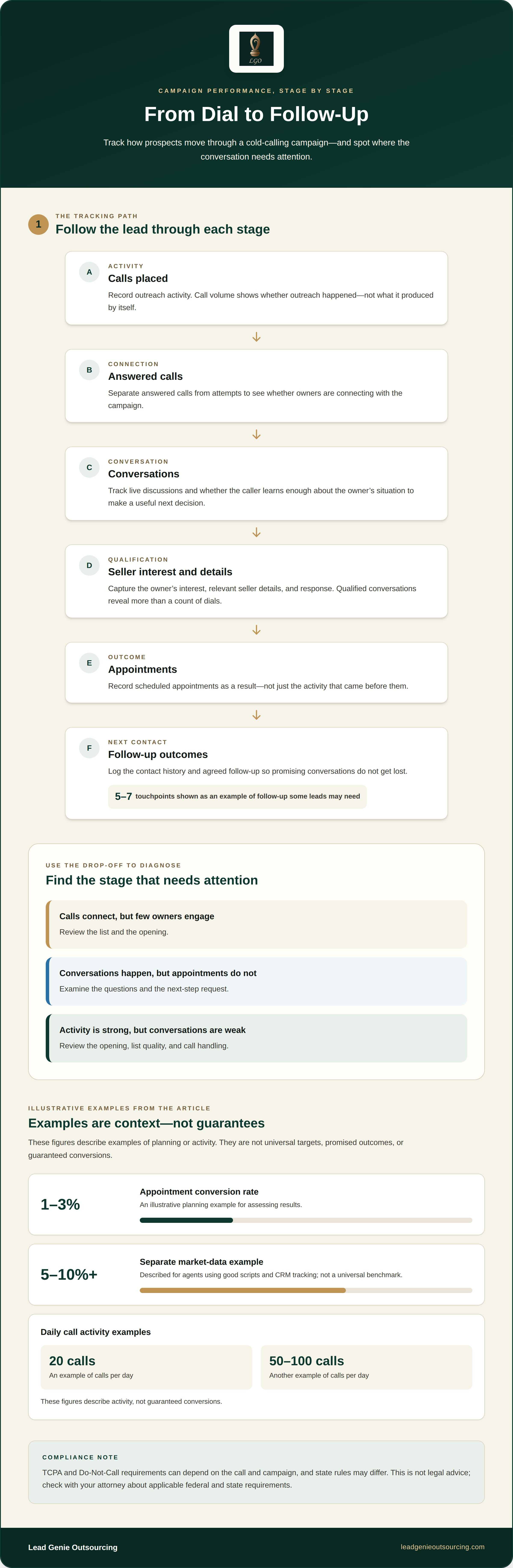
Cold-call performance depends on more than the number of dials. As an illustrative planning example, an appointment conversion rate of 1-3% gives a team one way to assess results. A separate example in the market data describes 5-10% or higher for agents using good scripts and CRM tracking. Treat these as examples, not promised outcomes or universal benchmarks. List quality, owner availability, caller approach, and follow-up all shape results. Track each stage, from an attempted call to a qualified appointment, to see where the campaign changes course.
Recent sales can provide a specific starting point for a call. A caller might mention a nearby property that sold, then ask whether the owner has considered selling or would like to discuss the market. The sale provides context, not proof that the owner’s property has the same value or features. Keep the focus on the owner’s plans and willingness to talk. If the owner isn’t interested, record the response instead of pressing the point.
Useful reporting separates results into stages. Track calls placed, answered calls, conversations, seller interest, appointments, and follow-up outcomes in a CRM. Then compare where prospects move forward or drop off. If calls connect but few owners engage, review the list and opening. If conversations happen but appointments don’t, examine the questions and next-step request. This view helps distinguish a dialing issue from a script or follow-up problem.
U.S. cold-calling campaigns must account for the Telephone Consumer Protection Act (TCPA) and the National Do Not Call Registry. Federal and state requirements can affect how a campaign contacts property owners. This isn’t legal advice. Clients must ensure any lists they provide meet applicable legal requirements, including TCPA rules, and should consult a qualified attorney about their campaign.
There’s no fixed number of calls that guarantees reaching or converting a property owner. The result depends on the records, whether owners answer, their interest, and the campaign’s definition of conversion. As illustrative workload examples, some agents make 20 calls a day, while top-performing agents make 50-100 calls per day. Those figures describe activity, not guaranteed conversions. The market data also gives 5-7 touchpoints as an example of the follow-up some leads may need. Reviewing each contact’s history gives a more useful picture than counting dials alone.
A clear calling workflow connects call activity, seller qualification, and appointment tracking, giving investors a more useful view of campaign performance.
3. What professional cold-calling scripts for homeowners and property sellers include
A professional script gives the caller a clear opening, a reason for reaching out, and a path through the conversation. For example, a caller might say, “Hi, I’m calling about the property on Oak Street. Would you be open to discussing a sale?” The opening should quickly make the call relevant while still sounding natural. The caller should listen and respond to the owner rather than read every line word for word.
For wholesalers and investors, questions should establish whether a conversation about a possible purchase makes sense. A caller might ask what prompted the owner to consider selling, what timing they have in mind, and what they expect for the property. These are example prompts, not a required script. If an owner says they may sell after relocating, the caller can note that plan and ask whether a later follow-up would be welcome. The record should reflect the owner’s actual words.
Scripts for homeowners and property sellers should offer a low-pressure next step. For example, a neighborhood call might ask whether an owner has considered selling in the next 6 to 12 months. An expired-listing conversation could offer a meeting of about 15 minutes. A for-sale-by-owner script might suggest a 20-30 minute meeting if the owner wants to discuss options. These are sample scenarios, not fixed meeting requirements. The caller should make any proposed next step clear and easy to decline.
When calling about an investment property, establish who is making the decision and whether a sale is under consideration. Don’t assume the owner wants to sell simply because the property is an investment. If an owner says the property is occupied and not for sale, don’t use a pitch based on vacancy. If the owner mentions a possible future sale, record the reason and timing for relevant follow-up.
A neighborhood value script can use a nearby sale to start a focused conversation. The caller might mention that a nearby property sold, then ask whether a local market update would be useful. That sale is context, not proof of the owner’s property value. Avoid unsupported price claims and ask about the owner’s plans. A short informational conversation may be more useful than asking for an immediate commitment.
For a sample weekday schedule, a provider might test morning, lunch, and late-afternoon calling windows, such as 8-9 AM, 12-1 PM, or 4-6 PM. These are examples, not guaranteed best times. The provider can compare actual contact and conversation outcomes across its schedule. Script performance also depends on whether callers record owner responses accurately. A seller qualification framework can help keep those conversations focused without making them feel like an interrogation.
4. Responding to commission objections
A commission objection usually signals a concern about value, cost, or control. The caller’s first move is to clarify, not defend. If a seller says, “I don’t want to pay more than 3%,” the professional can acknowledge the limit and ask what outcome matters most. That keeps the conversation on the seller’s priorities instead of turning it into an argument about a percentage.
A measured response might be: “I hear that keeping the fee at or below 3% matters to you. What would you need from the sale to feel the service is worthwhile?” The answer may reveal a concern about marketing, communication, timing, or net proceeds. The caller should not promise a particular fee or result during an initial call. The next step is to understand the seller’s expectations and arrange a fuller discussion if they want one.
Investors and wholesalers should distinguish an agent’s commission objection from questions about a direct purchase. A seller who asks about commission may expect representation or listing services. A buyer calling about a possible direct purchase should explain that the conversation is about a potential sale, not a listing agreement. The caller can ask whether the owner is open to discussing that option. Clear language helps prevent a mismatch between the seller’s expectations and the caller’s role.
Small agreements can make a next step easier to accept. Instead of pushing for a major decision, ask permission to clarify a detail, confirm whether the owner wants follow-up, or arrange a conversation about the property. For example: “Would it help to talk through your timeline before deciding whether to meet?” Each agreement keeps the owner in control and gives the caller a clear action to record.
Follow-up should reflect what the owner actually said. If the seller wants time to consider possible fees, record that concern and the agreed next step. If the owner declines, respect the response rather than treating silence as consent. A useful call record captures the objection, the underlying concern, and any permission to reconnect. That makes the next conversation specific and avoids asking the seller to repeat the same explanation.
For an investor or wholesaler, the goal isn’t to overcome every objection. It’s to learn whether the owner wants a relevant conversation. A professional cold-calling workflow keeps responses, seller details, and follow-up aligned while leaving the owner free to say yes, no, or not now.
5. Benefits to highlight when calling property owners
A benefit matters only when it fits the owner’s situation. A seller facing repairs may care about avoiding more work. An owner managing a vacant property may value a simpler path to a sale. Ask what matters first, then discuss only the relevant option. An investor or wholesaler should describe a potential purchase plainly, without promising a price, closing date, or outcome.
Use the owner’s stated reason to shape the value statement. If the property needs repairs, the caller might say, “You mentioned the roof needs work. Would discussing a sale in its current condition be useful?” That’s an invitation, not a claim that every buyer will accept the property as-is. If timing is the main concern, ask what schedule the seller has in mind before discussing a possible next step. A benefit is relevant when it addresses a stated need.
Clarity can be a benefit, too. Explain who is calling, why the property came up, and what the conversation can cover. Then ask permission to discuss the seller’s timeline, the property’s condition, and the asking price. If the owner wants time to think, agree on whether and how to follow up. A direct conversation reduces needless back-and-forth and helps the owner decide whether further discussion makes sense.
Some real estate businesses may highlight a specific service benefit, such as discounted fees if a property sells within 30 days. Treat that only as an example, not a default offer. For an investor or wholesaler, the caller should instead state the actual purchase approach available for that conversation. Don’t borrow a listing service’s discount or imply it applies to a direct buyer. The offer must match the business and the seller’s circumstances.
Calling without consent can create compliance and legal risks, especially when Do-Not-Call or TCPA rules apply. Covered telemarketers have up to 31 days after a number is registered to stop calling it, according to the Federal Trade Commission. The consequences depend on the call and applicable requirements, so don’t assume every call is treated alike. This isn’t legal advice; check with your attorney about TCPA, Do-Not-Call, and state rules.
End a useful call with one relevant next step: answer a question, arrange follow-up the owner agrees to, or close politely. If an owner wants to consider selling after handling repairs, for example, record that reason and ask whether a later conversation would help. This keeps the discussion tied to the owner’s plan rather than a canned pitch.
Lead Genie Outsourcing
Lead Genie Outsourcing supports real estate investors and wholesalers with dedicated cold callers and the LGO CRM. Consider its service when call volume, consistent follow-up, or seller qualification is taking time away from running your operation.
Each caller works 40 hours a week and receives 10,000 skip-traced, scrubbed records. Leads are qualified on reason to sell, timeline, condition, and asking price, with a call recording for review. The guarantee is 30 qualified seller appointments a month, or dialing continues free until that mark is reached. The LGO CRM is free for 30 days.
Book a free 30-minute call with Lead Genie Outsourcing to discuss your seller outreach.
Turn Your Calling Plan Into Consistent Action
A disciplined approach to cold calling property owners starts with a clear operating standard. Define what makes a seller conversation useful, which information to capture, and how to record the next step. Apply that standard consistently across your pipeline. A script should guide the caller, not flatten every owner into the same conversation.
For your next move, consider where seller outreach competes with work only you can do. If calls and follow-up keep slipping, dedicated callers can bring structure to that part of your operation. If you’re still building the process, make each handoff clear: what the caller learned, what the owner agreed to, and what happens next. Gaps in these details can slow a promising conversation.
Lead Genie Outsourcing supports real estate investors and wholesalers with cold calling and the LGO CRM. Choose the next step that fits your workflow, then keep your team focused on moving qualified conversations forward. Book a free 30-minute call with Lead Genie Outsourcing and put a clear plan in motion.
Frequently Asked Questions
What is a real estate cold calling script?
A real estate cold-calling script is a flexible guide for speaking with property owners about a possible sale. It helps the caller explain why they’re reaching out, keep the conversation focused, and respond to the owner’s answers. The caller can record whether the owner wants no further contact, a later conversation, or information about a potential purchase. That outcome determines the next action.
How can a cold-calling provider find property owners’ phone numbers?
Skip tracing can match property records with available phone contact details. List preparation can remove duplicate records and scrub against do-not-call and opt-out records. Deduplication, for example, helps prevent the same owner from appearing more than once on a campaign list. List preparation doesn’t replace legal guidance. Clients must ensure any lists they provide meet applicable legal requirements, including TCPA rules, and should consult a qualified attorney about their campaign.
What should the best script for cold calling property owners include?
A useful script should make the caller’s role clear and avoid implying they are an agent, appraiser, or lender when they’re calling as an investor or wholesaler. Include a concise opening, a relevant reason for calling, and questions that let the owner explain their goals. The caller also needs a clear way to record a refusal and end the conversation respectfully.
What should investors expect a provider to do to prepare for and follow up after cold calls to property owners?
Before dialing, a provider should prepare the owner list and tailor the script to the investor’s campaign. Investors should also expect the provider to document call outcomes and agreed next steps, such as whether an owner requested information or welcomed follow-up. Lead Genie Outsourcing records calls and delivers qualified seller leads with recordings.
What are the risks and penalties for calling property owners without consent?
Calls may be subject to TCPA, Do-Not-Call, and state requirements; telemarketers covered by the National Do Not Call Registry have up to 31 days after a number is registered to stop calling it. The material does not provide specific penalties for calling without consent.
Do cold-call rules differ by state, and what local restrictions apply?
Yes. State restrictions can differ, and over half the states have statutes restricting telephone marketing; check with your attorney about which federal and state rules apply to your campaign.