

Cold calling is useful only when seller conversations land somewhere your team can act on them. In real estate, it means calling property owners who haven’t asked to speak with you. Cold calling with CRM lead delivery connects those conversations to a system for tracking seller details, call outcomes, and next steps.
The call is only one part of the workflow. Records need to reach the CRM, call activity and outcomes need to be tracked, and follow-up must retain the seller’s context. Software can support that process, but it does not replace trained callers or a clear handoff.
This guide explains how cold calling works, how CRM imports and dialer delivery fit together, and what to look for in platforms and service providers. It also covers how lead details and call outcomes can shape follow-up, what affects lead quality, and when a professional service may fit your operation better than managing calls in-house.
Key Takeaways
- Keep CRM records organized so callers can track each seller conversation and its next step.
- Choose an outbound calling platform that fits your lead handoff and follow-up workflow.
- Use clear qualification details to help your team prioritize seller leads and act on them.
- Consider a professional calling service when you need consistent outreach without managing every call in-house.
- For TCPA and Do Not Call questions, consult your attorney before setting up a calling process.
1. What is cold calling?
Cold calling is outbound phone outreach to people who haven’t requested a call. In real estate, callers contact property owners to learn whether they would consider selling. The first call is a conversation, not a promise of a deal. Its purpose is to understand interest, gather relevant details, and record a clear next step.
A provider starts by defining the campaign’s target. For example, an investor may want conversations with owners in a specific market. The provider then researches prospects using sources such as online directories and organizes records by location or other agreed criteria. Before outreach, records are prepared for the campaign and loaded into a CRM, where each prospect can be tied to call outcomes and follow-up.
CRM setup gives callers a consistent place to work. Records can include the property address, owner contact details, call status, notes, and follow-up date. A dialer can use the CRM’s prospect list to place calls and log outcomes against each record. Tasks can surface the next action, while a voicemail may be part of the process when a call goes unanswered.
List quality matters more than list size. Track where records came from, when they entered the campaign, and any call restriction or request not to be contacted. Purchased or transferred leads can create privacy and consent risks if their origin, accuracy, or permissions are unclear. Preserve available source and consent details, and have an attorney assess the campaign’s legal requirements.
U.S. cold calling involves the Telephone Consumer Protection Act and Do Not Call lists. The Telephone Consumer Protection Act was passed by the U.S. Congress in 1991. The Federal Communications Commission says businesses cannot call residences before 8 a.m. local time or after 9 p.m. local time under the TCPA guidance it describes. The TCPA restricts unsolicited calls, and businesses must follow Do Not Call lists, according to the Federal Communications Commission and Federal Trade Commission. Rules can apply differently to calling methods, including automated dialing, so consult your attorney before launching outreach.
Track attempts, live conversations, qualified prospects, appointments set, and completed follow-up. Compare results by campaign and source to spot poor records or inconsistent caller notes. If calls connect but few prospects qualify, review the targeting or qualification process. If qualified conversations lack a recorded next step, tighten the CRM workflow.
That’s the working model behind cold calling with CRM lead delivery: a provider sources and organizes prospects, calls them through a defined workflow, and records the result for follow-up. For real estate investors and wholesalers, the value is a traceable path from prospect record to seller conversation, not simply more calls. TCPA and Do Not Call considerations belong in campaign planning, alongside the target market and CRM handoff.
2. CRM imports and lead delivery to dialers
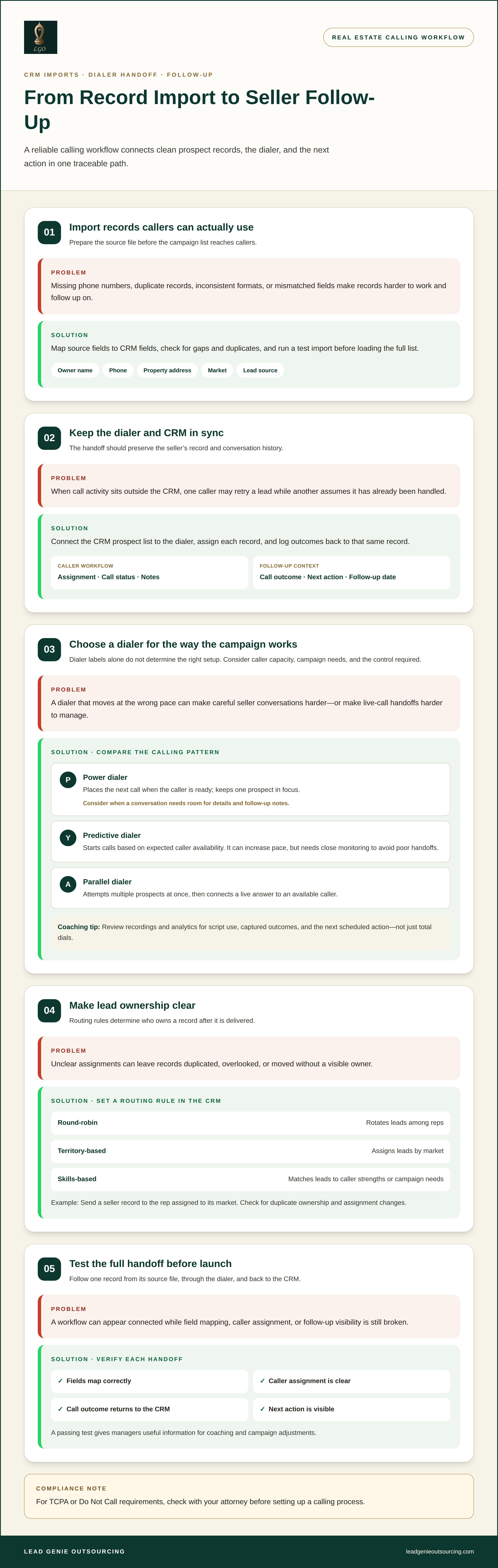
A clean import gives callers usable records and the context they need. Map each source file’s fields to CRM fields such as owner name, phone, property address, market, and lead source. Check for missing numbers, duplicate records, and inconsistent formats before loading the campaign. A test import can catch field mismatches before they affect the full list.
Next, set campaign rules and connect the CRM list to the dialer. Records can include an assigned caller, call status, notes, and follow-up date. The dialer should log call outcomes to the same CRM record. Without that connection, one caller may contact a lead again while another assumes it has already been handled.
Choose a dialer based on how callers work and how the campaign handles live conversations. A power dialer places the next call when a caller is ready, keeping one prospect in focus. A predictive dialer starts calls based on expected caller availability, which can increase pace but needs close monitoring to avoid poor handoffs. A parallel dialer attempts multiple prospects at once, then connects a live answer to an available caller. The right setup depends on campaign size, caller capacity, and the level of control required.
For a real estate campaign centered on careful seller conversations, a power dialer can give callers room to handle objections, follow the script, and record property details. Predictive dialing may suit a provider focused on call volume and equipped to manage the pace. Use recordings and analytics for coaching, not just total dials. Managers can review whether callers follow the script, capture outcomes, and schedule the right next step.
Dialer costs depend on the pricing model and campaign needs. Compare the number of users, calling capacity, integrations, analytics, support, and usage-based charges. A plan with more automation or reporting may cost more than a basic setup. Compare the functions the campaign actually needs, not just the dialer label. The terms “power” and “predictive” do not determine a price.
Lead routing determines who owns a record after delivery. Round-robin routing rotates leads among reps; territory-based routing assigns them by market; skills-based routing matches them to caller strengths or campaign needs. Set routing rules in the CRM, then check for duplicate ownership and assignment changes. For example, a seller record can go to the rep assigned to its market.
Before launch, test a record from source file through dialer and back to the CRM. Check field mapping, caller assignment, call outcome logging, and follow-up visibility. A workflow that passes these checks gives managers useful information for coaching and campaign adjustments. See how the calling workflow is structured.
3. CRM platforms for outbound calling
Choose a CRM for the work it needs to support, not its feature list. In real estate outreach, a property record should connect the owner’s contact details, property notes, call history, and next action. Callers need that context without searching through scattered files. The platform should make the record clear before the conversation starts.
Start with the handoff. Map how prospects enter the CRM, how callers receive assigned records, and how call outcomes return. The integration should preserve key fields such as lead source, property address, caller notes, and follow-up status. If a seller record loses its source or call notes, the next person cannot see how it entered the campaign.
Next, assess the dialer connection. Callers should be able to open the right CRM record, place a call, and log its outcome against that same contact. Test a sample property record from import through call logging. This can reveal mismatched fields, duplicate records, or a status that fails to update after a call.
Workflow fit matters more than a long menu of tools. Set useful stages such as new prospect, attempted contact, conversation started, qualified, and follow-up due. Choose labels that match the team’s process. A seller who requests a later call needs a dated follow-up task, not a record marked complete.
Check how the platform handles appointments and ownership. An appointment should appear with the seller’s contact record, relevant property details, and call notes. Make the assigned team member clear so the next conversation has context. Access settings can also reflect each person’s role, keeping caller work and manager review organized.
Reporting should answer practical questions. Can a manager see which records need follow-up, review call outcomes, and spot fields callers leave blank? Can they compare activity by source or market? Easy-to-use reports support coaching and record cleanup. Reports that require manual spreadsheet work add friction to daily call handling.
Before choosing a platform, walk through a real workflow using a sample lead. Follow the record from import to caller assignment, outbound call, notes, and next action. Confirm that the integration supports the team’s existing process instead of forcing callers to keep separate logs. A CRM for cold calling should make the handoff visible from prospect intake through appointment follow-up.
For real estate investors and wholesalers, a useful platform keeps property context, call activity, and lead ownership together. The provider should explain how records move, what callers see, and how managers review the work. Understanding that workflow is more useful than choosing by platform name alone.
4. CRM-based lead management and follow-up
Treat each prospect as a working record, not just a name on a spreadsheet. Include property details, source, assigned caller, conversation notes, and next action. If an owner requests a later call, for example, the caller can log the request and set a follow-up task. The next caller can review the history before reaching out.
Providers prioritize leads using signals recorded in the CRM, such as recent engagement, seller interest, or a requested callback. They route records by territory, caller availability, or campaign needs, then assign one clear owner. That prevents duplicate outreach and gives managers a way to spot leads waiting without action. The routing rule should match how the team handles each market.
Use clear labels for call outcomes, such as no answer, voicemail left, conversation completed, follow-up requested, or not interested. Specific labels make reports useful; a note that just says “called” does not explain what happened. If a caller leaves a voicemail, record that outcome and the next step without treating silence as a conversation.
Follow-up should carry the seller’s context forward. Record the owner’s stated timing, property concerns, questions, and preferred next contact. If email is part of the agreed workflow, keep the message and response with the same record. CRM tasks and reminders can manage follow-up, while integrations can connect other systems. Either way, the record should show what happened and what comes next.
Call recordings help managers review how conversations were handled. They preserve the seller’s words alongside the caller’s notes, making it easier to coach on listening, script use, and accurate logging. Compare the recording with the CRM entry and correct gaps before handing the lead to another team member. The goal is a useful handoff, not extra paperwork.
Review the follow-up queue, overdue tasks, and lead stages as part of campaign oversight. A prospect marked “callback requested,” for example, should not sit in the same stage as an unanswered call. Reviewing records can reveal missed actions, repeated attempts, or unclear notes. It also shows whether the process is moving prospects toward a meaningful next conversation.
For cold callers, routing works best when assignment rules and statuses are simple. Send new records by territory, rotate assignments, or route specific campaigns to trained callers. The CRM tracks ownership and the next task. Clear rules let callers focus on conversations while managers maintain visibility across the pipeline.
Strong lead management connects each call, voicemail, recording, and follow-up task to one prospect record. The next person can then continue the conversation without asking the seller to repeat details. Keep stages and task rules aligned with the actual outreach process so CRM updates reflect real work, not activity for its own sake.
5. Cold calling service providers
A cold calling provider manages the work between prospect records and seller conversations. For a real estate investor, that can include organizing outreach, calling property owners, recording outcomes, and passing qualified conversations to the sales team. The provider handles dialing and lead documentation; the investor decides how to respond to seller opportunities.
Start with the campaign target and handoff. Define the market, property types or owner groups to reach, and the information the sales team needs after each call. A seller lead may include the owner’s reason for selling, timeline, property condition, and asking price. Those details help the team decide whether and how to continue the conversation.
Training should match the real estate campaign. A script should guide the opening without turning every cold call into a rigid recital. Coach callers on listening, handling objections, and taking accurate notes. Call reviews can show whether a caller missed the seller’s timeline, gave an unclear answer, or failed to log the agreed next step.
Call volume alone is a poor measure of campaign quality. Track dialing alongside live conversations, qualified leads, appointments, and completed follow-up. These measures help distinguish a targeting problem from a call-handling problem. If calls reach owners but few conversations qualify, review the campaign criteria or opening. If qualified leads lack clear notes, improve the handoff.
Give each calling sequence a clear purpose. Organize attempts and follow-up around recorded outcomes instead of repeating the same action for every prospect. An unanswered call, a callback request, and a seller who says no require different next steps. The CRM should show each record’s status and owner so the sales team can see what has happened.
Outsourcing may suit investors who want consistent outreach without managing every caller, script change, and CRM update in-house. It is less useful if the business has no defined target market or cannot respond to qualified seller conversations. A provider can run the calling workflow, but the investor still needs a process for reviewing leads and deciding what happens next.
Keep accountability visible. A provider’s reporting should connect dialing activity to lead details and recorded outcomes. The investor should be able to follow a seller record from campaign assignment through its latest call and next action. That makes it easier to spot stalled follow-up, assess lead fit, and give the provider specific direction without relying on vague impressions.
Choose a service model based on the work your operation needs covered: prospect outreach, consistent call handling, CRM logging, or a clear lead handoff. For investors and wholesalers, a real estate-focused workflow keeps seller conversations connected to property details. Review the cold calling process to see how the pieces fit together.
Lead Genie Outsourcing
Lead Genie Outsourcing provides real estate investors and wholesalers with cold calling and the LGO CRM. Trained callers contact property owners, and qualified, recorded seller leads are delivered to the client’s CRM. This connects outreach with a place to review lead details and call recordings.
This service can suit teams that want help managing seller outreach instead of handling every call in-house. Caller plans include the LGO CRM, so leads and call details can be reviewed in one place. The service also includes follow-up support.
Use your target market and lead-review workflow to decide whether outsourced calling fits your operation.
Put the workflow to work
Define how seller conversations move through your operation. Decide who reviews each lead, what information the sales team needs, and who owns follow-up. A clear handoff ties calling activity to decisions, not just CRM records.
For investors and wholesalers, Lead Genie Outsourcing combines real estate cold calling with the LGO CRM. Trained callers contact property owners, and qualified, recorded leads are delivered to the client’s CRM. Your team can review the seller’s details and call recording as it decides what action to take.
Use your needs to guide the discussion: target market, caller workflow, CRM handoff, and lead review. Then you can assess whether cold calling with CRM lead delivery fits your operation and which outreach tasks a provider can handle.
With the workflow defined, your team can manage seller conversations with clear ownership and follow-up.
Frequently Asked Questions
What is cold calling?
Cold calling means contacting people who haven’t requested a sales conversation. In real estate, a caller may reach a property owner to learn whether selling is an option. The aim is to understand the owner’s situation, not force a decision. An owner who isn’t ready today may welcome a later conversation if the caller records that preference accurately.
How do cold calling providers generate cold leads?
Providers build prospect lists from property and contact records, then organize them around a campaign’s target market. A real estate team might focus on owners in a chosen area or with a defined property profile. Before calls begin, the provider prepares records for outreach and removes duplicates. Lead quality depends on accurate contact details, a clear targeting plan, and useful information gathered during the conversation.
How do cold calling providers automate calls?
Providers use dialers to place calls from an assigned campaign list and connect call activity with lead records. A power dialer can start the next call when a caller is ready; predictive or parallel dialing can place calls at a faster pace. The provider selects a setup based on caller capacity and campaign workflow. Automation can manage call flow, but callers still handle live conversations.
How do providers track sales calls?
Log each call outcome against the prospect’s record. Useful notes show whether the caller reached the owner, what the owner said, and what action follows. A callback request, for example, should have an assigned owner and due date. Managers can review recordings alongside CRM notes to identify missing context, coach callers, and keep follow-up on track.
Which CRMs support automated lead delivery and cold-calling workflows?
CRM support depends on the platform and dialer connection. Some workflows use a built-in dialer; others connect separate systems through an integration or import. Test how a sample lead enters the CRM, reaches a caller, and returns with notes and status updates. This shows whether the setup supports the team’s actual handoff process.
How much do CRM lead delivery and cold-calling services cost?
Costs depend on service scope, caller staffing, campaign needs, and CRM setup. For an outsourced campaign, compare the plan’s stated price and included services against your requirements. Review what calling and lead handling cover, along with the billing terms. Do not compare plans by one headline figure alone; compare the work and support included.
How does a provider set up a CRM for cold calling and lead distribution?
Define the record fields and stages the calling team needs, including property details, lead source, call status, owner, and next action. Map incoming records, assign leads using the agreed routing rules, and test a sample through the dialer. A clear test confirms callers see the right details and managers can trace each assignment.
How can providers use CRM integrations to automate call logging, follow-ups, and lead updates?
Integrations can send a prospect record to a dialer and return the call outcome and notes to the CRM. A follow-up rule can create a task when an owner requests another call. Test whether the callback date appears on the correct record after the call. If updates fail, review the field mapping and connection settings.
Book a free 30-minute call with Lead Genie Outsourcing to discuss your calling workflow.