

You don’t need to add a caller to payroll to put seller conversations on the calendar. Real estate cold calling without hiring means having dedicated callers contact property owners, qualify their interest, and pass promising leads to your team. The callers handle outreach; you handle the seller conversations that fit your buying criteria.
That works best when the handoff is clear. Callers need your target market, property criteria, and questions that help reveal whether an owner may be ready to sell. You also need a way to review call notes and recordings, track follow-up, and see which leads meet your standards. This guide explains how outsourced calling works, what to provide, how seller leads are qualified and tracked, and what to consider when choosing a calling service. No payroll hire, and no mystery pipeline.
Key Takeaways
- Set clear seller and property criteria so callers can focus conversations on leads that fit your buying plan.
- Use a direct, natural opening that earns a conversation, then respond to objections without forcing the pitch.
- Qualify seller interest by uncovering the reason for selling, timeline, property condition, and asking price.
- Track call activity, lead notes, and recordings so your team can review handoffs and manage follow-up.
- Assess a calling service by its caller setup, lead qualification process, reporting, and fit with your workflow.
What Is Cold Calling in Real Estate?
- Define the work before judging results. Real estate cold calling means contacting property owners who haven’t asked to hear from you, then finding out whether a seller conversation makes sense. For investors and wholesalers, the goal is a qualified lead, not an instant deal. Results depend on the records selected, the caller’s questions, and what happens after an owner shows interest. A campaign should be judged by relevant conversations and useful next steps, not calls made alone.
- Choose records that fit the deal you want. Real estate agents commonly contact homeowners in selected neighborhoods, owners of expired listings, For Sale By Owner properties, and investor-owned homes. Investors can use that same targeting principle: define the property and seller profile, then tailor the call to the campaign. For example, a caller reaching owners of investment properties can ask whether they would consider selling. A clear target makes each conversation easier to assess.
- For investors, real estate cold calling without hiring means outsourcing seller outreach instead of adding an in-house caller. Before a campaign begins, align on its purpose, the property profile, and the details callers should capture. That gives the caller a clear path from introduction to handoff. The investor can then decide whether a prospect fits the acquisition plan, rather than sorting through unstructured call notes.
- Have a qualified attorney review do-not-call requirements before outreach begins. Federal and state rules can depend on the call, number, and campaign, and an attorney can assess which requirements and list-screening steps apply. TCPA rules may also apply to automated calls and texts. Applicability depends on the technology and context, so have an attorney review the specific setup.
Software and data costs depend on the provider, record source, data fields, skip tracing, and included tools. Compare what each option covers, such as records, call tracking, and lead management. A phone number alone doesn’t make a record useful. Poor-fit records can use caller time without producing relevant seller conversations.
- A real estate cold calling without hiring setup also needs a plan for risks such as compliance mistakes, poor targeting, missed follow-up, and time pulled away from acquisitions. Use an attorney-reviewed process, a focused list, and consistent call records. Capture each outcome, including no interest and a requested follow-up. This helps the team act on seller interest instead of treating every attempted call as a lead.
Review lead quality alongside call activity. A connected call isn’t automatically a qualified opportunity. Capture whether the owner is open to selling, what prompted the conversation, and what next step they accepted. If a list generates conversations but few relevant leads, reassess its fit with your buying plan. Professional callers handle outreach; investors decide which leads merit acquisition follow-up.
How professional callers open real estate cold calls and handle objections
- Use a brief opening to sound clear, calm, and relevant. The opening should identify the caller, explain why they’re calling, and ask permission to continue. For example: “Hi, this is Jordan calling about your property. Did I catch you with a moment?” Keep it short. A long pitch gives the owner an easy reason to end the call.
- Make the reason for the call specific, not scripted-sounding. Name the property when appropriate, then ask about the owner’s plans. Avoid unsupported claims about the home or its value. A practical transition might be: “I’m reaching out to see whether you’d consider an offer on the property.” Callers should sound prepared, not as if they’re reading every line in the same tone.
- Ask one question, then let the owner answer. Stacking questions can make a call feel like an interrogation. Start with the owner’s plans, then follow their answer. If the owner says, “Maybe later,” ask what might change before selling becomes an option. If they say, “I’m not interested,” acknowledge the answer and ask whether they’d prefer no further calls. Respect the response; don’t argue.
- Handle objections by understanding the concern behind the words. “I’m busy” may mean the timing is wrong; ask whether another time would work, without pressing. “I already have an agent” calls for acknowledgment, not debate. “What’s your offer?” requires care. Explain the next step for discussing property details instead of inventing a price. The aim is an honest exchange, not a forced commitment.
- Keep each response short and tied to what the owner said. For “I need to talk to my spouse,” a caller might say, “Of course. Would it help to reconnect after you’ve had that conversation?” For “How did you get my number?” answer directly using the campaign’s approved explanation. Don’t guess, dodge, or make unsupported claims. Clear answers build trust; evasive answers can end the call.
- Close with a next step the owner accepts. A successful call can lead to a follow-up conversation, meeting, or appointment, rather than an immediate listing agreement. Confirm the agreed action plainly, then record the owner’s words and timing accurately. If there’s no interest, end politely and record that outcome. Strong call handling keeps the conversation useful, whether it leads to a next step or a clear no.
For a closer look at the call process, the real estate cold calling guide covers the work from opening through follow-up.
How professional callers prepare and personalize real estate cold calls
- Start with your buying criteria. Callers need to know which property types, markets, and seller situations fit the campaign. For example, a wholesaler focused on single-family homes needs a different call focus than an investor seeking rental properties. Clear criteria help callers distinguish relevant conversations from general interest. Without them, callers may collect details that don’t help the acquisitions team decide what to do next.
- Turn those criteria into a usable call brief. Include the target market, property profile, your role, and the purpose of outreach. Explain what callers may say about a potential purchase and what requires a handoff. For example, callers should know whether to arrange a follow-up when an owner asks about offer terms. Clear boundaries keep calls accurate and protect your team’s time.
- Review the records before dialing. Callers should have the property address and available owner or property details in view. The point isn’t to guess at a seller’s motivation, but to avoid asking for information already in the record and keep the conversation tied to the property. If a field is missing or appears inconsistent, callers should avoid presenting it as fact.
- Build a flexible script around the campaign, not a rigid speech. Write a plain opening, a reason for calling, and follow-up prompts that fit the investor’s criteria. Add branches for common answers, such as an owner considering a sale or one who wants more information. Callers should use the script as a guide, then follow the owner’s actual responses instead of forcing every conversation down one path.
- Prepare questions that uncover seller fit. A useful call brief prompts callers to learn why an owner might sell, their timeline, the property’s condition, and the asking price. These details give you context for deciding whether to follow up. For instance, a seller’s timeline may affect how quickly the acquisitions team should respond. Capture the owner’s answer clearly; don’t turn a guess into a lead detail.
- Match the call to the list source and campaign goal. Owners in a selected market may need a different introduction than owners of expired listings or investor-owned properties. Callers should know which group they’re contacting and why it matters to the campaign. Keep personalization grounded in the record and your plan. Don’t imply a personal connection or property knowledge the caller doesn’t have.
- Set the handoff before the first conversation. Decide what details callers record, when an interested seller moves to your team, and how to mark a follow-up request. For example, a clear note might state the owner’s reason for considering a sale, their timeline, and the next agreed action. A consistent handoff lets the acquisitions team review each lead without relying on memory.
How professional real estate cold calling supports lead generation
- Set the campaign outcome before callers start. Decide whether the priority is identifying owners open to a sale, finding future opportunities, or booking seller appointments. That choice shapes the records, call questions, and handoff. For example, a campaign seeking sellers who may act soon should capture timing early. Don’t treat every curious owner as equally ready for an acquisition conversation.
- Align the target list with your buying plan. Specify the property type, target market, and owner profile that fit the campaign. A list of rental-property owners, for example, won’t help if you only want to discuss a different asset type. Clear targeting helps professional callers focus on conversations the acquisitions team can assess and act on.
- Build lead records around information that supports a decision. Capture the seller’s motivation, timeline, property condition, and asking price. Those details help an investor decide whether to follow up, ask for more information, or pass. The four seller qualification pillars give the calling team a consistent framework for recording those conversations.
- Separate possible interest from a clear next step. An owner who might consider selling later is different from one who wants to discuss an offer now. Record what the owner actually said, and don’t mark a lead as ready without support. For example, “considering a sale after reviewing repairs” gives the acquisitions team more useful context than a broad “interested” label.
- Route seller conversations to the right person. Callers should know who handles acquisition follow-up and what details that person needs. If an owner asks about an offer, callers can record the request and arrange the next contact rather than guessing at deal terms. For investors, real estate cold calling without hiring an in-house caller can keep prospecting active while leaving acquisition decisions with your team.
- Make follow-up reflect the owner’s request. If an owner agrees to reconnect, record the reason and expected timing. If they decline further contact, record that accurately. This gives your team a clearer pipeline and helps keep old or declined prospects from appearing active. A useful handoff says what happened and what action, if any, the owner accepted.
- Review campaign quality, not just call volume. Compare conversations from each list with your target profile. If a list produces contacts but few relevant seller discussions, review the records and caller notes to find the mismatch. You can build lead generation around real estate cold calling without hiring an in-house caller, then use those patterns to refine targeting and handoffs.
How a real estate cold calling service tracks call activity and results
- Use a CRM as the working record for every call. A calling service needs a place to log contact attempts, conversation outcomes, seller details, and follow-up tasks. A phone system can place calls, but it won’t show whether an owner asked for another conversation. The CRM connects the call to a property and keeps the next action visible. Choose tools that support that handoff, not just dialing.
There’s no universal daily call count for a professional caller. The right pace depends on list quality, connection rates, conversation length, and the time needed to record outcomes.
- Log each attempt with a clear outcome. Useful labels distinguish no answer, wrong number, conversation, not interested, and follow-up requested. If callers mark every completed attempt as “contacted,” you’re left guessing. Clear outcomes show what happened without requiring your team to replay every call or decode vague notes.
- Track conversations separately from qualified opportunities. A conversation means an owner spoke with the caller; a qualified lead means the seller details fit your criteria. For example, someone asking about a possible sale may still need review against your target property profile. Keeping these stages distinct prevents raw activity from looking like an acquisition-ready pipeline.
- Capture the next action while the call is fresh. If an owner requests follow-up, the record should state the agreed timing and reason. If they want an investor to discuss the property, assign that handoff clearly. “Call back” alone isn’t enough context. “Owner wants to discuss selling after reviewing repairs” gives the acquisitions team a useful starting point.
- Use call recordings to review the conversation, not just the summary. A recording can help you understand the owner’s wording, hear how the caller handled questions, and clarify details in the notes. Pair it with a consistent review process. For example, compare the recording with the recorded outcome when a lead seems mismatched to your campaign criteria.
- Review results by list, caller, and outcome. Call totals show activity, while outcome patterns reveal where the campaign stalls. If one list creates frequent conversations but few relevant seller leads, examine the property fit and call notes. If follow-up requests aren’t becoming completed conversations, check whether those tasks are reaching the right person.
- Share reporting in a format your acquisitions team can use. A practical view connects call attempts, qualified leads, recordings, and pending follow-ups. Make ownership clear: callers document conversations, and your team handles acquisition decisions. A defined workflow keeps the handoff visible and shows how calling and lead handling fit together.
Lead Genie Outsourcing
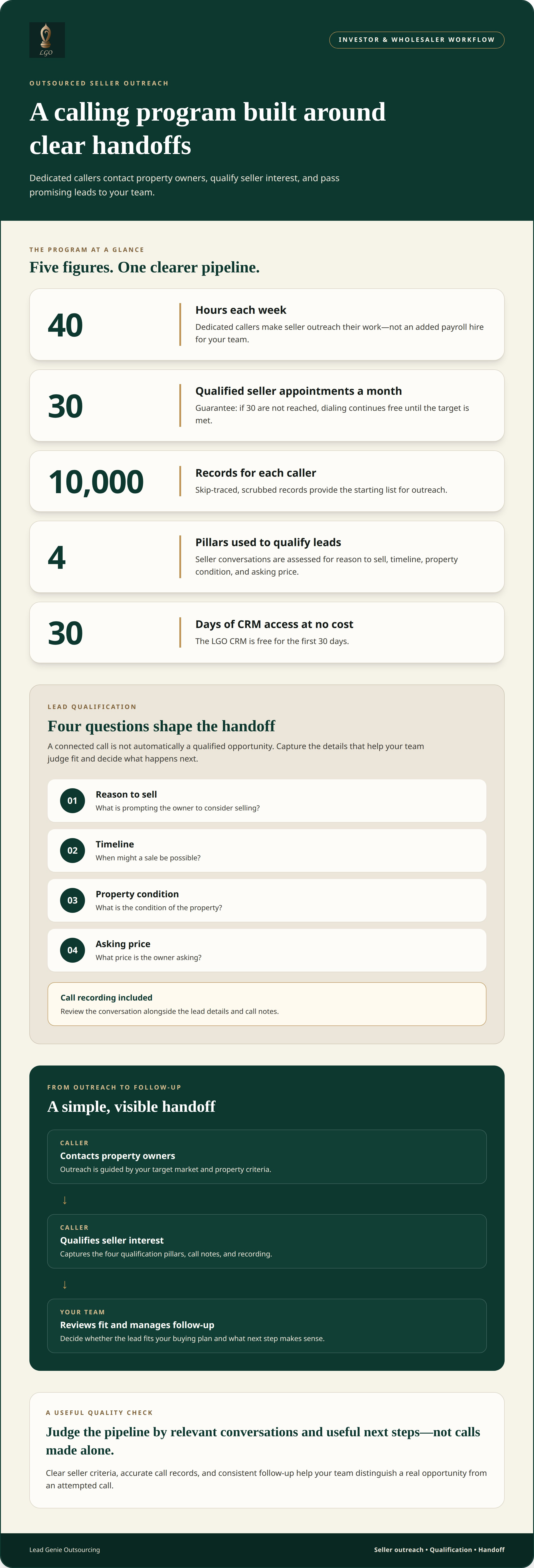
Lead Genie Outsourcing helps real estate investors and wholesalers build seller conversations without hiring an in-house caller. Dedicated callers make calls 40 hours a week, using records prepared for real estate outreach. Each caller gets 10,000 skip-traced, scrubbed records.
Leads are qualified on four pillars: reason to sell, timeline, condition, and asking price. Call recordings let you review the conversation behind each lead. The guarantee is 30 qualified seller appointments a month, or Lead Genie Outsourcing keeps dialing free until it reaches 30. The LGO CRM is free for 30 days, giving you a place to manage lead activity.
If you want professional calling support without adding a caller to payroll, book a free 30-minute call with Lead Genie Outsourcing.
Build Your Next Seller Conversation
Make your next move about capacity. Decide which seller conversations need your attention, then choose how outreach should fit around that priority. Real estate cold calling without hiring can work when you want dedicated callers handling outreach while you focus on acquisition decisions. The right setup keeps lead information visible and gives your team a clear handoff.
Lead Genie Outsourcing provides cold calling for real estate wholesalers and investors, along with the LGO CRM. That gives you a path to add calling support while keeping lead activity organized in a CRM. Choose the support that matches your workflow and the seller pipeline you want to build.
Ready to discuss your calling needs? Book a free 30-minute call with Lead Genie Outsourcing.
Frequently Asked Questions
How can real estate agents get cold calling support without hiring in-house callers?
Agents can outsource seller outreach to a professional calling service. Callers handle prospect conversations, while agents focus on evaluating opportunities and deciding which sellers need direct follow-up. Before outreach starts, define the target property profile, campaign goal, and what counts as a useful handoff. That structure ties outsourced calling to the agent’s pipeline instead of generating activity without a clear next step.
Where can agents find real estate seller and buyer leads for cold calling?
Seller calls begin with property-owner records selected to match the campaign, such as owners of FSBO or expired listings. Buyer contacts serve a different purpose, so keep them in a separate list and track their purchase criteria and preferred property types. A seller-focused call campaign is built to identify owners who may sell; it isn’t a buyer-lead source. Keep each list tied to its intended audience and follow-up.
What should a professional real estate cold caller say when calling FSBO and expired listings?
For a FSBO owner, callers can identify the property and ask whether the owner is still handling the sale. For an expired listing, they can mention the prior listing and ask whether selling remains a goal. For example: “Are you still considering selling the property?” Keep the opening factual and brief. If the owner declines, acknowledge the answer instead of pushing for a meeting or making claims about the property.
How does a real estate cold calling service track leads and follow-ups?
A calling service records each call outcome, relevant owner responses, and any agreed next action in a CRM or lead-tracking system. For example, a note can distinguish “requested a callback” from “not interested,” then assign the follow-up to the right person. Reviewing records by campaign source helps the team spot weak-fit lists and missed handoffs. Call recordings can add context when a lead note needs clarification.
How does DIY real estate cold calling compare with hiring a virtual assistant or call service?
DIY calling gives you direct control, but you also handle dialing, call notes, and follow-up alongside acquisition work. A virtual assistant can take on assigned outreach tasks, while a calling service focuses on seller conversations and lead handoffs. The practical difference is who owns daily execution and quality review. Choose the setup that fits your available time, desired oversight, and need for a consistent process.