

A seller can sound motivated and still be a poor fit. What makes a qualified seller lead is a genuine willingness to sell, a property that fits your buy box, and enough information to assess whether the opportunity is worth pursuing. You also need to know who can approve the sale, the property’s condition, the seller’s price expectations, and their preferred timing.
That’s the difference between a name in your CRM and a lead ready for a useful sales conversation. Interest alone doesn’t show whether the seller’s timeline, price expectations, or decision authority align with your next step. A clear qualification standard helps your team assess those signals consistently instead of treating every conversation as equally urgent.
This article explains how lead qualification works for real estate investors and wholesalers. You’ll learn how to assess seller fit, intent, decision authority, and readiness, and how frameworks such as BANT can help structure the conversation. The goal is to focus on leads with a credible path forward and give every other lead a clear next step.
Key Takeaways
- Separate a lead’s fit from their level of engagement so activity alone doesn’t drive your sales priorities.
- Use consistent scoring criteria to help callers and managers assign leads the same next step.
- Apply qualification frameworks as prompts for a better conversation, not as a substitute for judgment.
- Capture the seller details that help your team assess readiness and decide what follow-up makes sense.
- Track what happens after qualification to spot gaps between initial contact, appointments, and offers.
What Is Lead Qualification and How Does It Work?
Lead qualification sorts seller conversations by fit, intent, and readiness for a useful next step. For investors and wholesalers, that means assessing the seller and property before deciding how to prioritize follow-up.
Qualified and Unqualified Leads
A qualified lead meets your criteria for a meaningful sales conversation; an unqualified lead doesn’t yet show enough fit or intent. This distinction helps teams focus on opportunities that may move forward. A seller lead involves an owner considering a sale, while a buyer lead involves someone seeking to purchase property. The two have different needs and next steps.
A seller who wants to sell but lacks clear authority to approve the sale may need more discovery. An owner who explains a reason for selling and agrees to discuss timing gives your team more to assess. Qualification isn’t a promise of a deal. It’s a reasoned decision about whether to act, gather details, or follow up later.
Marketing and Sales Qualification
A marketing-qualified lead has engaged with marketing but may not be ready for a sales conversation. Someone might submit a form, respond to an advertisement, or ask for information without sharing a clear selling plan. That signal can justify follow-up, but it doesn’t prove the person will sell.
A sales-qualified lead has been contacted and assessed by a sales representative. The conversation directly tests fit and intent instead of relying only on clicks or form activity. Marketing can attract interest, while sales confirms readiness. Teams can then assign a clear next step, such as a sales call, further discovery, or later follow-up.
Seller leads can come from direct outreach, referrals, and inbound marketing. Qualification begins when a real conversation establishes the owner’s situation, not when a name first enters a campaign.
Records, Raw Leads, and Qualified Leads
A list record is contact or property information assembled for outreach. A raw lead has been contacted or shown interest but hasn’t been assessed. A qualified lead has passed defined checks that support a specific sales action. Keeping these stages separate prevents a database entry from being mistaken for seller intent.
Confirm the person’s name and preferred contact details during a conversation. Check property details against reliable records, then ask the owner to clarify any differences. Note the source, confirmation date, and outstanding questions in your CRM. For TCPA and Do Not Call questions, consult a qualified attorney before outreach; requirements can depend on the campaign and contact method.
Seller Lead Qualification Tests
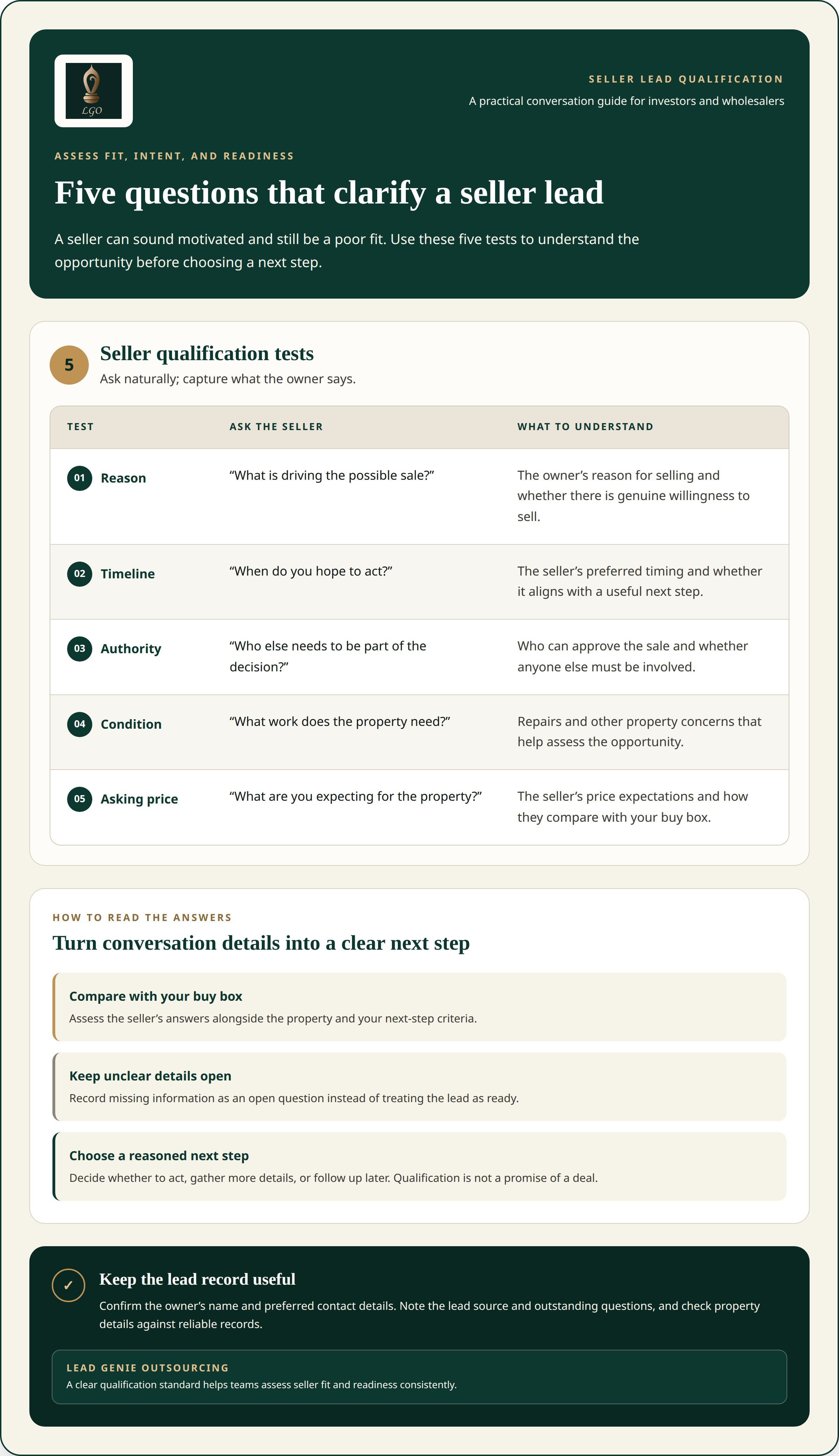
Use five tests to assess a seller conversation: reason, timeline, authority, condition, and asking price. Ask what is driving the possible sale and when the owner hopes to act. Confirm who must approve the decision. Ask about repairs or other property concerns, then clarify the seller’s price expectations.
These questions should feel like a conversation, not a checklist. “Who else needs to be part of the decision?” tests authority, while “What work does the property need?” reveals condition. Compare the answers with your buy box and next-step criteria. If a key detail is unclear, record it as an open question rather than treating the lead as ready.
Firmographic and behavioral lead scoring
Lead scoring organizes seller information into a consistent priority signal. Combine explicit fit factors with observed actions, then use the score to decide which conversation needs attention first.
Lead Scoring and Qualification
Lead scoring assigns values to details and actions; lead qualification checks whether the seller and opportunity meet your criteria. A score can help sort a pipeline, but it can’t confirm intent or replace a conversation. For example, a property in your target area may score well for location, while the owner’s answers show no current interest in selling.
Set a threshold to flag leads for sales review, not to declare a deal ready. A caller or acquisitions representative should still confirm the facts behind the score.
Explicit Scoring Criteria
Explicit criteria are facts the seller or property record provides, such as location, property type, ownership, and price expectations. These details show whether the lead fits your target market. In a general scoring example, a target industry receives 20 points, while an industry outside the ideal profile loses 20 points. Treat those as example values, not real estate scoring standards.
For a seller pipeline, define which locations and property types fit your buy box. Then record the owner’s decision authority and stated price expectations. Apply the same criteria to every lead so callers don’t score identical facts differently.
Behavioral Scoring Criteria
Behavioral criteria measure actions that show engagement, such as replying to outreach, requesting a call, or agreeing to a follow-up. A general lead-scoring example assigns 15 points to a pricing-page visit. For seller outreach, a direct response or a specific request to discuss a property gives stronger evidence than passive activity.
Record what happened, not what you assume it means. A reply may justify another conversation, but it doesn’t prove the owner is ready to sell or that the property fits.
Negative scoring lowers a lead’s priority when new information weakens its fit. An owner outside your target area, a property type you don’t pursue, or a clear lack of selling interest may warrant fewer points or disqualification. Keep these outcomes distinct: a low score may call for nurturing or later follow-up, while disqualification means the lead fails a stated requirement.
Review positive and negative signals together. A strong location match shouldn’t erase a mismatch in property type, and repeated engagement shouldn’t override a clear lack of authority to approve a sale. Record why scores change so the next person can see the reasoning behind the team’s decision.
For a practical seller-focused framework, compare your scoring fields with the four pillars of a motivated seller lead. Keep the scoring rules tied to facts your team can capture, then adjust them when sales conversations show that a signal isn’t helping identify suitable opportunities.
Sales-qualified lead definition and fit criteria
A qualified lead meets criteria that justify a sales conversation. For a real estate team, qualification combines seller intent, decision authority, property fit, and a workable next step.
Evidence-Based Qualification
Evidence-based qualification uses information from seller conversations and property details to determine whether a lead fits your buying criteria. It matters because a name or click alone can’t show whether an owner is prepared to discuss a sale.
Apply the same criteria to every conversation. Record the seller’s reason for considering a sale, preferred timeline, and who must approve the decision. Then compare those answers with the property’s location, condition, and price expectations. If the seller says a family member must agree, record that approval as an open step before scheduling an appointment.
Evidence from past customers and deals can also help refine your criteria. Review completed transactions and stalled opportunities, then identify which details helped predict a useful sales conversation. If a particular property type repeatedly falls outside your buy box, for example, include that mismatch in your screening rules. Base the rule on observed outcomes, not assumptions about every seller.
Qualified Lead Definitions
A qualified lead has enough fit and intent to warrant a defined sales action. Marketing-qualified leads, or MQLs, have engaged with marketing but may not be ready to discuss a sale. Sales-qualified leads, or SQLs, have been contacted and assessed by a sales representative. This distinction separates marketing activity from confirmed sales readiness.
A product-qualified lead, or PQL, usually refers to someone whose use of a product signals possible interest in buying it. That label has less relevance in a property-selling pipeline unless the business uses a product to qualify owners. A service-qualified lead, or Service-QL, has expressed interest through a service interaction, such as asking for help with a property-related need. Define each label before using it in your CRM.
For an SQL, document the evidence behind the status: the seller’s stated reason, timeline, authority, property details, asking price, and agreed next step. A form submission alone doesn’t establish these facts. Clear definitions help callers and acquisitions staff assign the same stage to similar conversations.
Seller Fit and Property Factors
Ownership, equity, and condition affect whether a seller and property fit your acquisition criteria. Confirm who owns the property and identify everyone whose approval is needed. If the person on the call can’t authorize a sale alone, record who else must join the discussion and what remains unresolved.
Equity can affect the seller’s options and price flexibility, but it doesn’t prove intent. Ask about the seller’s expectations and any relevant loan or payoff details they choose to share. Compare the asking price with your deal criteria; don’t treat the owner’s estimate as a property valuation.
Condition affects potential repair work and the numbers behind an offer. Ask about visible issues such as the roof or HVAC, foundation concerns, water damage, and electrical or plumbing problems. Record the seller’s answers, distinguishing reported issues from details that still need review. Ownership, equity context, and condition together help determine whether the lead merits an appointment, more discovery, or another follow-up action.
BANT, CHAMP, and MEDDICC frameworks
Qualification frameworks give teams shared prompts for assessing sales conversations. For real estate sellers, adapt each framework to the owner, property, and next step.
BANT: Budget, Authority, Need, and Timing
BANT covers budget, authority, need, and timing. In a seller conversation, translate “budget” into the owner’s asking price and flexibility. Ask who can approve a sale, what need is driving it, and when the seller hopes to act.
BANT works best when you consider the answers together. A seller may have a clear need but expect a price outside your acquisition criteria. Another owner may be open to selling but lack agreement from a co-owner. Record each factor separately, then decide whether to schedule an appointment, continue discovery, or follow up later.
CHAMP: Challenges, Authority, Money, and Prioritization
CHAMP starts with the seller’s challenge, then considers authority, money, and priority. Ask what problem a sale would solve. Clarify who needs to agree, what price the owner expects, and how selling ranks against other plans.
This order can make a call feel less like an interrogation. Start with the owner’s situation, then ask about approval and price in context. An inherited property, for example, may create a management burden, but several heirs could need to agree. That detail changes the follow-up, even if the owner sounds motivated.
MEDDICC: A Deeper Deal Review
MEDDICC stands for Metrics, Economic Buyer, Decision Criteria, Decision Process, Identify Pain, Champion, and Competition. It was built for complex sales, so wholesalers should adapt it rather than force every field into a seller call.
Use its elements to clarify the owner’s desired outcome, decision-maker, sale criteria, and approval process. “Competition” can prompt a neutral question about other options the seller is considering, such as listing the property or keeping it. A trusted contact who supports a sale may act as a champion, but doesn’t replace the owner’s authority.
Choose a Framework That Fits the Funnel
No single framework fits every lead. BANT offers a quick screen; CHAMP helps uncover the seller’s reasons and priorities; MEDDICC supports a deeper review when multiple decision-makers or steps are involved. Use the same core definitions across callers, even when the conversation prompts vary.
A first call, for example, can capture the owner’s challenge, authority, price expectations, and timeline. A later acquisition conversation can clarify decision criteria and unresolved concerns. Use the framework in your CRM as a set of prompts, not a pass-or-fail script. The seller’s natural answers matter more than completing every field.
Good cold calling supports this process by creating real conversations to assess, rather than treating every record as sales-ready. The real estate cold calling guide covers how outreach fits into seller lead generation.
What criteria indicate a homeowner is ready to sell?
A homeowner shows readiness through stated intent, a workable timeline, decision authority, and property details that fit your acquisition criteria. No single signal proves readiness. A clear reason to sell, paired with a specific next step, gives your team stronger evidence than general interest alone.
Start with the seller’s reason. A move, inherited property, costly repairs, or a change in plans can explain why selling is under consideration. Then ask what the owner wants to happen next. Someone who agrees to discuss options shows more intent than someone who asks for a rough price but avoids follow-up.
The timeline adds context. Ask when the owner hopes to sell and what might affect that date. A firm target can help your team decide whether to schedule an appointment or stay in touch. A seller who needs time to talk with family may still be a fit, but that approval step should be part of the follow-up plan.
Authority matters just as much. Confirm whether the person on the call owns the property and who else must approve a sale. A co-owner, spouse, heir, or other decision-maker can change the process. Record each person’s role, then include everyone whose agreement is needed in the next conversation.
Condition and price help determine whether the property fits your buy box. Ask about repairs, occupancy, and the owner’s asking price. Keep reported details separate from information that still needs review. A seller may be ready to move, but the property’s condition or price expectations can still make the opportunity a poor fit for your acquisition plan.
For example, a property might have 1,451 square feet, and its roof age might be 3 to 10 years. Those details help frame a conversation, but they don’t establish value or confirm a deal. Your team still needs to understand the seller’s expectations, property condition, and decision process.
Use these readiness signals together:
- Reason: The owner can explain why selling is under consideration.
- Timeline: The owner gives a target or explains what must happen first.
- Authority: The people needed to approve the sale are identified.
- Condition: The owner can describe known repairs or property issues.
- Price: The owner states an asking price or expectations for an offer.
A qualified conversation ends with a clear action, such as an acquisition appointment, a request to include another owner, or scheduled follow-up. Record the seller’s answers and the agreed next step. This keeps your pipeline grounded in what the homeowner said, not what the team assumed.
Lead Genie Outsourcing
Lead Genie Outsourcing helps real estate investors and wholesalers turn seller conversations into leads their teams can assess. Its callers qualify each lead on four pillars: reason to sell, timeline, property condition, and asking price. Call recordings give you a way to review the conversation and understand the details behind each lead.
That can help when outreach is taking time away from acquisitions or when your team needs a consistent way to capture seller intent. The LGO CRM is free for 30 days, giving you a place to manage lead information and follow-up.
See how Lead Genie Outsourcing works, then decide whether its calling support fits your pipeline.
Book a free 30-minute call with Lead Genie Outsourcing.
Make Your Qualification Standard Work in the Pipeline
Knowing what makes a qualified seller lead is useful only if your team applies the standard consistently. Turn your criteria into clear CRM stages and agreed next steps. This gives callers, acquisition staff, and managers a shared view of what needs attention instead of relying on individual guesses about readiness.
Build a feedback loop from outcomes. When a lead stalls, record what blocked progress. When an appointment becomes a serious opportunity, note which early details helped your team make that assessment. Review those patterns and adjust your qualification rules when the evidence suggests a better fit standard. Keep any changes clear so the next conversation is handled consistently.
Start with one stage or field that causes confusion. Clarify its definition, apply it across the pipeline, and assess whether it helps the team choose a better next step. A practical standard can evolve as you learn from real seller conversations.
Book a free 30-minute call with Lead Genie Outsourcing and put your next step in motion.
Frequently Asked Questions
What changes when you optimize for qualified leads?
Shift your focus from lead volume to what happens after contact. Compare sources by how often they produce a real conversation, a scheduled appointment, and a viable opportunity. For example, a campaign that brings fewer names but more sellers who fit your buy box may deserve more attention. Track the same stages across campaigns so you can judge pipeline progress, not just the size of a contact list.
What disqualifies a motivated seller lead?
A lead may be disqualified if the owner or property falls outside your acquisition criteria or the contact has no intent to sell. An owner who can’t authorize a sale alone may need a different follow-up, not automatic rejection. A property already listed with a realtor may also fall outside an off-market buyer’s criteria. Record the reason for disqualification so the team can distinguish a poor fit from an unresolved question.
What is BANT and how does it help qualify leads?
BANT stands for budget, authority, need, and timing. In a seller conversation, budget can mean the owner’s price expectations, while authority identifies who can approve a sale. Need explores why selling is under consideration; timing clarifies when the owner may act. Use the framework to guide discovery, not as a script. If the seller’s answers conflict, note what needs clarification before moving the opportunity forward.
What is a qualified seller lead in real estate?
What makes a qualified seller lead is evidence that the owner may sell and that the property fits your acquisition criteria. A homeowner may have a clear reason to move, for example, but expect a price your business can’t pursue. That lead still provides useful information, but it may not belong in the same priority stage as an owner whose expectations and next step align with your process.
How do real estate agents qualify seller leads?
Agents qualify seller leads by confirming the owner’s goals, intended timing, decision-makers, and expectations for the sale. They can also clarify whether the owner is exploring options or wants to discuss a listing. A useful record captures the lead source, the owner’s preferred next contact, and any concerns that could affect the decision. That keeps follow-up relevant instead of sending the same message to every homeowner.
How do motivation, timeline, and urgency affect seller lead qualification?
Motivation explains why an owner is considering a sale; timeline shows when action may be possible. Urgency can help set follow-up priority, but it doesn’t prove the price or property fits your buy box. A seller facing a near-term change may need a prompt conversation, while an owner still weighing options may need a later check-in. Match the next contact to the seller’s stated situation.
What seller lead scoring models and benchmarks do real estate teams use?
Teams can use a points-based model, a framework such as BANT, or simple pipeline stages such as new, contacted, qualified, and follow-up. No single benchmark fits every buy box. Set thresholds using your own lead history, then compare scores with appointments and offers. If high-scoring leads rarely progress, review which signals earned points and adjust the model to reflect actual outcomes.