

A low quote doesn’t tell you whether the calls will produce usable seller conversations. A cold calling service for cash buyers is priced according to the work included, such as caller time, lead qualification, call review, and CRM integration. The price depends on the case and is given after a quote request; the service model and scope shape the quote.
You should be able to judge both the costs and the call quality, not just hear a pitch about call volume. The right fit depends on how much control you need, how leads are qualified, and how call results move into your pipeline.
This guide explains the factors that shape pricing, the differences between human and AI calling, and what to look for in recordings, quality checks, and CRM delivery. Use it to compare providers and choose an approach that fits your team’s workflow.
Key Takeaways
- Compare quotes by what the service includes, not call volume alone. Caller time, qualification, call review, and CRM workflow all affect the value.
- Use recordings and clear lead fields to judge whether seller conversations are useful and ready for follow-up.
- Match the calling model to your operation: human-led, AI-assisted, and automated approaches handle conversations differently.
- Define what counts as a qualified lead before calls begin, including the seller’s reason, timing, property condition, and asking price.
- Choose a setup that fits your pipeline and gives your team a clear next step when a seller is ready to talk.
Call recordings, CRM integration, and quality checks
Call data is useful only when your team can review it and act on it. Recordings, CRM fields, and follow-up steps show whether a call reached the right person and created a clear next step.
Call Recording and CRM Integration
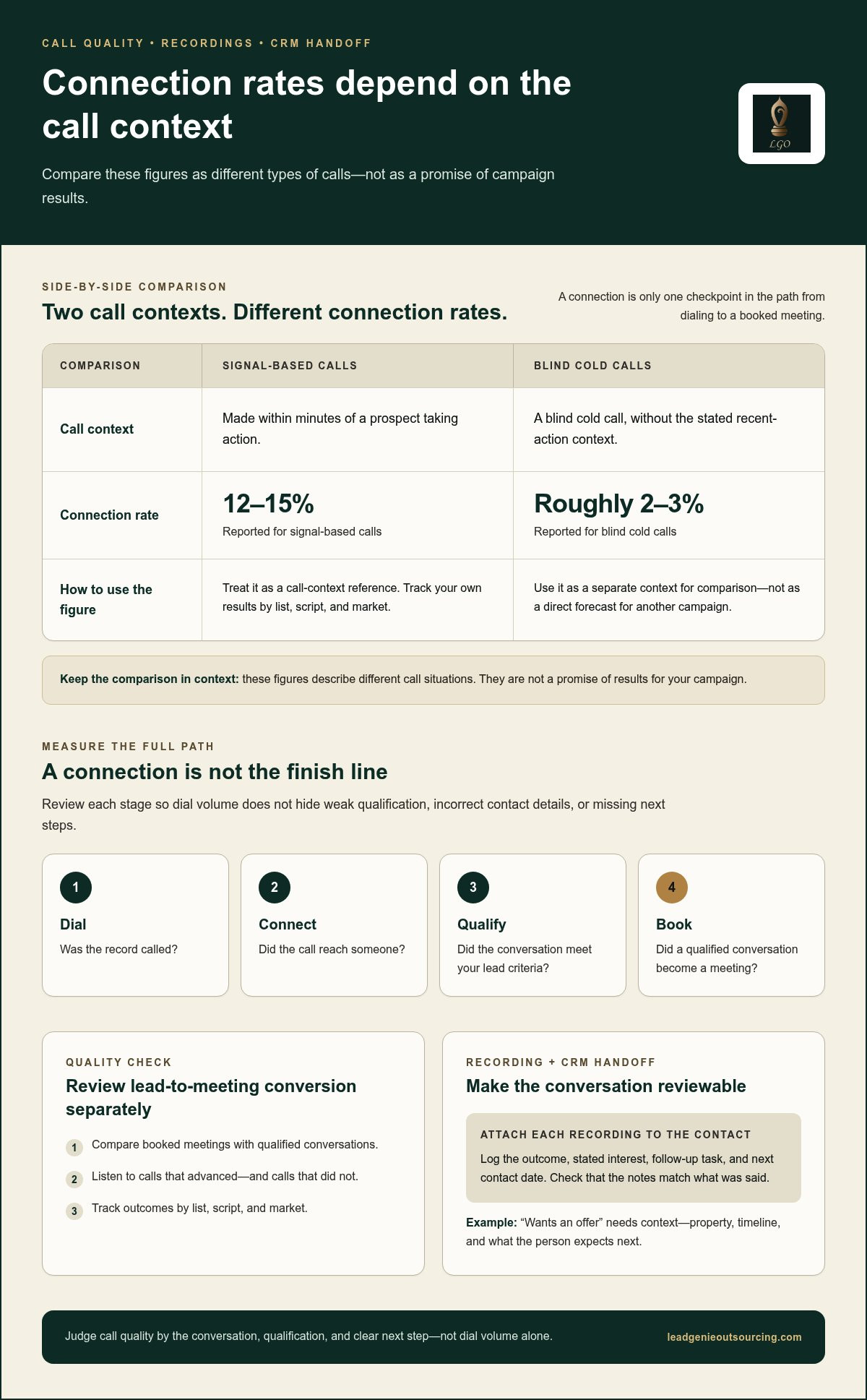
A recording lets you hear the seller’s or buyer’s words, not just read a caller’s summary. In your CRM, connect each recording to the contact and log the outcome, stated interest, follow-up task, and next contact date. Check that the notes match the conversation. For example, “wants an offer” needs context: the property, timeline, and what the person expects next.
Quality Checks and Conversion Rates
Check the path from dial to connection, qualified conversation, and booked meeting. Signal-based calls made within minutes of a prospect taking action have a 12-15% connection rate; blind cold calls connect roughly 2-3% of the time. Treat those figures as different call contexts, not a promise of campaign results. Track your own outcomes by list, script, and market.
Review lead-to-meeting conversion separately. Compare booked meetings with qualified conversations, then listen to calls that did and didn’t advance. High dial volume can hide weak qualification, incorrect contact details, or missing next steps. Lead Genie Outsourcing reviews every call through QA before delivery, and clients receive recordings to assess the conversation and CRM handoff.
Which cold calling services specialize in real estate investors and cash buyers? Look for teams focused on real estate conversations, including Call Box’s real estate calling services. The useful distinction is whether callers can identify investor intent and capture the details your acquisition or buyer team needs.
What scripts and qualification questions work for calling potential cash buyers? Start with a clear reason for the call, then ask about target areas, property types, buying timeline, and deal criteria. For a seller call, ask about the reason for selling, timeline, property condition, and price expectations. Review recordings to confirm callers asked and logged the relevant details.
Do Not Call list scrubbing and calling windows belong in the campaign setup, not as an afterthought. Screen records before dialing, maintain suppression records, and set calling windows for the relevant market. For TCPA and DNC requirements, check with your attorney. This is a risk-control step, not legal advice.
What are the risks of using a cold calling service, and how can you reduce them? Poor data, weak scripts, missed follow-up, and unclear qualification can waste calls or damage your reputation. Set CRM fields, review recordings, and assign an owner to each follow-up. Define how callbacks are routed and logged so your team can respond and track the next step.
How do local real estate markets affect cash buyer calling campaigns? Buyer demand, property types, and deal criteria vary by market. Set targeting and questions around the areas and properties your team pursues, then review outcomes by area. This keeps the script relevant to your market rather than treating every buyer as interchangeable.
Cold calling agency pricing and service models
A quote is useful only when it matches the work you need. Compare caller time, lead handling, contract terms, and billing structure before weighing the likely effect on your pipeline.
Agency and Competitor Pricing
Agency pricing can bundle caller hours, list preparation, training, call review, reporting, or CRM work. A lower quote may cover fewer tasks, while a broader scope may include more support across the calling campaign workflow. Compare the same deliverables across proposals, not just the monthly total.
Large retainer agencies may require contracts lasting 3 to 12 months. Dedicated agents at large retainer agencies may be shared across 3 to 4 clients. Those terms affect access and continuity, so read the service scope alongside the contract length. A short campaign and a long-term pipeline build are different buying decisions.
For a service quote, price depends on the case and is given after a quote request; key factors include caller time, list handling, qualification, review, CRM workflow, and contract terms. Compare those items line by line, then consider whether the model fits your team's capacity. The cold-calling pricing details can help frame that comparison.
Caller Pricing
Caller pricing can be structured around time, dedicated capacity, campaign scope, or a defined appointment outcome. Each model shifts what you pay for. Time-based billing emphasizes hours worked; appointment-based billing requires a clear definition of a qualified appointment and how it gets counted.
Before choosing, write down the caller’s responsibilities. Does the role cover dialing only, or also qualification, follow-up, and CRM notes? Map those tasks to your pipeline. If your team can handle follow-up, paying for it may add little value. If you need call review and a clean handoff, include those in your comparison.
Ask how call volume is planned, what happens when records need replacement, and how reports show completed work. Tie each question to the written scope. If callers record outcomes differently from your team, you may have extra cleanup even when the agreed call time is met.
Finally, separate a guaranteed appointment target from a guaranteed deal. Appointments are a measurable service output; acquisitions still depend on your criteria, seller terms, and follow-up. Put the target, qualification rules, and any make-up dialing terms in writing, so your team can compare offers on the same basis.
Choosing a cold-calling service for a real estate business
Choose based on the work your team needs done, not the service label. Before comparing options, write down the campaign goal, target market, lead criteria, and person responsible for each handoff.
How do cold calling services compare with virtual assistants and lead-generation platforms? A cold calling service handles outbound conversations, while a virtual assistant may take on broader assigned tasks. A lead-generation platform provides tools or contact records, but your staff manages outreach unless calling is included.
Start with the appointment definition. For a seller campaign, decide what makes a conversation worth booking: motivation, timeline, property condition, and price expectations. For a cash-buyer campaign, specify target areas, property types, and purchase criteria. A shared definition keeps callers and your acquisitions team aligned.
Next, map the handoff. Identify who receives each qualified lead, what details they need, and what action comes next. For example, a completed call can create a CRM follow-up task. If your team uses a spreadsheet, agree on the fields before the campaign starts.
Match the calling strategy to your operation. A wholesaler with a defined buyer list may need callers to identify active investors and record their criteria. An investor seeking seller conversations needs a different script and qualification process. Don’t use one script for both audiences without changing the questions and desired outcome.
Check how training and feedback work. Provide the calling team with your script, common objections, and examples of qualified and unqualified conversations. Then set a regular review process: listen to selected recordings, compare notes with your criteria, and update the script if callers repeatedly misunderstand a question.
Review the reporting format before the campaign starts. Ask to see how attempted calls, conversations, outcomes, and appointments are tracked. Make sure each status has a clear definition. “Interested,” for example, should describe an observable response, not a caller’s guess about future intent.
Fit matters in daily operations. If your acquisitions team can take calls and follow up, a calling service can add focused outreach capacity. If you need help with a wider range of office tasks, a virtual assistant may fit better. If your team already has callers, a lead platform may support its existing process.
Match the service to your management capacity, too. Assign an internal owner to answer caller questions, review records, and route appointments. Without that owner, even a clear strategy can stall between the first conversation and the next step in your pipeline.
Human-led, AI-hybrid, and automated AI calling services
The key difference is who handles the live conversation. A human caller can respond to a seller’s answers in real time; an automated system follows a programmed flow. An AI-assisted model combines automated steps with human involvement. Choose based on the conversations your real estate pipeline requires.
Human-led calling suits conversations that require judgment, tone, and follow-up questions. A trained caller can notice when a seller’s stated timeline conflicts with their reason for selling and ask for clarification. Before signing, define the caller’s role, the audience, and what counts as a completed call or qualified appointment.
AI-assisted models can assign routine tasks to software while reserving human attention for selected conversations. For example, automation might organize call outcomes and route interested sellers to a person for further qualification. Make the handoff explicit: decide who receives the conversation and what information they need.
Automated AI calling uses software to conduct the interaction. It may suit a narrow, repeatable task, such as confirming whether someone is open to follow-up. It may be a poor fit when a seller raises an unusual concern or asks about a property detail outside the script. Decide how a person will handle those cases before launch.
Compare models using the same scenario. A seller says the property needs work and asks how quickly a buyer can move. A human caller can explore the answer directly; an AI-assisted workflow can route the question to a person; a fully automated flow may rely on a preset response. The right approach depends on your follow-up plan.
Measure outcomes your team can interpret, not just labels. Define how callers record a completed conversation, a follow-up request, and a booked appointment. Then check whether each model captures the details your acquisitions team needs. A call without a clear next step adds activity, not useful progress.
Keep the contract aligned with the operating model. Specify whether the service includes human review, how callers are trained, how script changes are handled, and who owns follow-up. For a cash-buyer campaign, define which buyer details matter, such as target areas and property types. Clear responsibilities give your team a fair basis for comparison.
How do cold calling services find and qualify real estate cash buyers?
Start with a buyer profile, then build a call list around it. Define target markets, property types, and deal criteria before dialing. A wholesaler seeking buyers for small multifamily deals, for example, needs different questions from an investor targeting single-family homes. Clear criteria help callers separate relevant contacts from general interest.
Some campaigns call real estate agents to identify investors who buy with cash. Callers can ask whether an agent works with active cash buyers, what property types those buyers pursue, and where they’re looking. A useful outcome is a named contact with stated criteria, not an assumption that every investor referred by an agent can close.
Other campaigns call contacts the business has already identified. Organize records by market and the information your team has before outreach. During the call, confirm the person’s role and interest in buying. If someone says they only want land, record that preference rather than sending unrelated house deals.
Qualification should test fit and readiness through direct questions. Ask which areas the buyer targets, what property types they consider, and whether they’re actively reviewing deals. Then ask what details they need before deciding. A buyer with specific location and condition criteria is easier to match than a contact who gives no clear requirements.
Separate stated interest from verified capacity. A caller can record that someone describes themselves as a cash buyer, but that label alone doesn’t prove they have funds or can close. Assign your team a follow-up step to assess readiness through its normal deal process. Keep notes factual: record what the person said, not what the caller assumes.
Use a consistent call flow: explain the reason for the call, confirm the buyer’s market, ask about purchase criteria, and agree on a next step. That might mean getting permission to send a matching deal or scheduling a follow-up conversation. If the person declines, record it clearly so your team doesn’t mistake politeness for active demand.
Keep CRM fields tied to decisions your team makes. Record the market, property type, stated buying interest, deal requirements, and follow-up status. Compare completed calls with those fields. If a caller logs “ready” but the recording shows only general curiosity, clarify the definition and train callers to use the same standard.
Match each buyer to a relevant opportunity before calling again. A buyer seeking properties in one area may not fit a deal elsewhere. Organized criteria, accurate notes, and a clearly assigned follow-up owner make buyer outreach more useful to a wholesaler’s pipeline.
Lead Genie Outsourcing: Cold calling for real estate wholesalers
Lead Genie Outsourcing supports wholesalers and investors who need seller outreach and clear lead handoffs. Dedicated callers work 40 hours a week, using 10,000 skip-traced, scrubbed records per caller. Seller leads are qualified on reason to sell, timeline, condition, and asking price, with call recordings for review.
The service fits teams seeking caller capacity and an organized lead workflow. The LGO CRM is free for 30 days. Lead Genie Outsourcing guarantees 30 qualified seller appointments a month, or keeps dialing free until it reaches 30.
Set the next move for your pipeline
Choose a calling setup your team can manage after each conversation. Decide who owns follow-up, how buyer interest is reviewed, and what makes an opportunity worth pursuing. Clear ownership connects outreach to deal work.
A cold calling service for cash buyers should fit your team’s process, not force a new one. Lead Genie Outsourcing provides cold calling for real estate wholesalers and investors, along with the LGO CRM. Consider whether those services fit the way your team tracks and acts on leads.
Before moving forward, define your target market, buyer criteria, and handoff process. A clear operating plan gives callers and your team the same direction and gives each lead a defined next step.
Frequently Asked Questions
What is a cold calling service for real estate cash buyers?
A cold calling service for cash buyers contacts potential investors or referral sources to identify people looking for real estate deals. Callers can ask about target areas, property types, and purchase criteria, then record responses for follow-up. That information can help a wholesaler match buyers with relevant opportunities. A recorded statement of interest is a starting point, not proof that someone is ready or able to purchase.
How much do cold calling services for cash buyers cost?
Pricing depends on the service model and scope, including caller staffing, list preparation, qualification, call review, and CRM handoff. Compare proposals by what the fee covers and how the provider defines a completed call or qualified appointment. For Lead Genie Outsourcing, pricing depends on the case and is given after a quote request. Ask for the agreed deliverables and billing terms in writing.
What questions should you ask before hiring a cold calling service?
Ask who makes the calls, how the team learns your buyer criteria, and what activity or outcomes the agreement covers. Clarify how records, notes, and recordings reach your workflow and who handles follow-up. Also ask how script changes, caller performance concerns, cancellation, and data access work. For example, decide whether a buyer seeking a different property type qualifies or needs a separate status.
What U.S. laws govern cold calls, Do Not Call lists, and automated calls?
TCPA and Do Not Call rules are important compliance considerations for U.S. campaigns, and automated calls can raise additional legal questions. Requirements may depend on the calling method, recipient, and campaign details. A vendor’s process is not legal clearance. Have your attorney review the campaign, including scripts, lists, calling windows, and opt-out procedures, before outreach begins.
How can you measure the performance and ROI of a cash buyer cold calling campaign?
Track each stage separately: calls, conversations, qualified buyer contacts, follow-ups, deal reviews, and closed transactions. Compare campaign costs with the results your team attributes to those calls. For example, calculate cost per qualified buyer contact alongside cost per closed deal: the first shows outreach efficiency, while the second connects activity with revenue. Apply consistent attribution rules so repeat contacts or unrelated deals don’t distort the comparison.