

The cheaper lead source can still produce the more expensive deal. To compare cold calling and direct mail cost per deal in real estate, divide each channel’s campaign spend by the deals it closes. That is the number that matters, not the cost of a call or mail piece on its own.
Direct mail gives sellers something tangible to keep, while cold calling lets you hear a response and answer questions in real time. Both can reach motivated owners. Both also depend on list quality, follow-up, and how well the message fits the person receiving it.
This comparison breaks down cost per lead and cost per deal, then weighs speed, interaction, personality, and budget. You’ll see what each method asks of your time and cash, where the trade-offs sit, and how to choose a channel that fits the way you want to build your pipeline.
Key Takeaways
- Compare channels by closed deals and total campaign spend, not by the price of one call or mail piece.
- Direct mail can reach owners who may not answer the phone, but response depends on the list and offer.
- Cold calling gives you a chance to hear objections and qualify a seller during the conversation.
- Choose the channel that fits your budget, follow-up capacity, and preferred way of starting seller conversations.
What About Direct Mail?
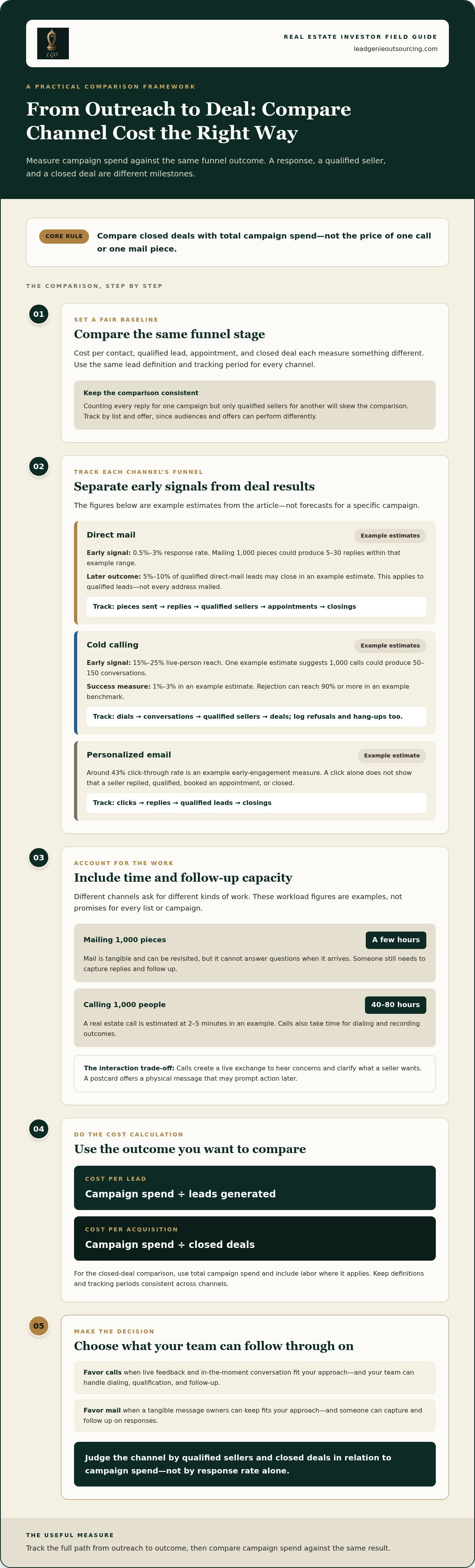
Real estate direct-mail response rates are often estimated between 0.5% and 3%. Treat those figures as example benchmarks, not a forecast for your campaign. For example, if you mail 1,000 pieces and receive responses within that range, you might see 5 to 30 replies. A reply is not automatically a qualified seller lead, an appointment, or a closed deal.
List quality and offer strength shape results. A mailing aimed at absentee owners may perform differently from one sent to a broad list. The offer matters too. A handwritten note can feel personal, but sellers still need a clear reason to respond. Repeated campaigns may also generate a different response pattern than a single mailing.
Deal conversion adds another filter. An example estimate puts closings at 5% to 10% of qualified real estate direct-mail leads. That range applies to qualified leads, not every address that received a postcard. Track pieces mailed, responses, qualified sellers, appointments, and closings as separate stages. This shows whether the drop-off happens before qualification or later in follow-up.
Cold calling has a different funnel. As example estimates, live-person reach may fall between 15% and 25% of dials, and success may range from 1% to 3%. One example estimate suggests 1,000 calls could produce 50 to 150 conversations. Rejection can reach 90% or more in an example benchmark, so log refusals and hang-ups alongside useful conversations. Caller skill and list quality also affect results.
Email offers another comparison, but its metrics measure different actions. An example estimate puts personalized email click-through rates around 43%. A click does not prove that a seller replied, qualified, or booked an appointment. Compare clicks with mail responses and phone conversations only as early engagement signals. Judge all channels by qualified leads and closed deals.
| Option | Example early response signal | Example deal conversion measure | What to track |
|---|---|---|---|
| Direct mail | Example estimate: 0.5% to 3% response rate | Example estimate: 5% to 10% of qualified leads close | Pieces, replies, qualified leads, closings |
| Cold calling | Example estimate: 15% to 25% live-person reach | Example estimate: 1% to 3% success | Dials, conversations, qualified sellers, deals |
| Personalized email | Example estimate: around 43% click-through rate | Clicks alone don’t measure deal conversion | Clicks, replies, qualified leads, closings |
Choose by comparing qualified sellers and closed deals with campaign spend, not by response rate alone.
Real-time interaction and tangible marketing
A cold call creates a live exchange. The investor can explain an offer, hear an owner’s concerns, and respond in the moment. A postcard works on the seller’s schedule. It gives the owner something tangible to keep, but it cannot answer questions or build rapport as soon as it arrives. The practical difference is a conversation now versus a physical message that may prompt action later.
That changes the work required after first contact. On a call, the investor can ask about the property and clarify what the seller wants. With mail, the message needs a clear call to action, such as calling a number or responding online. Someone then needs to capture the response and follow up. Choose a channel based on who will handle those tasks, not just who will send the first message.
Time demands differ too. As an example estimate, preparing and mailing 1,000 pieces might take a few hours. Calling 1,000 people could take 40 to 80 hours, depending on the campaign and contact results. An example estimate puts a real estate call at 2 to 5 minutes. Those figures illustrate workload, not a promise for every list. Calls also take time for dialing and recording outcomes.
Digital marketing offers another comparison. Building SEO content to rank can take 6 to 18 months, as an example timeline. Compare these channels only after defining the same campaign period and what counts as a deal.
Operator size can shape the channel mix. Example operating profiles include solo investors doing 1 to 5 deals per year and established small operators doing 5 to 15. Mid-size operations may do 15 to 50, while large operations may do 50 or more. These are examples, not fixed categories. A solo investor may favor a manageable workflow; a larger team may assign calls, mail, and follow-up separately.
Track each channel from outreach to outcome. For postcards, log pieces sent, responses, qualified sellers, and closings. For calls, record dials, conversations, seller qualifications, and closings. A 3% response rate can be an example of early engagement, but it doesn’t show deal cost by itself. Compare campaign spend with closed deals, and include labor where it applies.
Choose the channel your team can track and follow through on. For an investor who values quick feedback, calls create direct interaction. For one who wants a physical message owners can revisit, postcards provide a tangible touchpoint. The useful measure is whether the channel moves qualified sellers toward a close.
Direct-mail and cold-calling cost per lead
Compare channels at the same funnel stage. Cost per contact, qualified lead, appointment, and closed deal each measure something different.
To compare cold calling vs. direct mail cost per deal in real estate, keep cost definitions and tracking periods consistent.
Cost per Lead and Acquisition
Cost per lead is campaign spend divided by the leads generated. Cost per acquisition uses closed deals as the denominator, capturing the full path from outreach to closing. Keep the lead definition consistent: counting every reply for one campaign and only qualified sellers for another will skew the comparison.
Property type and seller motivation affect the funnel, not the calculation. For example, a campaign aimed at absentee owners may perform differently from one aimed at inherited-property owners. Track qualified leads and closings by list and offer to see which audience moves toward a deal.
Costs per Contact, Lead, and Deal
Contact cost measures spend per person reached. Lead cost measures spend per person who shows interest or meets your qualification standard. Deal cost divides total campaign spend by closed transactions. These measures distinguish reach from seller intent, and seller intent from revenue.
For calls, record dials, live conversations, qualified sellers, appointments, and closings. One example estimate puts the volume needed for a deal at 500 to 1,000 dials. Treat that as a planning illustration, since list quality and seller interest affect results. For mail, track pieces, replies, qualified sellers, appointments, and closings. A reply alone isn’t a closed deal.
Direct Mail Campaign and Response Costs
Postcard size, mailing format, and list costs affect the total.
For an example response-rate range of 0.5% to 3%, mailing 1,000 pieces could produce about 5 to 30 replies. Divide spend by replies for example cost per response, then use qualified leads or closings for later funnel costs. Compare cold calling vs. direct mail cost per deal using closed deals, not early responses.
Market size affects the pool of owners available to contact. Competition can make a broad message less distinctive, while property type and seller motivation influence who responds. Mailing costs also vary with format, postage, and campaign volume. Compare campaigns in the same market and seller segment to see how these factors affect results.
To decide, compare campaign spend with qualified leads and closed deals. Use cost per contact to assess reach, cost per lead to assess seller interest, and cost per acquisition to judge the final result.
Choosing a method based on personality and budget
Choose the channel your team can run consistently. Cold calling suits investors who can handle live conversations, hear “no,” and keep working the list. Direct mail suits operators who prefer writing an offer, choosing a format, and planning follow-up. Neither preference replaces the numbers: track spend, qualified sellers, appointments, and closed deals for each campaign.
Direct mail gives the prospect a physical reminder. A postcard or handwritten letter can stay visible after delivery, while a phone call asks for attention right away. In the research figures, 70% of consumers say direct mail feels more personal than online interactions, and 56% say print marketing is the most trustworthy type. Those perceptions may inform your format, but they don’t show whether a seller will act.
Cold calling puts the call to action into a live exchange. A caller can explain why they’re reaching out, listen to an owner’s concerns, and respond during the conversation. That approach requires persistence and comfort with rejection. Mail requires different skills: a clear offer, a useful message, and follow-up when the prospect responds. Choose based on the work your team will actually complete.
Budget affects the decision. Direct-mail expenses are predictable, but repeated mailings can strain a tight budget. Cold calling puts more of the workload into people and calling time. For either channel, estimate the full campaign cost before launch, including the list, materials, labor, and follow-up. Set a clear point to review results rather than judging a campaign by one reply.
- Choose calls if you can assign a caller to speak with owners, record outcomes, and follow up.
- Choose mail if your team can build a focused list and create letters or postcards with one clear action.
- Use both if your workflow can connect a mailing to later calls without losing track of seller responses.
- Review the funnel by comparing campaign spend with qualified leads, appointments, and closed deals.
- Adjust the message when prospects respond but don’t take the next step, or when the list produces poor-fit sellers.
For a practical test, choose one seller segment, one offer, and one channel. Record each response and its next step, then compare the results with other campaigns. Investors who dislike phone conversations may favor mail, while teams seeking direct feedback may prefer calls. The best fit is the method your budget supports and your team can carry through to a decision.
Cold calling and direct mail costs for real estate investors
Investors compare these channels by cash spend, labor, seller response, and closed deals. A lower cost per contact does not automatically mean a lower cost per deal.
Cold Calling Costs and Rules
Cold calling costs include phone systems, dialing software, and staff time. One estimate puts the volume needed for a deal at 500 to 1,000 dials. Actual results depend on list quality, caller skill, and seller motivation. Track dials, live conversations, qualified sellers, appointments, and closings to find where the numbers shift.
U.S. telemarketing rules, including Do Not Call lists, can limit campaign reach. The Telephone Consumer Protection Act may also apply to calls. Requirements depend on the campaign and contact method, so discuss TCPA and DNC practices with your attorney before dialing.
Direct Mail Costs and Rules
Direct-mail costs include list acquisition, design, printing, postage, and tracking setup. Treat these as factors to account for, not a forecast for your campaign.
Mail costs depend on pieces and format, while calls also use staff time. Direct-mail requirements can vary with the message, list, and campaign details. Review a planned mailing with your attorney, especially when coordinating postcards with calls or other outreach.
That distinction matters for the relationship you want to build. A postcard lets an owner read the message on their own time and keep the phone number. A cold call creates a chance to answer questions immediately, but can also end with a quick hang-up. Either way, a clear call to action gives the seller a next step.
Use the same tracking window for both channels. Record the campaign date, list source, property type, message, seller motivation, and outcome. Then calculate cost per qualified lead and cost per closed deal separately. For mail, count every piece and response. For calls, count attempts and live conversations. This prevents a high contact count from hiding weak deal conversion.
Market conditions change the comparison. A smaller market may offer fewer owners to reach, while strong competition can make a generic message easier to ignore. Mailing costs also rise with repeat touches and selected formats. Caller time depends on dialing volume and conversation length. Compare campaigns within the same market and seller segment before shifting budget.
For a real estate investor, the useful question isn’t which channel sounds cheaper. It’s which campaign turns its full cost into qualified sellers and closings. Test one list and one message, log every appointment, then compare results with the next campaign. Keep calls only if the conversations justify the time; keep mail only if responses lead to real seller opportunities.
Lead Genie Outsourcing: Cold calling for real estate wholesalers
Lead Genie Outsourcing handles cold calling for real estate wholesalers and investors who need consistent seller outreach. Dedicated callers make calls 40 hours a week, using 10,000 skip-traced, scrubbed records per caller. The service guarantees 30 qualified seller appointments a month, or dialing continues free until that target is met.
Each lead is qualified on four pillars: reason to sell, timeline, property condition, and asking price. You also receive the call recording, so you can review the conversation and assess the lead yourself. The cold calling process gives you a view of how outreach and lead qualification fit together. The LGO CRM is free for 30 days.
If consistent seller calls fit your plan, book a free 30-minute call with Lead Genie Outsourcing.
Put Your Next Campaign to Work
Your next move is to turn the comparison into a test your team can manage. Set a clear seller segment, choose a message, and decide what counts as a qualified opportunity before outreach starts. That gives you a fair basis for judging cold calling and direct mail cost per deal in real estate, rather than switching channels based on one good response or a quiet week.
Keep the test focused. Change one element at a time, such as the list or call to action, and record what happened. Use the findings to shape the next campaign, strengthen follow-up, and put budget behind the channel that fits your operation.
Lead Genie Outsourcing supports investors and wholesalers with cold calling and the LGO CRM. Talk through your outreach plan in a free 30-minute call and map out a practical next step.
Frequently Asked Questions
Which Method Works Best?
Neither channel wins for every investor; the best fit depends on your team and target sellers. Choose calls if your workflow can handle live conversations and follow-up. Choose mail if a physical message suits your list and offer. For example, compare the same seller segment across campaigns, then judge qualified opportunities and closed deals, not just replies.
What is the average cost per deal for real estate cold calling?
Use your campaign records to calculate cost per deal: add the costs assigned to calls, then divide by closed deals. Include labor, data, dialing tools, and follow-up. A cash-only view and a labor-inclusive view answer different questions, so keep them separate. If a campaign has no closings yet, track cost per qualified lead as an interim measure.
What is the average cost per deal for real estate direct mail?
One estimate places U.S. Your result depends on the list, mailing format, campaign spend, and closings. Track each separately. For example, record spend for a postcard run, then divide by deals attributed to that campaign. Don’t use responses as the denominator when measuring cost per deal.
What are typical cold calling costs per hour, lead, and appointment in real estate?
There isn’t one useful cost for all three stages. For hourly cost, divide caller labor and operating costs by hours worked. For lead cost, divide campaign spend by qualified leads. For appointment cost, divide spend by appointments that meet your criteria. Keep software, data, and labor visible as separate inputs so you can see what drives each figure.
What are real estate cold calling and direct mail conversion rates from contact to closed deal?
Estimates put cold-calling success around 1% to 3%, depending on industry and list quality. For direct mail, an estimate says 5% to 10% of qualified leads close. These figures use different funnel stages, so they aren’t direct equivalents. Track contacts, qualified leads, appointments, and closings separately to calculate conversion using the same starting point for each channel.
How do real estate investors calculate cost per deal, including labor, data, postage, and software?
Add campaign expenses for the period, including caller labor, records, dialing software, design, printing, postage, and follow-up. Divide the total by the closed deals attributed to the campaign. For example, use one spreadsheet row per channel and tag each lead’s source. Allocate shared software costs consistently so one campaign doesn’t appear cheaper just because expenses were left out.
What factors make cold calling or direct mail more effective for real estate lead generation?
List quality, seller motivation, message, and follow-up shape performance. Calls let an investor hear a seller’s needs and respond during the conversation. Mail gives owners a physical piece and a clear way to respond. A focused list and relevant offer matter for either channel. Track outcomes by property type and lead source, then adjust the weakest step in the funnel.
How do cold calling and direct mail cost per deal vary by property type and seller motivation?
Property type and seller motivation can change response and conversion. For example, absentee-owner campaigns may perform differently from campaigns aimed at inherited-property owners. Track qualified leads and closed deals by list and offer, then divide campaign spend by closings to compare cost per deal.