

Follow-up isn’t about calling until a seller gives in. It’s about finding out whether the property and timing fit, then agreeing on a clear next step. To improve motivated seller follow up, set a schedule, record each conversation, and make the next contact fit the seller’s preferences.
Consistent follow-up matters, but more touches alone won’t move a deal forward. Give each contact a purpose: answer a question, confirm the seller’s timeline, understand the property’s condition and asking price, or book an appointment when there’s a fit.
This guide covers how to set and track a follow-up schedule, tailor calls, texts, and emails to seller preferences, qualify leads, and agree on the next contact before a conversation ends. Each step should make the conversation useful and clarify what happens next.
Key Takeaways
- Build a follow-up rhythm that gives each contact a clear purpose, then adjust it as the seller’s timeline changes.
- Log what the seller said, the date of each conversation, and the next agreed action so no lead gets lost.
- Ask how sellers prefer to communicate and use that preference to shape future outreach.
- End each call with a clear next contact time, not an open-ended promise to check back later.
- Qualify the seller’s reason, timeline, property condition, and asking price before deciding whether to book an appointment.
Consistent follow-up schedules for calls and direct mail
Use a repeatable schedule as a working plan, not a fixed script. Give each contact a purpose, and adjust when the seller’s response, timing, or preferred channel calls for it.
-
Set Call Goals and Follow-Up Schedules
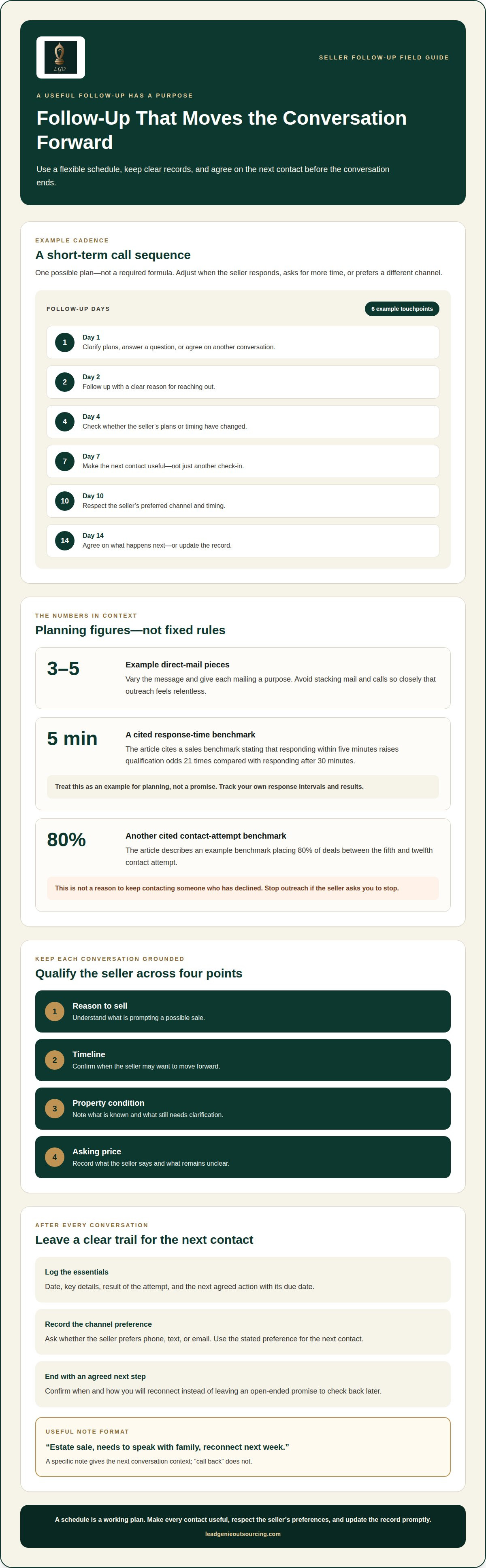
Choose the outcome you want from each call: clarify a seller’s plans, answer a question, or agree on another conversation. As an example, a short-term sequence might include follow-ups on days 1, 2, 4, 7, 10, and 14. That is one possible cadence, not a required formula. Leave room to adjust when a seller responds or asks for more time.
For direct mail, plan a sequence with a clear purpose for each piece. As an example, 3-5 mailings could vary the message rather than repeat the same offer. Use a letter to introduce your interest, then make later pieces relevant to the seller’s likely concerns. Avoid stacking mail and calls so closely that outreach feels relentless.
-
Personalize Contact by Motivation and Timeline
Ask what is prompting the possible sale, then plan follow-up around the answer. A seller handling an estate may need time to coordinate with family, while an owner preparing to move may have a nearer deadline. Personalize your follow-up by referring to the reason they shared, confirming whether the timing has changed, and agreeing on a next contact that fits.
Treat example schedules as flexible guides. A seller expecting to make a decision in a few weeks may welcome a check-in after that discussion; a longer-term prospect may prefer a later reminder. Neither is a rule. Ask before adding someone to ongoing outreach.
-
Adapt Follow-Up to Markets and Responses
Tailor questions and messages to the property and market. A vacant rental may prompt questions about upkeep and occupancy; an inherited home may involve several decision-makers. Local conditions and property needs determine which questions matter and when outreach is useful, so shape the conversation around the specific situation.
If a seller stops responding, give a later contact a different purpose instead of repeating the same message. If they decline, thank them and update the record. Stop outreach if they ask you to stop. For calls and texts to motivated sellers in the United States, legal requirements depend on the outreach and circumstances. Consult a qualified attorney about your obligations.
Tracking contacts and next steps in a CRM or spreadsheet
Track seller activity in a CRM or spreadsheet that makes the next step easy to see. Dated records help your team follow conversations, compare lead sources, and spot delays before they become missed opportunities.
-
Record Conversations and Promised Follow-Ups
After each seller conversation, record the date, key details, and agreed action with its due date. Note the seller’s reason for considering a sale, timeline, and asking price so the next caller has context. For example, “estate sale, needs to speak with family, reconnect next week” is more useful than “call back.”
Record the result of each attempt, such as reached, message left, appointment set, or declined. Add promised tasks, such as sending property information, and mark them complete when done. A spreadsheet can track the property, source, notes, status, and next action; a CRM can also organize leads and assign team tasks. Update records promptly instead of reconstructing the history from memory.
-
Review Conversion and Response Benchmarks
Track response time and contact outcomes so you can see where leads slow down. As an example, a cited sales benchmark says responding within five minutes raises qualification odds 21 times compared with responding after 30 minutes. Treat that figure as an example for planning, not a promise for your campaign. Track your own response intervals and results instead of assuming every market behaves alike.
Another example benchmark places 80% of deals between the fifth and twelfth contact attempt. Use it as a reminder to review the full follow-up path, not as a reason to keep contacting someone who has declined. What follow-up conversion rates and response-time benchmarks are typical in real estate investing? Results vary by source, lead fit, and seller situation. Measure your own path from inquiry to conversation and appointment to find useful patterns.
-
Track Lead Sources and Deal Signals
Use a consistent source label for each campaign or channel. Avoid splitting one source among labels such as “mail,” “postcard,” and “direct mail,” which makes comparisons harder. Review conversations, appointments, and deals by source to see which efforts find sellers who fit your criteria.
Use conversation notes to flag points that need follow-up. If the asking price seems high for the property’s condition, record what the seller said and what remains unclear. Separate facts from assumptions, then set a dated task to revisit the open question. This helps an investor assess whether a lead merits more attention and gives the next conversation a clear starting point.
Adapting outreach to prospects’ communication preferences
Ask each seller which channel works best, then tailor your next message to their situation. Phone, text, and email scripts work best when they sound personal, give a clear reason to respond, and respect the seller’s choice.
-
Identify Prospects’ Communication Preferences
Ask, “Would you rather talk by phone, text, or email?” Record the answer and use that channel next time. Some sellers accept texts but rarely answer calls; others prefer a call to discuss selling details. Don’t assume one preference applies to everyone or switch channels just to get a response.
If a seller shares another contact method, note it as a backup. A seller may lose cellphone service or be away from the property, so an agreed alternative can keep an important conversation moving. Use it only if it fits the seller’s stated preferences.
-
Choose Scripts for Phone, Text, and Email
Keep scripts brief and connected to the last conversation. On a call, try: “You mentioned the property needs work. Has anything changed with your plans to sell?” This invites a useful conversation without pushing for a decision. Listen, then ask a follow-up question that fits the seller’s situation.
For a text, try a brief, direct prompt: “Hi, this is Alex. You asked me to check in about the property. Is selling still something you’re considering?” Identify yourself, provide context, and make it easy to reply. Avoid packing several questions into one message.
For email, use a clear subject and one useful point. For example, use “Checking in about your property” as the subject, then write, “You mentioned a possible move. Has your timeline changed?” End with a simple next step, such as asking whether a call would help. Scripts should guide the conversation without making every seller sound the same.
- Vary the reason for each contact. When a campaign includes several touches, change the message’s purpose. One contact might confirm the seller’s plans; another might ask whether the property condition or timing has changed. A useful question builds rapport better than repeating, “Are you ready to sell?”
Share information only when it addresses the seller’s stated concern. If they ask about handling an estate property, keep the next message focused on that situation. Don’t send generic material that ignores what they told you.
- Follow the seller’s response. If a seller replies by text, answer there unless they ask to switch to a call. If they aren’t ready, acknowledge that and ask whether they’d welcome a future check-in. If they ask you to stop, stop contacting them.
Review which messages lead to useful replies, not just which get opened. Keep the wording natural, the request clear, and every channel aligned with the seller’s preference.
Agreeing on the next contact before ending the first call
Before ending the first seller call, agree on a clear next step. Confirm the contact method, the reason for reconnecting, and a time that works for the seller. A defined plan prevents vague promises from becoming missed follow-ups.
- Ask before planning another contact. Try, “Would it help if I called after you’ve reviewed the property details?” Then let the seller suggest a suitable time. Don’t assume they want another call just because they answered the first one.
- Tie the timing to the seller’s situation. If they need to discuss an estate with family, ask when that conversation may happen. If they’re waiting for a repair estimate, agree to reconnect after they receive it. The next contact should support a decision or address an open question, not create urgency.
- State the channel and purpose clearly. For example, “I’ll call Tuesday to hear what you decided about the repairs,” or, “I’ll email the property details today.” A brief thank-you can confirm the agreed task. If a check-in soon after a promised action makes sense, one to two days is an example, not a rule. Follow the timing the seller requests.
- Repeat the plan to make sure you heard it correctly. Summarize the contact date, channel, and reason, then invite corrections. For example: “I’ll text Thursday afternoon, and we’ll talk about your timing. Does that work?” This lets the seller adjust the plan before the call ends.
- Close without pressure. A property sale can carry emotional weight, particularly during a family change or estate matter. A planned check-in is not a commitment to sell. Keep your tone calm and focus on the agreed conversation so the seller knows what to expect without feeling pushed.
- Record the agreement while the call is fresh. Note the preferred channel, contact time, promised action, and reason for reconnecting. Add the task to the lead record or calendar before moving on. If the seller changes the plan, update the record so future outreach follows their latest instructions.
- Use scripts as prompts, not fixed lines. A good close reflects the seller’s last point and names one clear next action. If they can’t choose a date, ask when they’d prefer to hear from you rather than deciding for them. If they decline further contact, respect their answer and don’t schedule another call.
Seller qualification and appointment booking
Qualify the seller before booking time with an investor. Understand their motivation, timeline, the property’s condition, and their price expectations, then set an appointment when the conversation supports it.
- Ask open-ended questions before deciding whether a lead is ready. Try, “What has you thinking about selling?” Listen for a specific reason, such as an estate, a move, or a property that needs work, then ask what the seller hopes will happen next. Don’t treat a vague answer or request for information as proof of immediate intent.
- Clarify the timeline with a direct follow-up question: “When would you ideally like to be done with the property?” If the seller wants to move quickly, offer an appointment promptly. If they’re considering a later sale, agree on follow-up that fits their plans rather than forcing an appointment.
- Ask about the property’s condition and the seller’s price expectations before assessing fit. Invite them to describe repairs, upkeep, or other concerns in their own words. Then ask what price they have in mind and how they arrived at it. An investor can use those details to decide whether a closer review makes sense, without treating the initial figure as a settled contract term.
- Ask what else could affect the seller’s decision. Find out whether anyone else needs to weigh in, whether they’re considering another offer, and what would make a sale workable. If they mention a competing offer, ask about its amount, timing, and contingencies. Keep questions neutral. The goal is to understand the decision, not pressure the seller or make claims about an offer you haven’t seen.
- Book an appointment when the seller has a clear reason, an understood timeline, and is willing to discuss the property. Explain the purpose and format, then confirm who will attend and what the seller wants to cover. For example: “Let’s meet to review the repairs and talk through your timing.” An appointment doesn’t mean the seller has agreed to sell.
- Keep the qualification notes useful for the next conversation. Record the seller’s own words about reason, timeline, condition, and asking price. Separate facts from assumptions, and flag unanswered questions for the appointment. A four-part seller qualification framework can help keep those details organized.
- Review marketing performance by lead source and appointment outcome. If a campaign starts conversations but few sellers have a workable timeline, adjust the targeting or call questions. If a seller isn’t ready, agree on a relevant next step instead of labeling the lead a failure. Better qualification helps investors use appointment time for conversations with a clear purpose.
Lead Genie Outsourcing
Lead Genie Outsourcing can take on the calling and lead qualification work when consistent seller follow-up is difficult to manage in-house. Dedicated callers work 40 hours a week, and each caller receives 10,000 skip-traced, scrubbed records. Seller leads are qualified on reason to sell, timeline, condition, and asking price, with a call recording for review. The LGO CRM is free for 30 days, giving you a place to manage lead flow and next steps.
If you want a steady process for seller conversations and appointments, book a free 30-minute call with Lead Genie Outsourcing to discuss your follow-up needs.
Put Your Follow-Up Process to Work
A schedule is useful only if it holds up during a busy week. Build a process your team can maintain, with clear ownership of each seller conversation and a next action that doesn’t rely on memory. Review what moves leads forward and adjust the workflow as seller needs or team capacity change.
If you want help keeping seller outreach moving, cold calling for real estate investors and wholesalers, along with the LGO CRM, can support your follow-up process. A focused conversation can help you decide whether that support fits your current needs.
Take the next step to improve motivated seller follow up with a process built around steady outreach and clear handoffs. Choose a time for your free 30-minute call with Lead Genie Outsourcing. Start with the follow-up gap that costs your team the most time, then make a practical plan to address it.
Frequently Asked Questions
What Is The Goal Of Follow Up?
The goal is to determine whether the seller’s needs, property, and timing could fit a real estate purchase, then agree on a useful next step. Use each contact to resolve an open question, such as who else is involved, what would make a sale workable, or whether circumstances have changed. This keeps follow-up focused on the seller’s decision, not simply on keeping a lead active.
What is an effective follow-up cadence for motivated seller leads?
An effective cadence follows the seller’s urgency and preferred channel, with a purpose for every contact. If a seller is awaiting a family decision, schedule the next conversation around it. If they’re ready to discuss terms, move toward an appointment instead of adding routine check-ins. Review replies after each contact, adjust as circumstances change, and stop outreach if the seller asks you to stop.
How soon should you contact a motivated seller after their first inquiry?
Respond as soon as your team can, with under 60 seconds as a practical target example. The first reply should identify you, acknowledge the property inquiry, and ask whether now is a good time to talk. If the seller can’t speak, offer a specific callback window and record it. The aim is to make a live conversation easy, not to launch a string of unanswered messages.
Which CRM tools and automation systems help manage motivated seller follow-up?
Use a CRM or spreadsheet that makes ownership and pending tasks easy to see. Link each seller record to contact history, lead source, status, and next action. Reminders can flag overdue calls, and templates can clarify routine messages. Assign someone to review replies and update records; automation should support the conversation, not ignore the seller’s stated preferences.
How can real estate investors track and improve motivated seller follow-up performance?
Set a baseline, then review where leads stall. Track conversations, appointments booked and held, and why sellers aren’t ready. Compare similar lead sources and time periods so one campaign doesn’t distort another’s results. Change one part of the process at a time, such as the opening question or task handoff. This makes it easier to identify which adjustments improve follow-through and which need more review.