

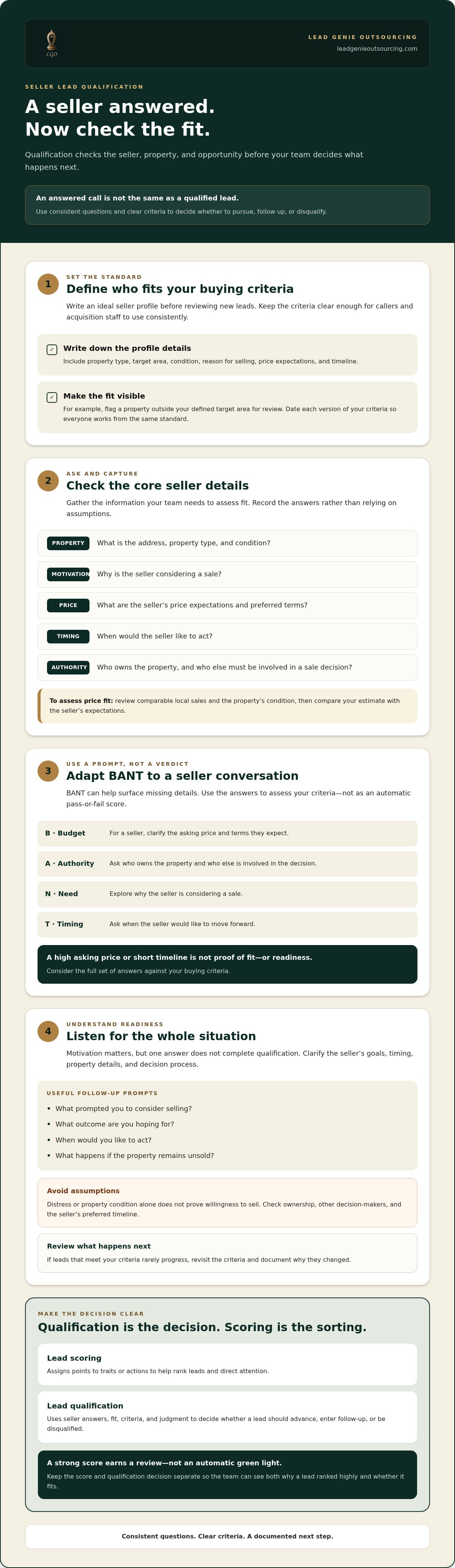
A lead isn’t qualified just because a seller answered the phone. A seller lead qualification process checks whether the owner has a reason to sell, a workable timeline, a property condition you can assess, and price expectations worth discussing. Those answers help you choose the next step: pursue the opportunity, follow up later, or move on.
That distinction matters. Lead scoring ranks leads using points; qualification uses fit, seller answers, and judgment to decide which ones deserve action. A clear process also keeps marketing, callers, and acquisition staff aligned on who asks the questions and who takes the next step.
This guide explains how to build that process, why it protects your team’s time, and how to use frameworks such as BANT, CHAMP, MEDDIC, and GPCTBA/C&I without forcing a complex sales model onto a seller conversation. You’ll also learn how CRM records can capture answers, track follow-up, and make lead status visible so promising conversations don’t get lost.
Key Takeaways
- Build qualification criteria around the seller and property types your business can actually pursue.
- Use scores to sort leads, then apply clear criteria and judgment before committing time to a conversation.
- Set handoff rules so callers, marketing, and acquisition staff know who owns each next step.
- Choose a qualification framework that fits the deal’s complexity instead of adding process for its own sake.
- Use CRM fields and follow-up tasks to keep seller details, lead status, and next actions visible.
Why does lead qualification matter?
A clear qualification process helps investor teams focus on sellers who fit their buying criteria. Define your target, ask consistent questions, and record why each lead advances or needs follow-up.
-
Define Ideal Seller Profiles and Criteria
Write an ideal seller profile before reviewing new leads. Include property type, target area, condition, the seller’s reason for selling, price expectations, and timeline. For example, a team buying single-family homes in a defined market should flag properties outside that area for review. Date each version of the criteria so callers and acquisition staff work from the same standard. Qualification requirements can vary with state or local real estate rules. Use your criteria as an operating guide and consult an attorney about jurisdiction-specific legal questions.
-
Identify Qualification Criteria and Disqualifiers
Choose the information that determines whether a lead advances, needs follow-up, or is disqualified. Ask about the property address and condition, price expectations, reason for selling, timeline, and who can make decisions. To clarify ownership and authority, compare the seller’s account with property records and ask whether anyone else must approve a sale. Review comparable local sales and the property’s condition to estimate value, then compare that estimate with the seller’s price expectations. An intake form should capture contact details, property address, motivation, condition, price expectations, timeline, and decision authority. Disqualify only against clear criteria, not assumptions about the seller’s situation.
-
Apply BANT Screening Criteria
Use BANT as a prompt for Budget, Authority, Need, and Timing. For seller leads, adapt Budget to the asking price and terms the seller expects. Clarify Authority by asking who owns the property and who else is involved. Explore Need by asking why the seller is considering a sale, then clarify Timing with a specific question. BANT can reveal missing details, but it was designed around buyer qualification. Don’t treat a seller’s price as proof of fit or a short timeline as proof of readiness. Use the answers to assess your criteria, not as an automatic pass-or-fail score.
-
Assess Seller Motivation and Readiness
Ask what prompted the seller to consider a sale, what outcome they want, and when they’d like to act. Clarify urgency with a concrete question, such as what happens if the property remains unsold. For distressed or inherited properties, ask about condition, ownership, other decision-makers, and the seller’s preferred timeline. Keep the conversation respectful; distress alone doesn’t prove willingness to sell. Common mistakes include assuming urgency from property condition, overlooking another decision-maker, and treating one answer as complete qualification. Review outcomes regularly: if leads that meet your criteria rarely progress, adjust the criteria and document the reason.
Lead qualification versus lead scoring
Use scoring to sort leads, then qualify them before deciding who advances. A score can guide attention, but it can’t replace a review of seller fit and intent.
-
Distinguish Qualification from Lead Scoring
Separate the two jobs in your pipeline. Lead scoring assigns points for traits or actions; qualification uses criteria and judgment to decide whether a lead should advance, enter follow-up, or be disqualified. For example, a seller who responds quickly might score well for engagement but still fall outside your target market. A high score signals that a lead deserves attention, not that it’s ready to pursue.
Keep the score and qualification decision in separate fields. That way, an acquisition team member can see why a lead ranked highly and whether the seller fits the buying criteria. Use scoring to prioritize review, not to make the final decision on its own.
-
Combine Scoring with Automated Qualification
Automate simple sorting rules, then leave judgment calls to a person. A CRM can add points for captured actions or traits and flag records that meet defined criteria. For a general B2B example, a demo request might add five points, while a consultant job title might subtract twenty. Those values are examples, not a real estate scoring formula.
Set veto conditions alongside the score. A lead that misses a must-have criterion shouldn’t advance just because engagement points raise its total. For an investor team, a veto might flag an out-of-market property or an owner who isn’t authorized to discuss a sale. Route the record for review rather than letting automation hide the mismatch.
- Set a scoring rule for each signal. Choose inputs your team can explain, such as location fit, property type, seller response, or stated timeline. Record whether each signal adds points, removes points, or triggers manual review. Don’t award points for data your team can’t verify or interpret.
Use past pipeline decisions to test whether the model helps. If high-scoring leads rarely move forward, inspect which signals inflated their scores. If qualified sellers score poorly, check whether your criteria overlook useful signs of intent. Change one rule at a time, then compare the next group of decisions.
- Review conversion and override patterns. Track how leads move from initial contact to a substantive seller conversation and later pipeline stages. Review leads that advanced despite low scores and those that stalled despite high ones. These cases show where human judgment helps and where scoring rules need adjustment.
Make overrides accountable. Ask the team member to record the reason, such as a newly clarified timeline or corrected property detail. A clear note prevents one person’s exception from becoming an invisible rule. Revisit scoring criteria during regular pipeline reviews, and make the current version available to everyone handling leads.
Who is responsible for qualifying leads?
Assign each handoff to a person, not a department. Clear ownership keeps engagement signals, seller details, and next actions from falling between marketing and sales.
-
Define Marketing and Sales Qualified Leads
Define marketing-qualified leads (MQLs) and sales-qualified leads (SQLs) separately. An MQL fits the target profile and shows enough engagement to merit sales attention. An SQL has been reviewed and accepted by sales for active pursuit. A team may also mark an account as a marketing-qualified account (MQA) when several people there show fit and engagement.
Write the criteria beside each stage in your CRM. For example, marketing can own initial screening and complete property or contact details, while acquisitions accepts a lead after reviewing the seller’s situation. Avoid treating an MQL as a promise of purchase intent. In one reported B2B benchmark, only 27% of leads sent directly to sales were qualified, showing the cost of unclear handoffs.
- Give marketing the first screening pass. Assign research and intake checks to the person generating or capturing leads. Confirm that the property fits your target market, then record the source, contact details, and known seller information. Marketing can flag gaps or disqualify records that clearly miss agreed criteria. Don’t expect this stage to make the final acquisition decision from incomplete information.
Define what sales needs before accepting a handoff. For example, require a property address, the seller’s stated reason for considering a sale, and a proposed next action. Sales should return incomplete records with a specific missing field, not a vague rejection. That feedback helps marketing improve screening and reduces repeat handoff disputes.
-
Set Seller Lead Response Expectations
Set a response-time target and name the person responsible for new seller inquiries. For online sales leads, firms that contacted a lead within an hour were nearly seven times as likely to qualify it as firms that waited at least an hour longer. Treat this finding as a response-planning benchmark, not a real-estate-specific conversion promise.
Use a written service-level agreement (SLA) to define the handoff, response target, coverage owner, and escalation path. For example, route an unanswered inquiry to a named backup and log the attempt in the CRM. Review missed responses alongside qualification outcomes so the team can identify delays rather than blaming lead quality alone.
- Align distribution with market research. Set lead-routing rules around geography, property type, and team capacity. A market researcher can identify target areas and property segments; the lead owner can then route matching records to the right acquisition staff. If several people handle the same market, make one person accountable for each new lead.
Review the SLA and routing rules during regular pipeline meetings. Compare accepted leads with returned leads and note the reasons for disqualification. Also distinguish seller engagement from basic contact activity. A shared definition of “qualified” gives marketing and sales a common standard for discussion and updates.
BANT, CHAMP, MEDDIC, and GPCTBA/C&I frameworks
Choose a framework to structure discovery, not to force seller conversations into a script. Match its questions to the property, seller, and decision process.
-
Compare BANT, CHAMP, MEDDIC, and GPCTBA/C&I
Start by matching the framework to the conversation. BANT means Budget, Authority, Need, and Timing, and suits straightforward sales with simpler decisions. CHAMP means Challenges, Authority, Money, and Prioritization, putting the seller’s challenge first. MEDDIC covers Metrics, Economic buyer, Decision criteria, Decision process, Identify pain, and Champion. It’s designed for complex, high-value decisions with several stakeholders.
GPCTBA/C&I means Goals, Plans, Challenges, Timeline, Budget, Authority, Consequences and Implications. It supports consultative discovery. FAINT is another named qualification framework, but don’t mix frameworks without defining what each answer means for your team.
- Use BANT for a short first pass. Ask whether the asking price fits your acquisition criteria, who has authority, why the owner may sell, and what timeline they have in mind. BANT gives callers a clear order for these questions. Its limitation is buyer-centric language: seller conversations don’t always map neatly to budget or purchase need.
Translate the framework, don’t force it. Treat “Budget” as the seller’s price expectation, then compare it with your own buying criteria. The seller’s number is information, not proof of fit. Keep “Authority” focused on who can discuss and decide about the property.
-
Explore CHAMP and Challenge-Led Discovery
Lead with CHAMP when the seller’s challenge matters more than opening with price. Ask what has made the property difficult to keep, what outcome the owner wants, and how the issue affects their timeline. Then identify everyone involved in the decision. Don’t assume distress means immediate interest or that a stated problem guarantees a purchase.
Challenge-led discovery helps uncover context before discussing terms. A property owner might mention repairs, vacancies, or a change in plans. Record the seller’s own words, then ask what they want to happen next. Keep the discussion respectful and don’t turn personal hardship into a pressure tactic.
- Reserve MEDDIC and GPCTBA/C&I for added complexity. MEDDIC can help map several decision-makers, decision criteria, and the process for moving forward. For a seller conversation involving co-owners or a complicated decision path, those prompts can show who needs to participate. GPCTBA/C&I can organize a broader discussion around goals, plans, challenges, timeline, and consequences.
Use only the parts that improve clarity. A conversation with one owner may not need enterprise-style detail. Revenue measures may also be irrelevant to a property seller. Pick a framework, define how each answer affects the next step, and train callers to use it consistently.
CRM support for lead qualification
Set up your CRM to show what the team knows, what remains unanswered, and who owns the next action. A useful record supports a decision, not just data storage.
- Build fields around qualification decisions. Create separate fields for property address, property type, condition, the seller’s reason, asking price, timeline, and decision authority. Use defined choices where possible, such as “needs follow-up” or “outside target area.” For example, a caller shouldn’t have to guess whether “soon” means a near-term timeline or an unclear answer.
Keep notes for details that don’t fit a dropdown. Record the seller’s exact words about repairs or desired timing, then mark which details still need confirmation. This gives the next person context without forcing every prospect into a rigid form. A four-pillar seller lead review can help shape the fields your team tracks.
- Connect each status to a next step. Set pipeline stages that reflect the work: new record, contact attempted, conversation completed, needs follow-up, qualified for review, or disqualified. Give every open stage a clear owner and action. A lead marked “follow-up” should include the reason and next contact task, not simply sit in a queue.
Use the CRM to distinguish buying interest from general engagement. A seller who answered one question may need more discovery; a seller who requested a specific next step may be ready for review. The stage should describe what happened, not what the team hopes will happen.
- Keep scoring separate from qualification records. Store points or engagement signals separately from required criteria. For example, repeated responses might raise a seller’s score, while an out-of-market property remains a clear mismatch. This keeps automated sorting from hiding a disqualifying detail.
Set alerts or tasks for missing information instead of treating blank fields as negative answers. If the seller hasn’t discussed condition, prompt the lead owner to ask. If the seller says another person must decide, note who that is and how to include them in the next step.
- Use CRM history to refine the process. Review qualified, disqualified, and stalled records together. Look for patterns, such as qualified leads that repeatedly lack decision authority or leads that advance despite unresolved property details. Update the criteria only after identifying the specific gap.
Keep a change log with the date, rule changed, and reason. If the team changes what counts as a qualified timeline, callers and acquisition staff need the same version. Reviewing sample records can show whether everyone applies the updated rule consistently.
- Make the record useful at handoff. Before transferring a lead to another owner, require a concise summary, key seller answers, unresolved questions, and the next action. For example, “seller wants to discuss after reviewing repair needs” is more useful than “call back.” The receiving team can continue the conversation without repeating basic questions.
Choose CRM views that match each role. Callers need their assigned records and follow-ups; acquisition staff need leads ready for review and the details behind each handoff. A structured seller-lead workflow helps bring that same clarity to CRM fields and tasks.
Lead Genie Outsourcing: Cold calling for real estate wholesalers
Lead Genie Outsourcing supports the qualification work with dedicated cold callers for real estate wholesalers and investors. Each caller works 40 hours a week and calls 10,000 skip-traced, scrubbed records. Seller conversations cover four pillars: reason for selling, timeline, property condition, and asking price. Call recordings let you review those answers and apply your team’s criteria.
Lead Genie Outsourcing guarantees 30 qualified seller appointments a month, or keeps dialing free until it reaches 30. The LGO CRM is free for 30 days, giving your team a place to manage lead details and follow-up. This can fit when your criteria are set but consistent seller outreach takes time away from other work.
Book a free 30-minute call to discuss your seller lead qualification process.
Put Your Qualification Rules to Work
Choose one point where your team loses momentum. Clarify the next action, assign an owner, and decide what information that person needs to move the lead forward. Small process changes are easier to assess when ownership is visible.
Keep the seller lead qualification process practical for day-to-day conversations. If a rule adds steps without helping the team make a clearer decision, revise it. The goal is a workflow your team can apply consistently while adapting to what each seller shares.
Ready to talk through your team’s workflow? Contact Lead Genie Outsourcing and share where you want to improve it.
Frequently Asked Questions
What is a Discovery Call?
A discovery call is a focused conversation to understand a seller’s situation and decide what follow-up makes sense. Start with an open prompt, such as, “What would you like to change about owning this property?” Then listen for details that need clarification. After the call, record the seller’s wording and any agreed next step, such as sharing information or scheduling another conversation.
What is the difference between an MQL and an SQL?
The practical difference is who has reviewed the lead and what action is expected next. For example, marketing might pass a seller inquiry to sales with an address and contact details, but the sales owner may return it if the property is outside the team’s buying area. Use the handoff status to show whether sales accepted it, needs more information, or declined it.
When does qualification happen in the sales process?
Qualification begins when a seller inquiry enters the pipeline and can continue through later conversations. Revisit the record whenever new information changes the next step. For instance, if a seller first says they’re unavailable, then later asks to discuss an offer, update the record and assign a new follow-up task. Keep the earlier note for context instead of overwriting the conversation history.
What is a seller lead qualification process?
It’s the team’s repeatable way to handle seller inquiries from first review through a decision about what happens next. A useful process defines who records the first contact, who reviews exceptions, and how the team closes out records it won’t pursue. For example, link a duplicate inquiry to the existing record rather than treating it as a new opportunity.
What questions should agents ask seller leads?
Ask questions that uncover the seller’s priorities and the people involved. Try, “What would make a sale work for you?” and “Who else should be part of the conversation?” If the owner mentions a planned move or a tenant, ask how that affects their preferred next step. Avoid stacking questions: ask one, listen, then follow the answer.
How should seller leads be scored and prioritized?
Prioritize records by the next action they need, not just their total points. A high-scoring lead with no assigned owner can still sit untouched, while a lower-scoring record may need one missing detail resolved. Review the queue for unassigned tasks, overdue follow-ups, and stale notes. These checks make the team’s work order visible to everyone.