

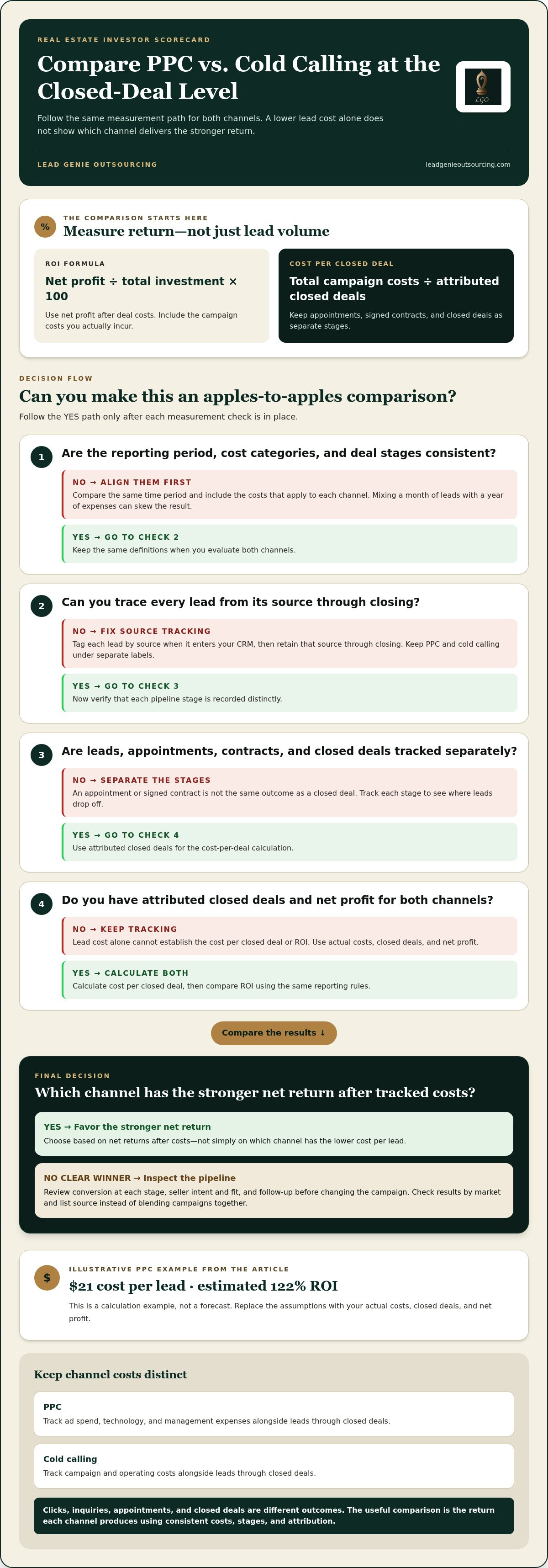
The cheaper lead doesn’t always produce the cheaper deal. A real estate PPC vs cold calling ROI comparison should start with cost per closed deal, not cost per lead. To calculate ROI, divide net profit by total investment, then multiply by 100.
Both channels can fill a pipeline, but they create different kinds of conversations. PPC attracts sellers who reach out first. Cold calling starts conversations directly, so lead quality depends on what the caller uncovers and how consistently your team follows up.
This comparison covers lead costs, cost per closed deal, ROI, and conversion quality without treating a click or appointment as a deal. You’ll learn what to track, how to compare the channels using your own numbers, and when each approach may suit a real estate investor or wholesaler.
Key Takeaways
- Calculate ROI from net profit and total campaign costs, not lead volume alone.
- Track cost per closed deal to see whether cheaper leads actually produce better returns.
- Compare seller intent and qualification details, not just how each channel generates inquiries.
- Use conversion rates at each pipeline stage to spot where leads are dropping off.
- Choose PPC, cold calling, or a mix based on your budget, follow-up capacity, and deal goals.
Calculating PPC return on investment
Track each channel from spend through closed deals, then compare net profit with total investment. A real estate PPC vs cold calling ROI comparison is meaningful only when both channels use the same reporting period, cost categories, and deal stages.
The basic ROI formula is net profit divided by total investment costs, multiplied by 100. Use net profit after deal costs, not gross revenue. Include ad spend, technology, management, and other campaign costs in the investment total. Apply those rules to PPC and cold calling alike.
One illustrative PPC example uses a $21 cost per lead and estimates 122% ROI.
Treat any example as a calculation model, not a forecast. Replace its assumptions with your actual costs, closed deals, and net profit, and keep the reporting periods aligned. Comparing one month of leads with a full year of expenses can skew the result.
- Record PPC spend, technology costs, and management expenses for the same period.
- Tag each lead by source when it enters your CRM, then retain that source through closing.
- Track leads, appointments, signed contracts, closed deals, and net profit as separate stages.
- Calculate cost per lead and cost per closed deal before calculating ROI.
Include management costs in your total investment when applicable. Leaving them out understates campaign costs. Use the amount you actually paid rather than assuming a general benchmark matches your setup.
| Channel | Spend to track | Outcomes to track | ROI inputs |
|---|---|---|---|
| PPC | Ad spend, technology, management | Leads through closed deals | Net profit and total investment |
| Cold calling | Campaign and operating costs | Leads through closed deals | Net profit and total investment |
For a real estate PPC vs cold calling ROI comparison, choose the channel with stronger net returns after tracked costs, not simply the lower lead cost. Use the same CRM stages and reporting period for both. This ties each closed deal to its source and makes ROI more useful for your next budget decision.
For context, real estate investors often aim for a return of 10% or higher. Many investors use around 10% as a benchmark for the S&P 500’s long-term average return. These figures can help frame performance, but they do not replace the channel-specific calculation above. Keep the cost categories and deal definitions consistent when interpreting your results, and treat a benchmark as context rather than a substitute for tracking your own net profit and investment.
Rental property ROI is calculated by dividing annual net profit after operating expenses by the total initial investment. Because this measure uses annual operating results and the initial investment, it is not automatically interchangeable with a PPC comparison based on campaign spending over a chosen period. Match the calculation to what you are evaluating and state which costs and outcomes are included. Clear definitions help you compare performance without confusing operating profit with campaign returns.
Cold calling cost per lead and closed deal
Measure cold-calling costs through the deal, not just the first conversation. These figures serve as general campaign benchmarks, not a vendor quote or a promise of results. Lead Genie Outsourcing helps agencies evaluate true performance beyond surface-level metrics.
The gap between a lead and a closed deal can be 20-40 times, depending on channel mix. That’s why a low cost per lead can mislead. If leads don’t qualify, respond, or reach closing, the initial cost says little about campaign performance.
To calculate your cost per closed deal, divide all campaign costs by the closed deals attributed to cold calling. Include the costs you actually incur, and use the same period and attribution rules as your PPC tracking. Keep appointments, signed contracts, and closed deals separate because they represent different pipeline stages.
- Tag each cold-call lead by source when it enters your CRM.
- Record campaign costs and the number of leads generated.
- Track each lead through appointment, contract, and closing.
- Divide total cold-calling costs by closed deals, then compare net profit with investment.
A campaign may generate many leads but few closed deals. Its cost per lead may look favorable even as its cost per deal rises. Review lead quality and follow-up at each stage before changing the campaign. Keep PPC and cold calling under separate source labels so one channel does not receive credit for another’s deal.
TCPA and the National Do Not Call Registry are relevant compliance considerations for U.S. calling. Requirements can depend on the call and circumstances, so consult your attorney about your specific process.
Competition and housing-market conditions can affect both channels by changing demand and seller response. More advertisers competing for the same searches can push PPC costs upward. In cold calling, market conditions influence which owners are open to a conversation and whether their situation fits your buy box. Review results by market, list source, and seller fit instead of blending campaigns together.
The risks differ. PPC can spend budget on clicks that never become qualified seller conversations, while cold calling takes staff time and may reach owners who are not interested. Either channel can underperform when targeting is broad, follow-up slips, or lead sources are not tracked. Judge outcomes by cost per closed deal and net profit, not lead count alone.
Cold calling versus PPC conversion quality
Conversion quality depends on seller intent, qualification, and follow-up. Compare each channel at every stage, from first contact through closing.
Acquisition Costs and ROI
Cost per acquisition measures campaign investment against clients acquired, not inquiries received. PPC may convert at higher rates because sellers initiated contact. Cold calling starts the conversation, so the caller must identify seller intent and fit. Compare both channels using the same definition of acquisition, reporting period, and net profit after deal costs. A busy pipeline alone does not prove profitability.
For agents comparing PPC and cold calling, the channel with the lower acquisition cost can still produce weaker ROI. Attribute closed deals to their original lead source, then weigh net profit against total investment. Separate seller leads from buyer leads in your CRM because their goals and paths to closing differ.
Lead Conversion Timelines
Online real estate leads can take 3-12 months to turn into sales. A PPC inquiry signals that someone reached out, but not necessarily that they’re ready to transact. Cold-call leads may reveal timing during the first conversation. That information helps sort immediate prospects from longer-term follow-up, but it doesn’t mean a deal closes faster.
Compare conversion time by recording the first contact, appointment, contract, and closing dates. Use the same pipeline stages for PPC and calls. A lead still in follow-up, for example, should not count as an acquisition in either channel. This avoids judging older online leads against newer calls.
Cold-Call Conversion Rates
One cold-calling example reported an 8.2% connect rate and a 3.1% appointment rate. Those figures describe different steps: a connection is not an appointment, and an appointment is not a closed deal. Real Estate Webmasters considers a 2% lead-to-sale conversion rate reasonable for agents who follow up diligently. Another benchmark places most agents between 1-3%.
For buyer versus seller leads, the channel’s role matters. PPC can capture buyers or sellers who initiate an inquiry, while cold calling can open direct conversations with potential sellers. Track each audience separately. Buyer inquiries and seller conversations require different qualification questions and next steps, so combining their results can hide weak conversion at either stage.
To compare lead quality, record intent and the next action at first contact. For a seller, note the reason for selling, timeline, property condition, and asking price. For a buyer, record stated purchase needs and the follow-up outcome. Then review how many leads reach appointments, contracts, and closings. These checkpoints show whether inbound PPC intent or direct cold-call outreach better fits your pipeline.
Assess conversion quality alongside acquisition cost and ROI. A higher appointment rate matters only if qualified prospects continue through the pipeline. Review PPC and cold-call cohorts separately, use consistent definitions, and compare closed outcomes rather than clicks or connections alone.
PPC and Google Ads lead and deal costs
It lists ROI at 200-400%, but your result depends on lead quality, follow-up, and deal profit. Use these ranges to frame your budget, then compare them with tracked campaign outcomes.
Investors are advised to budget at least 30% more than ad spend for management and optimization. That means the daily ad budget is only one part of the outlay. Add campaign labor, landing-page tools, tracking, and lead follow-up when tallying total investment.
Plan the test before launching. One recommendation is to start with $1,500 per month across two to three metro markets. Keep the markets and campaign sources separate in reporting. That lets you see whether one area produces qualified seller conversations while another mainly generates clicks.
- Ad spend: Record Google Ads charges by campaign and market.
- Management: Include optimization work and staff time in the campaign total.
- Tools: Track landing pages, call tracking, and CRM expenses tied to PPC.
- Results: Count leads, appointments, contracts, and closed deals by source.
Cold calling uses a different mix of resources. Account for caller labor, records, CRM tracking, and follow-up time when planning your budget. PPC buys exposure to searchers; calling allocates time to conversations. Compare each channel’s operating inputs with its appointments and closed deals rather than treating a click and a call as equivalent leads.
Historical figures need context. WordStream reported an average real estate industry cost per lead of $116.61 in 2018. That older benchmark is not a current campaign quote. It does show why you should compare like periods and markets, then use your own account data to judge present performance.
Call-only ads measure a different action from form leads: a phone call. Do not compare that figure directly with lead cost unless you define what counts as a qualified lead. Track answered calls, appointments, and deals separately.
Choose a budget by first setting a test period, market, and outcome. Then measure total spend against qualified appointments and closed deals. This ties PPC spending to results and shows whether calling labor or ad spend better fits your current pipeline.
For perspective, the benchmark table estimates PPC and Google Ads ROI at 200-400%; an example agent targets 30 PPC leads per month, or 360 leads per year.
What are typical conversion rates for real estate cold calls?
A cold-call conversion rate depends on the step being measured. Connect rate counts answered calls; appointment rate counts booked meetings; lead-to-sale rate counts closed transactions. If benchmarks use different funnel stages, do not compare them as if they measured the same outcome.
Start with the denominator. For connect rate, divide answered calls by calls attempted. For appointment rate, divide qualified appointments by answered calls or another clearly defined contact group. For lead-to-sale conversion, divide closed deals by leads generated. Define each measure before reviewing a campaign.
Those definitions change the story. A high connect rate can still lead to few appointments if owners are not interested. A strong appointment rate can still result in few deals if prospects do not fit your buy box or follow-up stalls. Review each stage in order to find where the funnel loses momentum.
- Attempted calls: Count dialed records using a consistent reporting period.
- Connections: Separate live owner conversations from unanswered attempts.
- Appointments: Count scheduled meetings that meet your qualification standard.
- Closed deals: Attribute completed transactions to their original lead source.
Use a CRM to keep these stages distinct. Add the call date, result, next action, and appointment status to each record, then review the same reporting window each time. If calls from the latest period have not had time to produce closings, compare early stages first, not final sales.
Imagine a team changes its opening script mid-campaign. Mark the change date and compare the same stages before and after. Keep the list source, market, and caller consistent where possible. Otherwise, a change in record quality or territory could be mistaken for a script improvement.
Conversion rates also depend on follow-up. Record whether an appointment was held, rescheduled, or missed, along with later contact attempts and the final outcome. A booked appointment is a useful milestone, not a closed deal. Consistent notes help show whether weak results came from the initial conversation, qualification, or what happened afterward.
For a fair PPC comparison, use the same funnel stages and source labels. PPC begins with an inbound inquiry; cold calling begins with an outbound attempt. Compare qualified appointments and closed deals, not clicks against dials. That makes each rate useful for budget decisions rather than a vanity metric.
Record the seller details that define a qualified conversation, including the key seller qualification factors. Those notes help explain which calls progress to appointments and which need a different follow-up.
Lead Genie Outsourcing: Cold calling for real estate wholesalers
Lead Genie Outsourcing provides cold calling for real estate wholesalers who need seller conversations and a trackable appointment pipeline. Dedicated callers work 40 hours a week, and each caller gets 10,000 skip-traced, scrubbed records.
Leads are qualified on four pillars: reason to sell, timeline, condition, and asking price. Call recordings let you review the conversation and assess fit before deciding how to follow up. The guarantee is 30 qualified seller appointments a month, or dialing continues free until the target is met.
Use this approach when your team wants outbound seller outreach and can follow up on qualified appointments. The cold-calling process shows how calls and lead handoff fit together. Book a free 30-minute call with Lead Genie Outsourcing to discuss your campaign needs.
Put Your Next Campaign to Work
A useful real estate PPC-versus-cold-calling ROI comparison should lead to an actionable decision, not another spreadsheet that goes unused. Set a clear test goal, choose the pipeline stage that matters most, and review outcomes before shifting more budget. Keep the process simple enough to repeat. That is how you build a channel mix around actual deal flow rather than assumptions.
If outbound seller conversations are part of that plan, Lead Genie Outsourcing offers cold calling for real estate wholesalers and investors, along with the LGO CRM. The right next step is a direct conversation about your campaign and how you want to track its results.
Book a free 30-minute call with Lead Genie Outsourcing and map out your next move.
Frequently Asked Questions
What is the average cost per lead for real estate PPC in the United States?
The U.S. benchmark range discussed in the PPC cost section is a planning reference, not a fixed average for every investor. For your account, use the same campaign dates and count only valid, unique seller leads. Separate duplicate inquiries, buyer inquiries, and out-of-market contacts so they do not distort the figure. Review cost by campaign and search intent before shifting spend.
What are typical conversion rates from real estate PPC leads to appointments and closed deals?
Rates vary with lead intent, appointment definitions, and follow-up. Use the benchmarks already covered as context, then compare your own PPC cohorts by inquiry type and outcome. Separate booked appointments from held appointments, and mark deals that remain active rather than closed. This shows whether leads drop off before the meeting, after it, or during negotiations. Keep those definitions consistent across reporting periods.
What does cold calling cost per lead and per closed real estate transaction?
The article’s benchmark ranges can guide initial planning, but actual costs depend on campaign operations and outcomes. Account for caller time, list preparation, and follow-up effort in your internal analysis. A campaign with open prospects may not yet have a final transaction cost. Revisit those records as they progress, then use resolved outcomes to assess where expenses build and which process changes may help.