
A recording is useful when it changes the next call. To learn how to review cold calling recordings, listen for what happened during the opening, seller discovery, objection handling, and close. Score each stage against observable behaviors, then choose one action for the caller to practice.
It’s easy to decide that a call went well or badly and move on. That doesn’t show which moment made the difference or what the caller should do next. A focused review turns a recording into specific coaching, not a vague verdict.
This guide shows you how to identify strong and weak moments, score key call stages, and give feedback callers can use on their next dial. You’ll also learn how to build playlists for onboarding and ongoing practice, making useful examples easy to find and revisit.
Key Takeaways
- Build focused playlists of call examples so reps can hear what strong openings, seller discovery, and next steps sound like.
- Review short call segments and identify the exact moment that helped or hurt the conversation.
- Use a consistent scorecard to assess openings, discovery, objection handling, and follow-up.
- Give each rep one clear behavior to practice, then revisit recordings to track progress.
- Turn useful call reviews into a steady coaching routine instead of treating recordings as files to store and forget.
Creating call playlists for onboarding and best practices
Build playlists around real call moments, not broad labels such as “good call.” Use each recording to teach a skill, then give new callers a specific listening task.
Set Recording Guidelines and Use Cases
Set a clear purpose for recording, such as onboarding, coaching, or reviewing seller conversations. Tell participants why the call is recorded and how it will be used; obtain consent from the sales representative and prospect. U.S. call-recording rules vary by state, and California and Pennsylvania require multi-party consent. Ask your attorney about your recording practices before calls are saved.
Keep recordings tied to useful cases, such as a strong opening, a missed seller detail, or a vague follow-up. Avoid storing every call without a review purpose. Transcripts can help reviewers find specific wording and support post-call analysis, but listen to the audio before judging tone or context.
- Choose a playlist goal. Teach one skill, such as asking about a seller’s timeline. Include calls that show both a clear question and a missed opportunity, so a new caller can compare the choices and their effect on the conversation.
- Label calls by stage and lesson. Use practical tags such as “opening” or “price objection,” then add a note about the behavior to notice. Keep labels specific enough for callers to find an example without replaying unrelated calls.
- Set a repeatable review cadence. Managers can review one or two calls per rep each week. Rotate examples across the sales team to expose reps to different voices, seller responses, and coaching points.
Apply Review Scorecards
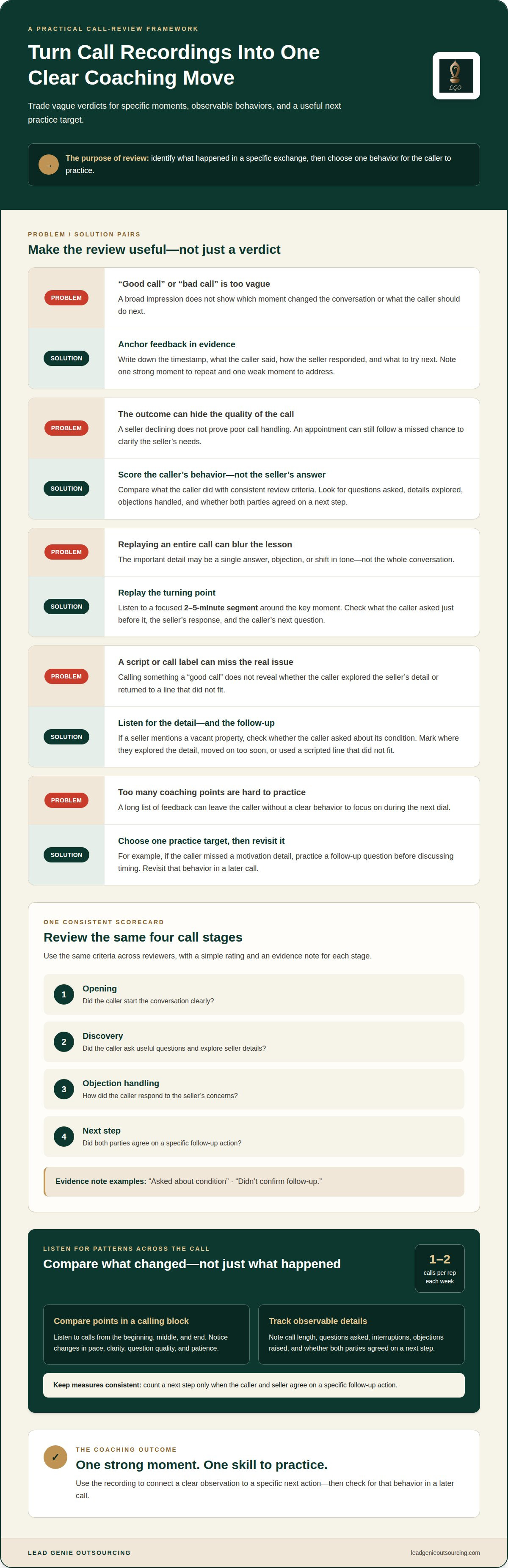
Create one scorecard with the same stages for each reviewer: opening, discovery, objection handling, and next step. Use a simple rating and an evidence note, such as “asked about condition” or “didn’t confirm follow-up.” Apply the same criteria across the team so reviews are consistent and comparable.
Score the caller’s behavior, not the seller’s final response. A seller declining an offer doesn’t prove poor call handling. Compare the recording with the scorecard, then choose one skill to practice.
- Build playlists from scorecard patterns. Pair a strong discovery example with a clip where the caller skips a useful question. This gives new callers a practical contrast to discuss with a manager.
- Track observable call details. Note call length, questions asked, interruptions, objections raised, and whether both parties agreed on a next step. Compare those details across calls, then listen to understand what happened.
Define each measure consistently before comparing callers. For example, count a next step only when the caller and seller agree on a specific follow-up action.
Reviewing recorded calls to identify successful and unsuccessful moments
Listen for the decision point, not just the outcome. A seller who declines may still reveal strong discovery, while an appointment can follow a missed chance to clarify the seller’s needs.
- Choose calls that show a clear contrast. Select recordings by outcome, difficulty, length, or rep feedback. Pair a call where the seller shared a reason to sell with one where the rep never uncovered it. Include wins, too. Strong calls help reps hear progress and spot behaviors worth repeating, not just mistakes.
- Find the moment that changed the conversation. Replay a focused 2-5-minute segment around a seller’s answer, objection, or shift in tone. Note what the rep asked immediately before that moment, then listen to the response and next question. This makes learning how to review cold calling recordings concrete: tie your observation to a specific exchange, not an impression of the entire call.
- Compare the caller’s words with the call’s direction. Check whether a script helped or made the caller sound rushed. If a seller mentions a vacant property, for example, did the caller ask about its condition? Mark where the caller explored the detail, moved on too soon, or returned to a scripted line that didn’t fit.
- Review calls from different points in a calling block. Compare recordings from the beginning, middle, and end. Listen for changes in pace, clarity, question quality, and patience. If later calls sound hurried, find where questions became shorter or interruptions increased. Use that evidence to choose one adjustment for the next block.
- Turn each review into one practice target. Note the timestamp, what the caller said, how the seller responded, and what to try next. If the caller missed a motivation detail, practice a follow-up question before discussing timing. Revisit the same behavior in a later call. That’s how to review cold calling recordings with a clear coaching outcome.
Build the habit around evidence: one strong moment to repeat, one weak moment to address, and one action to practice. A real estate cold calling guide can help connect review lessons with the wider calling process.
Salespeople should review successful calls occasionally to recognize improvement and celebrate small wins. Giving strong calls a place in the review helps make progress visible alongside moments that need work. Many high-performing teams review a few key recorded calls per sales development representative weekly or biweekly, keeping the focus on a manageable set of examples rather than every conversation. A mix of wins and missed opportunities can make it easier to identify what is already working and what to revisit in practice.
Select calls randomly or based on their outcome, length, difficulty, or feedback. The selection can match the review’s purpose: an outcome may highlight a turning point, while difficulty or feedback can direct attention to a particular exchange. You can also compare recordings from the beginning, middle, and end of a calling block. Listen for changes in pace, clarity, question quality, or patience, then choose a specific behavior to practice.
Reviewing recordings for conversation flow and coaching
Give constructive feedback by naming one recorded behavior, its effect, and a specific next move. Review the conversation from the prospect’s point of view, then agree on one skill to practice.
Assess Conversation Flow
Replay the full exchange and track how the caller moves from opening to discovery, response, and follow-up. Notice whether each question follows the seller’s last answer. For example, if a seller mentions an inherited property, check whether the caller explores that detail or jumps straight to an appointment request.
- Mark the turning point. Note where the prospect becomes more engaged, gives shorter answers, or changes direction. Compare the rep’s question just before that moment with the response that followed. This shows whether the conversation flowed naturally or shifted because the rep missed a cue.
- Check the handoffs between topics. Listen for abrupt jumps from property condition to asking price, or from a seller’s concern to a meeting request. A useful transition connects the topics: “You mentioned repairs. How is the property holding up now?” Mark transitions that help sellers keep talking.
- Separate listening from talking. Track whether the rep pauses after a question and lets the prospect finish. Note interruptions, repeated questions, or answers that ignore what the prospect just said. Use those moments to coach a specific change, such as waiting before asking the next question.
Give Constructive Coaching Feedback
Base coaching on the recording, not a general label like “too pushy.” Invite the caller to describe what they heard, then share one observation tied to a timestamp. A manager or coworker can add perspective, but keep the discussion focused on behavior the caller can change.
- Start with the rep’s read. Ask what they noticed when the prospect raised a concern about repairs. Their answer shows whether they heard the concern, understood its effect, and chose a fitting response.
- Give one clear correction. Say, “At this point, you returned to the script before answering the seller’s question.” Then model a response that acknowledges the concern and asks a relevant follow-up. Keep feedback about the call, not the caller’s character.
- Set a practice task and revisit it. Have the rep role-play the revised response, then use a later call to assess the same behavior. A focused coaching routine can fit into 30-60 minutes per week. Record the skill practiced and the evidence from the follow-up review.
Scoring openings, discovery, objections, and next steps
Evaluate what the caller did at each stage, using the recording as evidence. Check whether the opening earns a response, discovery surfaces seller details, objections are addressed, and the call ends with a clear next step.
Score observable behaviors, not whether the prospect agrees to meet. A seller declining an appointment doesn’t erase strong listening or sound discovery.
-
Evaluate Openings and Discovery
Listen to the opening, then score whether the rep identifies themselves clearly, explains the call’s purpose, and gives the prospect room to respond. During discovery, check if questions uncover the seller’s reason to sell, timeline, property condition, and asking price. Note the exact answer or missed question beside each score.
Use a simple “met” or “missed” mark for each behavior. Add a short evidence note, such as “asked about condition after seller mentioned repairs.” Avoid scoring personality or judging the call by its outcome. The recording should show what happened, not invite reviewers to guess what the caller intended.
For a structured coaching sequence, the first week can focus on the first five minutes of three calls per representative. Score openings and discovery separately, so a strong introduction doesn’t hide skipped seller questions. Compare the same behaviors across calls to spot patterns the rep can work on.
-
Assess Objections and Next Steps
Review calls where price or timing came up, and score how the rep responds. Listen for whether the rep acknowledges the concern, asks a useful follow-up, and answers without talking over the prospect. Don’t award points simply because the prospect stays on the line; score the behavior heard in the recording.
Assess the closing stage by checking whether the caller confirms a specific next action. A clear follow-up establishes who will reconnect and what information they’ll discuss. “I’ll check back” is less concrete than agreeing to revisit the seller’s repair timeline. Record what was agreed, not what the caller hoped would happen.
Organize reviews around call stages: openings and discovery first, then calls involving price or timing, and finally closing and next steps. This gives the team a clear progression from opening a conversation to handling concerns and setting follow-up.
Keep scorecard points tied to evidence. Recording tools can help organize notes, but the reviewer still needs to listen for context. If a transcript labels a seller’s concern incorrectly, check it against the audio before using it for coaching.
Using recordings to improve cold calling
Make each review useful for the caller’s next conversation. Managers need a repeatable loop: choose a recording, explain why a moment worked or fell short, then practice one adjustment.
- Set a review rhythm reps can keep. Schedule one sales call review per day, or five calls across the week, and capture the lesson immediately. Don’t wait until a difficult conversation becomes hard to remember. Note the call stage, the rep’s choice, and how the prospect responded. That turns recorded calls into working material, not a backlog.
- Compare a won call with a lost call. In week four of a coaching plan, review one complete won call and one lost call per representative. Look for differences in how each rep opened, explored the seller’s reason, handled concerns, and set a next step. The outcome matters, but the comparison should reveal behaviors the rep can repeat or change.
- Separate the call result from the caller’s controllable actions. A seller can decline even when the caller asks clear questions and listens well. Conversely, a meeting can be set after rushed discovery. Note what the caller controlled, such as asking a follow-up after hearing about property repairs, and what depended on the seller’s decision.
- Turn analysis into one testable action. If a caller moves to price before understanding the seller’s timeline, practice a follow-up question before the next call block. Then listen for that behavior in another recording. Keep the action easy to hear, such as pausing after the seller answers or confirming the agreed follow-up.
- Look for patterns before changing the script. If the same opening leads to short answers across several reviewed calls, compare the wording with the sellers’ responses. Change one phrase, then listen to later calls for a difference in engagement. Avoid rewriting the whole script after one difficult conversation; otherwise, it’s harder to tell which adjustment mattered.
- Keep the coaching record tied to evidence. Log the recording, the moment reviewed, the agreed practice action, and what happened in the next review. Managers can use that record to see whether coaching addresses a recurring issue or a one-off call. Each change should point back to something audible, not a general impression.
Build a coaching routine around real seller conversations and recorded calls. Talk through a call-review coaching workflow.
Lead Genie Outsourcing: Cold calling for real estate wholesalers
Lead Genie Outsourcing provides cold calling for real estate wholesalers who need seller conversations and recorded leads to review. Each lead is qualified on four pillars: reason to sell, timeline, condition, and asking price.
Dedicated callers make calls 40 hours a week, with 10,000 skip-traced, scrubbed records per caller. The guarantee is 30 qualified seller appointments a month, or dialing continues free until that target is reached. Use the call recordings to check how seller details were gathered and where coaching can sharpen follow-up.
If you want a calling process with recorded conversations and qualified seller appointments, book a free 30-minute call with Lead Genie Outsourcing.
Put the Next Call Review to Work
Turn call review into a team habit by assigning an owner and recording decisions. Choose one skill the team wants to sharpen, then include it in regular coaching conversations. A simple record of what the team is practicing keeps feedback focused and gives callers a shared standard.
The value of learning how to review cold calling recordings comes from applying each lesson to the next stretch of seller outreach. Keep the process practical: let callers reflect, name the next skill, and revisit whether the change helped. Consistent, focused adjustments help the team learn from its calls instead of relying on guesswork.
Ready to discuss how cold calling support could fit your operation? Book a free 30-minute call with Lead Genie Outsourcing. Take the next step with a clear plan and keep building a stronger calling process.
Frequently Asked Questions
What is a cold call recording review scorecard template?
A cold call recording review scorecard is a form that helps reviewers capture evidence consistently. Include fields for the caller, call stage, timestamp, behavior observed, and coaching note. For example, record “paused after question” or “seller’s answer wasn’t acknowledged.” Keep the form quick to complete. Remove any field that doesn’t help explain the call or guide practice.
How do you assess a cold call opening, discovery questions, and objection handling?
Assess each stage against what the rep said and the prospect’s response. For an opening, note whether the purpose was clear. For discovery, check if the rep asked a relevant follow-up after a prospect shared information. For objection handling, assess whether the response addressed the stated concern. Keep the notes specific enough that another reviewer could hear the same behavior in the recording.
What are common cold calling mistakes to listen for?
Listen for talking over prospects, asking several questions at once, repeating a line that no longer fits, or treating a pause as permission to keep pitching. Also note when a rep answers before the prospect finishes explaining a concern. Capture the timestamp and the words around the moment. That context helps distinguish a repeated habit from one awkward exchange.
What software can transcribe and analyze cold calling recordings?
Look for software that creates searchable transcripts and lets reviewers return to the matching audio. Search can help locate phrases about repairs, timing, or price expectations. Treat transcript labels as a starting point, not a final verdict. Automated text can miss speaker changes, sarcasm, or tone, so listen to the audio before using a transcript for coaching.
How can sales teams use call recordings for coaching without hurting morale?
Make coaching collaborative. Ask the caller what they noticed before sharing your own view, and discuss choices in the call rather than the person’s character. For example, focus on whether a question gave the seller room to explain. End by agreeing on one practice move and let the caller choose a future recording to review. This keeps feedback concrete and gives the caller a voice in the process.