

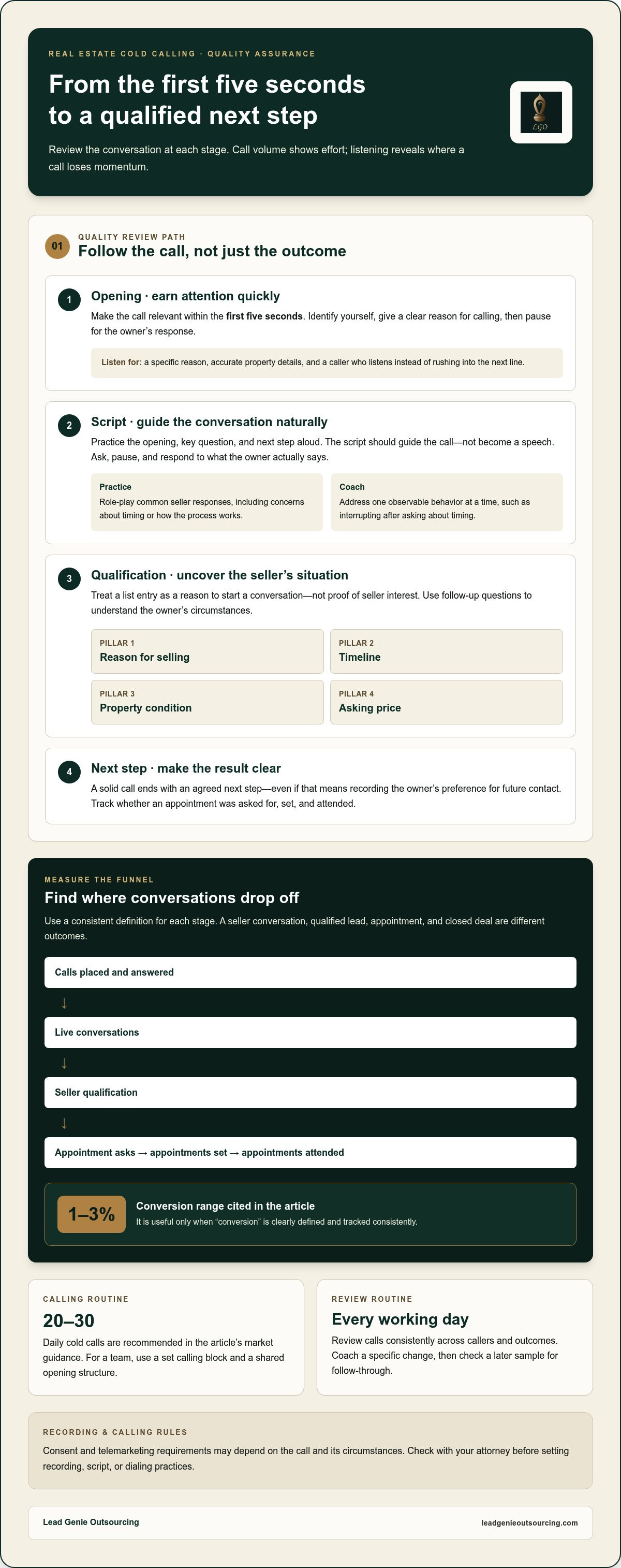
More calls won’t fix a weak call. Real estate cold calling quality assurance means reviewing four things: the opening, how callers use the script, whether leads fit your target, and whether conversations lead to qualified next steps. If one part breaks down, call volume alone won’t tell you why.
Consistent calling creates more chances to reach sellers, but volume alone can hide a flat opening, rushed script delivery, or a list that doesn’t match your buying criteria. Review the calls themselves, not just the outcomes, to find the problem.
This guide explains how to assess each part of a call, practice scripts without sounding stiff, and interpret conversion numbers in context. Use it to identify where conversations lose momentum, coach the next attempt, and decide whether the issue is the caller, message, targeting, or follow-up.
Key Takeaways
- Make the opening specific to the person you’re calling, then review whether it earns a real conversation.
- Practice scripts aloud, focusing on natural delivery and clear seller benefits rather than word-for-word recitation.
- Track each step from calls to qualified appointments so you can spot where prospects drop off.
- Use call recordings to coach one clear improvement at a time and connect feedback to what happened on the call.
- Ask your attorney which federal and state consent rules apply before recording calls.
1. Opening a call and establishing relevance
A cold-call opening has one job: give the person a reason to stay on the line. Make it relevant within the first five seconds, then say who you are and why you’re calling. For example, an investor calling about a property might say, “I’m calling about the house on Oak Street. Have you considered selling it?” The question is direct and gives the owner room to answer before the caller launches into a pitch.
Prepare for a specific opening by reviewing the property address, owner details, and any notes in your system before dialing. Decide what the call needs to establish, such as whether the owner would consider selling and what next step makes sense. Don’t treat a list entry as proof of seller interest. Use the conversation to find out whether the call is relevant to that owner.
Consistency matters, too. A steady call routine gives managers comparable conversations to assess. The market guidance recommends that agents make calls daily at the same time and practice with 20 to 30 cold calls daily. For an investor team, use a set calling block and a shared opening structure. Keep the wording natural, but hold the purpose steady so changes in performance are easier to spot.
Score the opening by observable actions, not personality. Did the caller identify themselves, give a clear reason for calling, and pause for a response? Did they listen or rush into the next line? Track indicators such as answered calls, conversations started, seller interest identified, and next steps agreed. Compare these stages instead of relying on call volume alone. A high dial count won’t explain why an opening fails to hold attention.
Managers should review calls every working day and sample consistently across each caller’s work, including different outcomes. Set a fixed sample for each review cycle, then expand it when patterns are mixed or a coaching change needs follow-up. This grounds feedback in actual conversations without cherry-picking only strong or weak examples.
Common quality risks include generic openings, inaccurate property details, reciting the script, and judging callers only by appointments. A rushed opening can feel irrelevant; a mistaken address can damage trust. For real estate cold calling quality assurance, note the specific behavior and its effect, coach one change for the next call, and check a later sample to see whether the caller made that change.
The opening should become relevant within the first five seconds. Use that as a coaching checkpoint: listen for when the caller connects the call to the owner’s situation, rather than simply finishing an introduction. If that connection comes later, coach the caller to bring the reason for calling forward while keeping the wording clear and natural.
2. Practicing scripts and highlighting benefits
A script should guide the call, not turn it into a speech. Practice the opening, key question, and next step, then let the caller respond naturally. For example, after asking whether the owner has considered selling, pause instead of filling the silence with features or promises. In a review, listen for clear wording, active listening, and a benefit tied to what the owner actually said.
Use role-play to practice common seller responses before live calls. One person can play an owner who wants to wait while the caller asks what might change their timing. Another scenario can involve an owner asking how the process works. Keep answers plain and accurate. A useful response addresses the seller’s stated concern, such as discussing the property’s condition, rather than assuming every seller wants the same outcome.
Match the script to the lead type. An investor script can ask whether the owner would consider selling and what matters most in that decision. A neighborhood script can ask whether the homeowner has considered a move in the next 6 to 12 months. For an expired listing, the example script suggests offering a meeting of about 15 minutes. Treat those lines as starting points, then adapt the follow-up question to the owner’s answer.
Build qualification into practice, not as a checklist read aloud. Train callers to uncover the reason for selling, timeline, property condition, and asking price through a natural conversation. The four pillars of a motivated seller lead can help shape follow-up questions around those details. If an owner says repairs are the main concern, ask what work remains. If timing matters, ask when they would want to make a decision. A solid call ends with a clear next step, even when that step is simply recording the owner’s preference for future contact.
Review scripts for accuracy and natural delivery. Flag unsupported claims, pressure tactics, and lines that skip over a seller’s stated concern. Then coach one change at a time. For example, if a caller keeps interrupting after asking about timing, practice asking the question and waiting through the full answer. Teams can use a real estate cold calling guide to shape practice around real seller conversations.
The TCPA, Do Not Call rules, and other telemarketing requirements may affect how real estate calls are made. Their application depends on the call and its circumstances. Consult your attorney before setting scripts or dialing practices.
4. Cold-calling effectiveness and conversion rates
Call volume shows effort. Conversion shows what happens next. Real estate cold calling commonly produces a 1-3% conversion rate, but that figure only helps when your team defines “conversion.” A seller conversation, a qualified lead, an appointment, and a closed deal are different outcomes. Pick one measure for each stage, then keep its definition consistent across callers and reporting periods.
Track the funnel from attempts to meaningful results: calls placed and answered, live conversations, seller qualification, appointment asks, appointments set, and appointments attended. Calculate each rate using its own denominator. For example, appointment ask rate is asks divided by eligible conversations, while appointment set rate is appointments booked divided by asks. This shows where prospects drop off instead of hiding the issue in one overall percentage.
Some market benchmarks set goals of 60% for appointment ask rate, 30% for appointment set rate, and 80% for identifying follow-ups. Treat these as reference points, not proof that every lead pool or campaign should perform identically. A team calling owners with different property types or seller readiness may see different results. Compare like with like, and note changes in targeting, script, or caller assignment before drawing conclusions.
To measure whether quality assurance improves appointments, conversions, and compliance, compare the same funnel measures before and after coaching, alongside call-review findings and flagged process issues. If appointment asks increase but qualified appointments don’t, review the ask and qualification criteria instead of focusing on the top-line count.
Read conversion alongside call quality. If callers ask for appointments consistently but few owners agree, listen for timing, clarity, and whether the caller responds to the seller’s concern. If appointments rise but attendance falls, review how expectations were set during the call. Experienced agents have been associated with 10-20% annual success through consistent daily calling, but that annual measure differs from a call-level conversion rate. Keep the denominator attached to every percentage.
A real estate cold calling quality assurance program should also track whether calls follow the approved process. Log the call outcome, required disclosures or steps in your company’s procedure, and any issue for follow-up. Don’t label a campaign compliant from a high appointment count. Review flagged calls and address recurring process gaps with your attorney’s guidance on applicable requirements.
Make one change at a time. Coach a specific behavior, then compare the next set of reviewed calls and funnel results. If the opening improves but appointment rates stay flat, inspect the qualification question or appointment ask. That turns the dashboard into a decision tool, not just a scoreboard.
4. What are best practices for recording, reviewing, and coaching real estate cold calls?
Start with a clear recording process. Before recording calls, define who can access them, how they’ll be used, and where they’ll be stored. Ask your attorney to review the recording approach and applicable consent requirements. Give callers a consistent explanation when your process calls for one. A clear policy keeps recordings focused on their purpose: reviewing conversations, coaching callers, and documenting what happened.
Review the whole call, not just the first few seconds or the appointment ask. Listen for tone, pace, questions, interruptions, and how the caller responds to the seller. Note where the conversation changes direction. For example, if an owner says the property needs repairs, check whether the caller asks a relevant follow-up or returns to a generic pitch.
Use the same scorecard for every caller, with measures tied to something a reviewer can hear. It might cover opening clarity, listening, qualification, accuracy, agreement on next steps, and call outcome. Add a brief evidence note beside each score, such as, “Caller asked about condition after owner mentioned repairs.” Evidence makes coaching specific and helps reviewers assess behavior consistently.
Balance the call sample. Include calls that led to appointments, calls that ended quickly, and conversations where the seller wasn’t ready. Reviewing only successful calls hides missed opportunities; reviewing only poor calls gives an incomplete picture. Keep the sample and review schedule consistent to compare feedback across the same caller’s work over time.
Coach one behavior at a time. Replay the moment, explain what the caller did, and give them a better line to practice. For example, replace a rushed reply with: “You mentioned the repairs. Which work is still outstanding?” Have the caller role-play the exchange, then listen for the change in a later recording. Specific practice is more useful than a broad instruction such as “sound more confident.”
Separate skill issues from process issues. If a caller records the wrong outcome, show the correct disposition and have them practice entering it after a sample call. If they make an unsupported promise, review the approved wording and rehearse a truthful response. This helps managers address the cause instead of giving generic feedback about the whole call.
After each coaching session, write down the behavior, the agreed practice, and what the next review will check. For example, the manager might listen for one clear follow-up question after a seller shares a concern. That gives the caller a concrete target and turns each recording into a useful coaching record.
5. What U.S. laws govern recording real estate sales calls, and which states require consent?
Recording a real estate sales call can involve federal and state rules. State consent requirements differ, so don’t assume one script or policy fits every call. Before recording, ask your attorney to identify the rules that apply to your callers, business, and prospects.
Don’t rely on the caller’s location alone. A caller in one state may reach an owner in another, and the relevant rules can depend on the circumstances. Tell your attorney which locations are involved, how calls are placed, and whether recordings capture audio, voicemail, or both. Ask for a process that covers each calling scenario.
There’s no safe shortcut for recalling consent requirements from memory. State rules can change, and legal details need current, state-specific review. Ask counsel which states require consent, what form of consent applies, and how to handle calls when the caller and prospect are in different states. Use that guidance to create the team’s written recording procedure.
Before launch, map the process in clear steps:
- Identify where callers work and which states their campaigns target.
- Ask counsel which recording and consent rules apply to those calls.
- Set the approved disclosure or consent process for each scenario.
- Train callers to follow the process and document the required action.
- Review recordings and call notes for consistent use of that process.
A manager’s review should assess recording compliance separately from sales quality. First check whether the caller followed the approved recording procedure, then assess opening clarity, listening, and the agreed next step. If a recording starts without a required action, flag it for review. A strong appointment outcome does not prove that the recording process was followed.
Keep the policy practical. Put the approved steps beside the dialer or call workflow, train callers before they start dialing, and update the process when counsel changes its guidance. If a prospect objects to recording, callers need a clear, approved response instead of an improvised answer. Ask your attorney how to handle and document that situation.
In a real estate cold calling quality assurance program, include recording rules in the same review system as call conduct. Limit access to people who need recordings for review, and use them for the stated coaching purpose. Have your attorney review the recording policy and call workflow before the team uses them.
Federal and state rules may govern recordings, and state consent requirements vary according to the call’s circumstances and the locations involved. Counsel should determine which states require consent and what form of consent applies to each scenario.
Lead Genie Outsourcing: Cold calling for real estate wholesalers
Lead Genie Outsourcing provides cold calling for real estate wholesalers and investors who need consistent seller conversations and qualified appointments. Dedicated callers work 40 hours a week, using skip-traced, scrubbed records to reach potential sellers.
Each lead is qualified around four points: reason to sell, timeline, property condition, and asking price. The call recording gives you a direct way to review the conversation and assess whether the lead fits your criteria. Lead Genie Outsourcing guarantees 30 qualified seller appointments a month, or keeps dialing free until it reaches 30.
If you need a calling team to support your seller outreach, book a free 30-minute call with Lead Genie Outsourcing.
Make call review part of the operating rhythm
Call quality improves when reviews become part of the team’s routine. Set a regular time to look for patterns, then turn each finding into a practical adjustment. Focus on what callers can change in their next conversation. Consistent course corrections help the process adapt as seller responses and campaign needs shift.
Set the next review date and decide what your team will examine. A clear cadence makes follow-through easier and keeps call feedback connected to daily work. Book a free 30-minute call to discuss your next step.
Keep reviews consistent, learn from each one, and improve calls over time.
Frequently Asked Questions
What does quality assurance mean for real estate cold calling?
It means checking calls against clear standards for accuracy, professionalism, and useful seller information. For example, if an owner says the property was inherited, the reviewer checks that the caller records the owner’s words accurately rather than assuming they want to sell. This prevents unsupported notes from shaping the next conversation.
What metrics should real estate teams track to assess cold-call quality?
Track call outcomes alongside lead-record accuracy. Compare records from different list sources for wrong-owner details, disconnected numbers, and missing qualification notes. Check whether scheduled follow-ups happened as agreed, too. These measures show whether the team is reaching the right owners and keeping useful records, not just generating activity. Review results by campaign or list source to spot patterns that a combined team total can hide.
How can you build a real estate cold-call quality assurance scorecard?
Set behavior-based rating criteria before scoring calls. Define what counts as an accurate property reference, a complete outcome note, and a clear next step. Mark critical errors separately so a strong opening can’t offset an inaccurate lead record. Have reviewers score the same call, compare their assessments, and clarify any vague criteria. Calibration helps keep scorecards consistent across managers and coaching sessions.
What scripts and disclosures should agents use for compliant real estate cold calls?
Use a script that accurately identifies the caller, gives a truthful reason for calling, and avoids unsupported claims about the property or offer. Required disclosures, recording language, and responses to opt-out requests should follow a process reviewed by your attorney. The right wording depends on the call and applicable requirements, so don’t treat a generic script as legal guidance. Have counsel review the script before callers use it.