

The dial rate alone won’t tell you what a cold-calling service will really cost. A useful real estate cold calling service comparison looks at how providers charge, what caller training and management cover, and how much you spend for a qualified listing appointment.
It’s reasonable to start with price, but a low rate means little if callers aren’t trained for seller conversations, the service leaves key work to your team, or appointments don’t meet your criteria. Compare both the cost and the work behind it.
This guide compares common service models, pricing structures, caller training, and the factors that affect cost per qualified appointment. Use it to weigh DIY calling, an in-house caller, and a managed service against your pipeline and available time. The goal is to understand the workload and value behind each option.
Key Takeaways
- Compare what each service includes, not just its quoted rate. Caller training, list handling, follow-up, and appointment qualification all affect the value.
- Dedicated callers offer a different setup from shared callers. The right fit depends on how much control, consistency, and calling capacity your pipeline needs.
- DIY calling may save on service fees, but it takes time away from other work. Weigh that time against the effort required to manage callers and leads.
- Measure cost per listing appointment using qualified appointments, not dials alone. Clear lead criteria make results easier to assess across different calling models.
- For real estate investors and wholesalers who want calling handled, Lead Genie Outsourcing provides dedicated callers and records seller conversations for review.
1. Cold calling as a real estate lead-generation strategy
Cold calling gives real estate investors a direct way to start seller conversations. Rather than waiting for a homeowner to click an ad or submit a form, a caller reaches out to discuss a possible sale. The conversation can reveal the seller’s reason for selling, timeline, property condition, and price expectations, helping you decide whether to follow up.
Consistency matters. Regular outreach creates more opportunities to speak with homeowners who may be open to a conversation. Before dialing, define your target, such as owners of inherited homes or landlords considering a sale. Use a script that opens naturally, captures useful answers, and sets a clear next step. If you call in-house, schedule prospecting blocks and track calls, conversations, follow-ups, and appointments separately.
The federal Telephone Consumer Protection Act (TCPA) and National Do Not Call Registry are central considerations for real estate cold calls, and state telemarketing laws may also apply. Check with your attorney about TCPA and do-not-call compliance for your calling plan. List screening and call procedures belong in the workflow, not as afterthoughts; the TCPA and DNC compliance guidance covers this topic.
Cold calling and digital lead generation work differently. A search ad or landing page captures people who respond online; a cold call initiates contact with a selected homeowner. Digital campaigns can bring inbound inquiries, while outbound calls let investors focus on a chosen property type or seller group. To compare channels, record each outcome in the same lead system so your team can identify whether a seller came from a form, a call, or follow-up.
Compare lead targets by definition, not headline count. An “appointment” might mean a scheduled conversation, or it might mean a seller who meets defined criteria and agrees to discuss the property. A qualified-lead standard should specify what counts, such as a reason to sell, a workable timeline, property condition, and price expectations. A guarantee is meaningful only when its target, measurement period, and remedy are clear. Track scheduled appointments, completed conversations, and qualified sellers separately.
Exclusivity affects how a lead can be worked. A record may be exclusive to one campaign or contacted by multiple teams, affecting duplicate outreach, the seller’s experience, and follow-up ownership. Set clear rules for assigning records, logging attempts, and handling callbacks. If a homeowner asks for a later call, for example, record the agreed timing and route the follow-up to the right person. This connects cold calling to the rest of your lead generation process.
2. Caller training and dedicated versus shared callers
A real estate caller needs more than a script. They must keep the seller conversation on track, listen for the reason behind a possible sale, and record clear next steps. Training should cover your buying criteria, the opening, common seller responses, and how to log useful details. Callers should know when a seller’s timeline calls for follow-up rather than an immediate handoff.
Use a sample call to assess skill before comparing caller models. Listen for a natural opening, relevant questions, accurate notes, and a clear close. Check whether the caller explains the next step without pressuring the seller. A short role-play can reveal training gaps: ask how they would respond to an owner who wants a price before discussing the property. Strong training prepares callers to handle that moment and capture the answer.
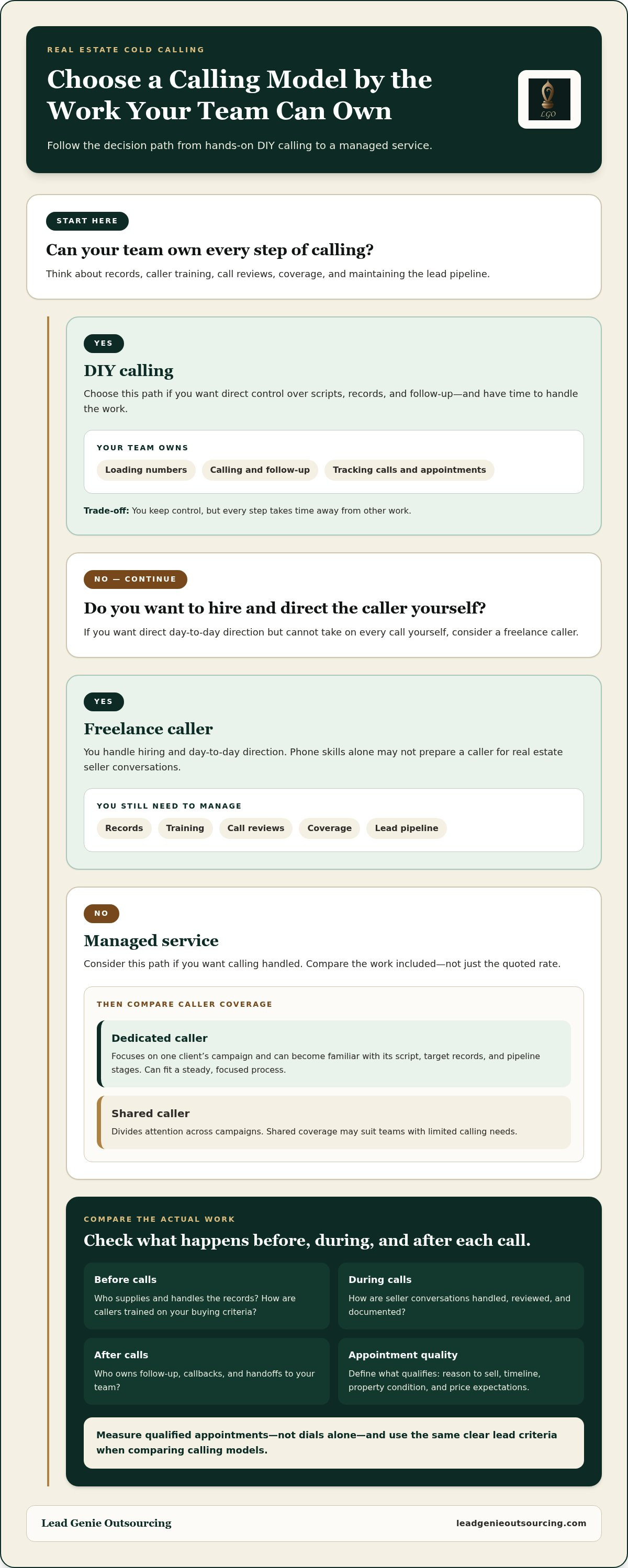
A dedicated caller focuses on one client’s campaign and can become familiar with its script, target records, and pipeline stages. A shared caller divides attention across campaigns. Shared coverage may suit teams with limited calling needs, while dedicated coverage can fit investors who need a steady, focused process. The key distinction is attention and continuity, not the label. Ask how each model handles calls, notes, callbacks, and campaign changes.
Onshore senior callers may suit investors who value local market fluency and experienced seller conversations. Their pricing reflects factors such as caller seniority, time committed, supervision, and the work included. Compare those inputs with the output you need, rather than judging a rate alone. A senior caller may be a poor fit if your team lacks a clear script or cannot promptly handle qualified seller conversations.
Management keeps training connected to daily calls. Set a review rhythm, listen to recordings, and coach against specific moments, such as missed questions or weak follow-up notes. Also define who updates scripts when buying criteria change. Before work starts, agree on how performance concerns are handled and how a caller handoff works. That plan protects the pipeline if staffing changes, without leaving callback records or seller context behind.
Freelance callers give investors direct control over hiring and day-to-day direction, but add management work. You must supply records, train the caller, review calls, manage coverage, and maintain the pipeline. Strong phone skills alone may not prepare a freelancer for real estate seller conversations. Map these responsibilities before comparing freelance work with managed calling: the workload goes well beyond dialing.
Use a caller workflow breakdown to see how training, call reviews, and lead handoffs fit together. A clear process makes it easier to compare staffing models by execution, not promises.
3. Choosing between done-for-you and DIY services
DIY calling gives you direct control over scripts, records, and follow-up. It also puts every step on your calendar: someone must load numbers, place calls, log outcomes, and call sellers again. If a homeowner asks for a later call, for example, you must record the timing and make sure the callback happens. A managed service takes on the dialing work, while your team handles seller conversations that require investor decisions.
Choose based on the work your team can reliably handle. If someone can call consistently, review recordings, and maintain the pipeline, DIY may fit. If calls keep slipping behind property research or negotiations, outsourcing can free up that time. Compare the entire workflow, not just who makes the first call. Include list preparation, script changes, call reviews, lead notes, callbacks, and handoffs.
Common risks include poor contact data, generic scripts, unclear lead definitions, and appointments that don’t match your buying criteria. Missed callbacks and weak reporting can leave sellers waiting and make results difficult to assess.
Before choosing an outbound service, define what counts as a usable lead. Specify the details your team needs, such as reason for selling, timeline, property condition, and price expectations. Then map those fields to the call notes and your CRM. A scheduled conversation alone may not be enough. An appointment with someone who has no selling timeline, for example, may not fit your pipeline even if it meets a loose booking target.
Compare providers against the same operating checklist. Ask how callers learn your scripts, how campaign changes reach them, how calls are reviewed, and who owns follow-up. Check whether recordings and lead notes are available to the people who make acquisition decisions. The real estate cold calling guide can help shape the campaign steps and seller conversation you want assessed.
Test the handoff with a sample seller scenario. Give each service the same target profile and ask how a caller would handle an owner who wants a price before discussing timing or condition. Review the response, the notes they would capture, and the next action. This exposes gaps more quickly than polished sales language. Choose the model that fits your team’s time, script ownership, lead standards, and follow-through capacity.
4. Cost per listing appointment by calling model
Calculate cost per appointment by dividing total calling costs by the number of qualified appointments produced. Use the same appointment definition across models. Count a booking only if it meets your criteria and reaches the right person. Separate scheduled conversations from appointments that meet your buying criteria; otherwise, a high appointment count can hide poor seller fit.
Volume helps frame the comparison, but it doesn’t settle it. A DIY agent making 400 dials per week may generate 6 to 12 listing appointments per month under the stated assumptions. An in-house ISA making 1,500 dials per month is estimated to generate 15 to 25 listing appointments per month. Compare those estimates with your own call records, then track the number of qualified appointments that actually move forward.
For a fair comparison, add each model’s relevant costs and divide by its qualified appointment count. For DIY, include the caller’s time and any tools or list work. For an in-house ISA, include employment costs and management time. For an outsourced campaign, use the service cost and the appointment definition in its terms. Compare the same time period, such as one month against one month.
Contract terms can change the calculation. Review the billing period, included calling work, appointment criteria, reporting, and rules for pauses or cancellations. A guarantee should identify its target, measurement period, qualification standard, and remedy. If a report counts every booking but your team counts only sellers who meet buying criteria, the results won’t compare cleanly. Align definitions before judging performance.
Commission is separate from cold-calling cost. Real estate agents can assess an appointment’s potential business value against the commission they may earn if a listing closes. Investors and wholesalers should measure whether the seller conversation advances their acquisition pipeline. A possible commission doesn’t prove an appointment was profitable; track the path from appointment to signed agreement and completed transaction.
Use a short comparison sheet for each model: total cost for the period, dials, qualified appointments, appointments kept, and next-stage outcomes. State clearly what counts as qualified, then recalculate cost per appointment as results come in. This distinguishes a low-cost booking from a useful opportunity and gives your team a solid basis for reviewing the agreement or adjusting the campaign.
5. Side-by-side provider pricing and features
Compare services by the work behind the quote, not the headline rate. A per-dial plan ties billing to call volume, while a monthly plan may bundle caller time and campaign management. An appointment-based model focuses on booked outcomes, so its appointment definition matters. A real estate cold calling service comparison is useful only when each option is measured against the same target, records, and lead criteria.
Pricing depends on the service scope and the factors included in the quote, such as calling volume, caller coverage, list preparation, and management. Ask how the quote handles record cleanup, script changes, and seller callbacks. These tasks affect what your team must do, even when they aren’t part of the main billing line. Include them in the comparison rather than treating the quoted amount as the full operating cost.
Real estate cold calling services may offer live transfers, appointment setting, or prospect list building, but their service scope varies. List each feature separately and match it to the handoff your team needs. A live transfer requires someone ready to take the call; appointment setting schedules a later seller conversation.
Appointment setting can suit investors who want a planned conversation with a motivated seller. A live transfer connects a seller with your team during an active call. List building prepares records for outreach, but your target criteria determine whether they fit your acquisition plan. A campaign aimed at landlords, for example, needs a different record profile from one focused on inherited properties.
Next, compare lead quality and visibility. Check whether notes capture seller motivation, timeline, property condition, price expectations, and the agreed next step. Find out how your team can review recordings and connect them to the correct CRM record. That context helps distinguish a motivated seller from a conversation that misses your buying criteria, and gives the person handling follow-up a clear starting point.
Build a scorecard covering pricing model, caller coverage, list sourcing, appointment criteria, transfer process, reporting, and follow-up ownership. Mark each feature as included, optional, or outside the scope. A second real estate cold calling service comparison is easier when the same scorecard shows who handles callbacks and how leads reach your pipeline. These operating details can matter more than a bundled feature label.
Use the managed calling workflow to map how dialing, qualification, and lead handoff connect. Then compare it with the tasks your team wants to keep in-house.
Lead Genie Outsourcing: Cold calling for real estate wholesalers
Lead Genie Outsourcing handles cold calling for real estate wholesalers and investors who need steady seller outreach. Dedicated callers work 40 hours a week, using records prepared for their campaigns. Calls qualify sellers by reason for selling, timeline, property condition, and asking price, with recordings available for review. This gives your team context before it follows up.
The service guarantees 30 qualified seller appointments a month, or dialing continues free until that target is reached. The LGO CRM is free for 30 days. These features may suit investors who want calling and seller qualification handled as part of their lead-generation workflow, rather than managing every call themselves.
Visit Lead Genie Outsourcing to book a free 30-minute call and discuss your calling needs.
Turn the comparison into a clear next step
Before choosing a calling model, decide what your team needs to own and what it needs handled. Define the seller profile and a qualified appointment, then map how calls move into follow-up. Compare services against the same requirements. That keeps the decision tied to your acquisition process, not a sales pitch or a single headline metric.
A useful real estate cold calling service comparison should leave you with a workable plan: who calls, what information is captured, who follows up, and how you’ll assess progress. Once those responsibilities are clear, you can discuss fit and execution with a service. If they aren’t clear yet, define them first. Clear criteria make the choice easier to explain and manage once calling starts.
Lead Genie Outsourcing works with real estate investors and wholesalers who want cold calling support. Book a free 30-minute call with Lead Genie Outsourcing to discuss your next step.
Frequently Asked Questions
How much do cold calling companies charge?
There’s no single rate that applies across calling services. Billing may be based on caller time, dialing activity, appointments, or a monthly campaign. To understand a quote, separate the base service from work your team must handle internally. A proposal is easier to assess when it states the billing unit, included work, campaign period, and how it treats unused capacity or incomplete activity.
Which real estate cold calling services are best for agents and investors in the United States?
The right fit depends on the conversations your business needs. A listing agent may focus on homeowners considering a sale, while an investor may prioritize seller motivation and a potential purchase timeline. Match the service’s real estate experience to your target property and the next action your team can take. A strong fit supports your strategy; it doesn’t replace clear buying criteria or timely decisions.
How do real estate cold calling services compare on features, lead quality, and pricing?
Compare the included work and outcome definitions side by side. Check whether the service reports activity separately from qualified results. Review how it defines a completed conversation, a booked appointment, and a lead ready for follow-up. Then compare pricing with that scope. If proposals count different outcomes, their headline totals aren’t comparable, even when both use monthly billing.
What are the typical costs per hour, appointment, or lead for real estate cold calling?
Costs depend on the billing model and what the service counts as a billable result. Hourly pricing measures labor, while appointment or lead pricing depends on the agreed definition of each outcome. For a useful comparison, use the same campaign period and count only outcomes your team can act on. Keep separate totals for booked conversations, completed appointments, and leads that progress.
Which services provide trained callers, scripts, CRM integration, and call recordings?
Features vary by service model, so no single label guarantees every capability. “Trained caller” might mean basic phone onboarding or preparation for seller conversations and campaign-specific language. CRM integration also varies in how lead details enter your workflow. Check whether the process gives your team enough context to take the next step without re-entering information or searching for key details.
How do outsourced cold callers compare with hiring in-house callers or using an automated dialer?
Outsourcing moves caller staffing and management outside your internal team. An in-house caller gives you more direct day-to-day oversight, but your business handles recruiting, coaching, and coverage. An automated dialer is a tool, not a caller; your team still provides the people, scripts, and follow-through. Compare responsibilities with what your operation can consistently manage before choosing a model.
What questions should real estate businesses ask before choosing a cold calling provider?
Clarify the campaign target, expected handoff, and owner of each follow-up task. Ask how changes to your criteria reach callers and how the service reports activity against outcomes. Define what counts as a qualified appointment and how missed or rescheduled conversations are recorded. For TCPA and do-not-call compliance, consult your attorney about your calling plan.
How can real estate agents measure cold calling service performance and return on investment?
Track progress through the stages that lead to revenue: completed conversations, follow-up actions, appointments held, and signed agreements. Compare these outcomes with campaign spending over the same period. Note where prospects stall, such as no response after an appointment or a mismatch with your target property. This breakdown helps show whether the issue is outreach, qualification, or your team’s follow-through.