

More leads won’t fix a follow-up process that drops the ball. If you’re asking why real estate seller leads do not convert, start with four operational gaps: slow first contact, missed timelines, weak process tracking, and follow-up that fades too soon.
You may already have a steady flow of seller leads and still see too few turn into real conversations. That doesn’t automatically mean the leads are poor quality. Sellers may not be reached while they’re ready to talk, their timing may not be captured, or nobody may own the next step.
This article explains how response speed and seller timelines affect conversion, which process metrics reveal where leads stall, and why consistent follow-up across channels matters. Use the practical checks below to compare breakdown points and decide what to fix first. The goal is to identify where the process is losing sellers, not to guess.
Key Takeaways
- Separate slow first contact from weak follow-up so you can pinpoint where seller conversations are slipping.
- Use each seller’s timeline to set a sensible next step instead of treating every lead as ready now.
- Track process stages, not just closed deals, to spot gaps in contact, qualification, and follow-through.
- Build a steady follow-up cadence across channels, with clear notes so the next touch has context.
- When consistent seller outreach is hard to maintain in-house, dedicated cold calling and a CRM can help keep the process moving.
Slow response times and speed-to-contact
Speed-to-contact affects whether a seller answers while the inquiry is still active. Compare delayed outreach with prompt contact, then track which step leads to a useful conversation.
Slow Responses
When a new seller inquiry sits untouched, the seller’s attention may shift elsewhere. The longer an agent waits, the less context the seller may remember about the original request. They may have moved on, become harder to reach, or spoken with someone else. Log the inquiry time and each contact attempt to see whether delays are a recurring process gap.
Quick Responses to New Inquiries
Prompt contact gives an agent a chance to speak with the seller while the request is still fresh. The goal is a real conversation, not simply a fast outbound call. Ask what prompted the inquiry, confirm the best next step, and record the answer. Later follow-up serves a different purpose: restarting a conversation after the initial opportunity has passed.
Pricing expectations can also keep a seller from moving forward. If the seller expects more than the property can support, the disagreement can weaken trust and delay a decision. Discuss the seller’s target, the home’s condition, and the reasons behind the valuation. Clear reasoning can surface the gap before it stalls the conversation.
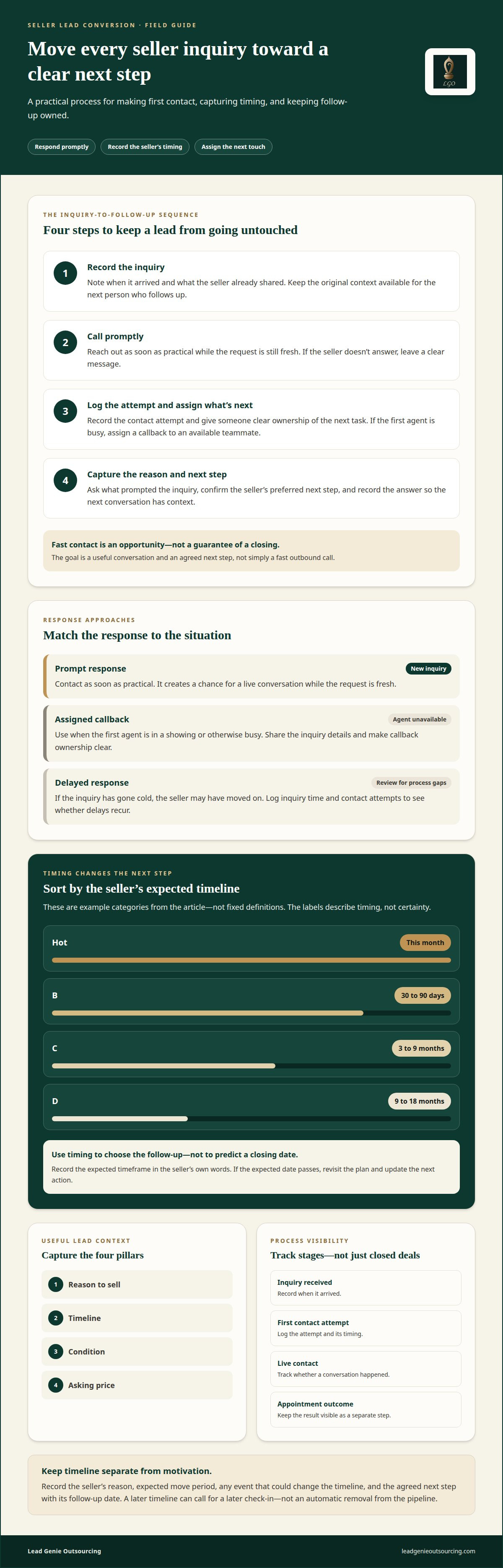
Use a consistent contact sequence when a new inquiry arrives:
- Record when the inquiry arrived and what the seller shared.
- Call promptly, and leave a clear message if the seller doesn’t answer.
- Log the attempt and assign the next contact task.
- Capture the seller’s reason for reaching out and preferred next step.
For example, an agent may be in a showing when a new inquiry comes in. Assigning the callback to an available teammate can prevent the lead from sitting untouched. Share the inquiry source and details already provided so the seller doesn’t have to repeat them. Make clear who owns the next attempt.
| Response approach | Timing | Contact implications | Best use |
|---|---|---|---|
| Delayed response | After the inquiry has gone cold | Seller may have moved on | Review for process gaps |
| Prompt response | As soon as practical | Creates a chance for a live conversation | New seller inquiries |
| Assigned callback | When the first agent is unavailable | Keeps next-step ownership clear | Showings or busy periods |
Contact new inquiries promptly, and assign a callback when the first agent can’t respond.
Fast contact doesn’t guarantee a closing. It creates an earlier opportunity to understand the seller’s needs, address a pricing concern, and agree on what happens next. Track inquiry receipt, first attempt, live contact, and appointment outcome as separate steps. Those records show whether sellers are being lost before the substantive conversation begins.
Categorizing leads by buying or selling timeline
A seller’s timing changes what a useful next step looks like. Someone planning to list soon needs a different conversation from an owner considering a move much later. If every contact sits in the same pipeline stage, agents may mistake a later timeline for a dead lead or keep pressing someone who isn’t ready.
For example, a team could sort seller timelines into these categories:
- Hot: planning to move this month.
- B: planning to move in 30 to 90 days.
- C: planning to move in three to nine months.
- D: planning to move in nine to 18 months.
These ranges are examples of a sorting framework, not fixed definitions for every team. The labels describe timing, not certainty. A seller planning to list this month still needs a clear reason, decision-maker, and next step. Someone in the three-to-nine-month example may need a later follow-up, not removal from the pipeline. Record the expected move period in the seller’s own words.
Some circumstances can extend the timeline beyond the first conversation. Probate, relocation, downsizing, divorce, and inherited property may involve decisions or logistics before a seller is ready to list. Ask what needs to happen before a sale becomes realistic. For an inherited home, the next step may depend on family discussions. For relocation, the seller may need to coordinate a move before choosing a listing date.
Keep timeline separate from motivation. A seller may have a strong reason to move but no near-term date. Another may say “soon” without naming a reason or concrete action. Capture both details. A useful lead record makes clear why the owner may sell, when they expect to act, and what follow-up fits.
For each seller, log these items:
- Expected listing or sale timeframe.
- Reason for considering a move.
- Event or decision that could change the timeline.
- Agreed next step and follow-up date.
For example, an owner considering a move in six months may ask for a check-in after a family decision. Set a task for the agreed point rather than marking the lead “not interested.” If the seller’s plans change, update the timeline and next action. This keeps the record useful for the next agent handling the conversation.
Qualification gets sharper when a call captures reason, timeline, condition, and asking price together. Those details give the next conversation context instead of forcing the seller to repeat the basics. See how the four pillars of a motivated seller lead support a clearer handoff.
Use timeline categories to set the next action, not predict a closing date. A listing depends on the seller’s readiness, decisions, and circumstances. Review older records when the expected date passes. Update the seller’s stated plan, then decide whether to schedule another conversation or keep the lead in longer-term follow-up.
Conversion rates and process metrics
A single conversion rate can hide where seller leads stall. Separate inquiry-to-contact, contact-to-qualified conversation, appointment, agreement, and closing. Each stage has its own denominator. A low closing rate may originate in poor lead fit, missed calls, or weak qualification, rather than the final sales conversation.
Use the same formula for each stage: divide the number that advanced by the number that entered, then multiply by 100. For example, if 20 clients came from 200 leads, the lead-to-client conversion rate would be 10%. Those figures are an illustration only. The calculation is useful when “client” and “lead” mean the same thing each time you measure.
For context, example U.S. benchmark ranges for purchased online real estate leads are 0.4% to 1.2%; example ranges for organic and referral leads are 2% to 5%. Treat these as broad market examples, not seller-only targets or promises for a campaign. Source, intent, qualification, and the outcome being measured all affect comparisons between lead types.
Track seller-specific stages in your CRM instead of comparing unlike lead types. A social inquiry, an old contact, and a direct referral may arrive with different context. Record the source, date received, first successful contact, qualification status, appointment outcome, and final disposition. Then compare similar sources over the same measurement period.
- Contact rate: leads reached in a live conversation divided by leads attempted.
- Qualification rate: conversations meeting your seller criteria divided by live conversations.
- Appointment rate: appointments set divided by qualified conversations.
- Agreement rate: signed agreements divided by appointments held.
- Closing rate: completed transactions divided by signed agreements.
Different metrics point to different fixes. Low contact rates suggest reviewing call coverage and contact details. Strong contact but weak qualification may signal poor targeting or unclear questions. Qualified conversations that rarely become appointments may need a clearer discussion of the next step. Appointments that don’t lead to agreements call for a review of seller expectations, property fit, and conversation notes.
Keep a count beside every percentage. In an illustrative small batch, one appointment can shift the rate sharply when another lead is added. Review both the rate and the underlying lead count. Compare one source with another, and qualified leads with qualified leads, not raw inquiries with referrals.
Use a weekly review to find the first stage with a clear drop. Check a sample of records from that stage, then look for a shared cause: missing seller context, no scheduled next action, or a mismatch between the stated timeline and follow-up. Change one process step, then measure that same stage again. This turns a broad conversion concern into a specific operating problem you can address.
Multi-channel follow-up and long-term nurturing
Follow-up frequency and channel choice shape whether a seller stays in the conversation. For hot leads, follow up within 24 hours, then every 2-3 days; use phone, text, email, and direct mail as appropriate.
Multi-Channel Follow-Up
Multi-channel follow-up uses more than calls to reach a seller. A phone attempt can start a live conversation, while a short email or text gives the seller another way to respond. Keep every touch tied to the same lead record so agents can see prior attempts and avoid sending mismatched messages.
Long-Term Lead Nurturing
Long-term nurturing keeps a seller in view when a transaction isn’t near-term. Real estate nurture systems can span 90-180 days, giving agents room to reconnect as plans change. This differs from active follow-up: the aim is to stay relevant over time, not to press for an immediate appointment.
Follow-Up Frequency
Frequency should match the seller’s stated timeline and response. For a hot lead, make the next follow-up within 24 hours, then every 2-3 days. A seller planning a later move needs a scheduled check-in that fits their timeline, rather than repeated urgent calls. Log the agreed date and adjust when the seller provides new information.
Follow-Up Methods
Phone, text, email, and direct mail each offer a different opening for contact. A call can address a detailed question; an email can recap a conversation; direct mail can support a longer campaign. Choose the channel that fits the last interaction, then record the outcome so the next touch builds on it.
Build a simple campaign around the seller’s last response, not a generic sequence. After a call, note whether the seller answered, requested a later check-in, or shared a changed timeline. Use that detail to shape the next message. If the seller responds by email, address the question they raised instead of restarting the pitch.
For a lead who hasn’t replied, vary the method and plan the timing deliberately. A possible sequence could move from a phone attempt to an email, then another call. This is an example, not a fixed rule. The right cadence depends on the seller’s engagement and stated plans.
- Record each attempt and its outcome in the lead record.
- Set a date for the next contact before closing the task.
- Pause or adjust the cadence when the seller gives a clear preference.
- Review leads that ignore multiple attempts over 6-12 months; consider deprioritizing them while retaining CRM records for occasional re-engagement.
Consistent records help keep a long-term seller relationship from going cold between agents or campaign stages. Each new touch should reflect the last known timeline and the seller’s prior response.
Follow-up consistency
Consistent outreach means every seller has a clear next action, an owner, and a recorded outcome. A lead shouldn’t depend on one agent remembering to call again.
A follow-up plan designed to run across 10 business days over two weeks gives the team a defined window for initial contact attempts. Treat it as a process, not a promise that every seller will respond within that period. Record each attempt, result, and next task. If the seller gives a preferred time or asks for a later check-in, update the plan to match.
Use a shared CRM task list to make ownership visible. Each open seller record should show who handles the next touch and what happened last. If an agent is away or a lead changes hands, the next person can continue the conversation without starting from scratch. A note such as “asked for a call after reviewing the property condition” gives the next attempt context and a clear reason.
Consistency also means using a cadence the team can maintain. A sequence that looks thorough on paper fails if agents skip steps during busy periods. Set tasks that fit the team’s calling capacity, then review overdue follow-ups during a regular pipeline check. A missed task needs a new owner or date, not an invisible status change.
- Assign ownership: Name the person responsible for the next outreach.
- Log the result: Record whether the seller answered, declined, or requested another time.
- Set the next task: Add a due date before closing the current task.
- Review overdue leads: Reassign or update each open follow-up during the team’s pipeline review.
Measure execution separately from conversion. For example, count completed follow-up tasks alongside appointments set. If tasks are often overdue, capacity or ownership may be the issue. If tasks are completed but sellers still don’t progress, review the conversation notes, lead fit, and next step. This distinction keeps teams from blaming the script for a process gap.
Keep messages consistent across agents, too. If one person promises a callback and another sends an unrelated pitch, the seller has to rebuild context. Use the recorded reason for contact and prior response to guide the next conversation. The wording can vary, but the seller’s stated need and agreed next step should stay clear.
For real estate investors and wholesalers, cold calling can support steady seller outreach, but the workflow still needs clear lead ownership and follow-up records. A real estate cold calling guide can help map the calling process to those follow-up steps.
At the end of each review, choose one process fix. It might be assigning unowned records, clearing overdue tasks, or improving call notes. Make the change visible in the CRM, then check whether the next review shows better follow-through. A consistent system makes missed touches easier to spot and repair.
Lead Genie Outsourcing
Lead Genie Outsourcing helps real estate investors and wholesalers keep seller outreach moving through dedicated cold calling and the LGO CRM. Turn to this support when your team can’t keep calls, lead qualification, and follow-up records consistent alongside daily deal work.
Each caller works 40 hours a week and receives 10,000 skip-traced, scrubbed records. Seller conversations are qualified on reason to sell, timeline, condition, and asking price, with call recordings available for review. The guarantee is 30 qualified seller appointments a month, or dialing continues free until that target is reached.
Book a free 30-minute call with Lead Genie Outsourcing.
Make the Next Lead Easier to Track
Understanding why real estate seller leads do not convert is useful only if it changes what happens next. Pick one point in your pipeline where ownership or follow-through breaks down. Set a clear next action, assign responsibility, and make the result visible. Then use your next pipeline review to see whether the change held.
Don’t rebuild the whole process at once. A focused adjustment makes it easier to see what’s helping and what still needs attention. If your team needs steadier seller outreach or a clearer place to manage lead activity, Lead Genie Outsourcing can discuss how its cold calling and LGO CRM fit your operation.
Schedule your free 30-minute call with Lead Genie Outsourcing and take the next step with a clear plan.
Frequently Asked Questions
Why are my real estate leads not converting?
The reasons why real estate seller leads do not convert often appear before the closing conversation. A lead may lack a clear selling reason, have a timeline that doesn’t fit your pipeline, or come from a source with little seller context. Review a few stalled records and compare what was known, what was asked, and what next step was agreed. This helps separate lead-fit problems from execution gaps.
What makes a real estate lead qualified?
A qualified seller lead has a credible reason to sell, a useful timeline, enough property context, and a worthwhile next step. For example, an owner considering a move after an inherited-property decision may be suited to a later follow-up, not an immediate listing appointment. Qualification also means identifying who makes the sale decision and whether the seller’s expectations align with your investment strategy.
What are the most common reasons real estate seller leads do not convert?
Common causes include weak seller intent, a timing mismatch, unclear property details, unrealistic price expectations, and missed next steps. A seller may sound interested but still need a family decision or another event before acting. Distinguish those cases from leads with incorrect contact details or no real selling reason. Tag the specific barrier in your records so the team can address it instead of marking every stalled lead “unresponsive.”
How do slow response times affect real estate seller lead conversion rates?
Slow contact gives a seller more time to lose interest, forget the inquiry, or speak with someone else. A real estate lead contacted within 5 minutes can convert at rates 5x to 10x higher than one contacted after 30 minutes. Treat that comparison as a signal to inspect your contact workflow, not a forecast for every campaign. Track when inquiries arrive and when a live conversation happens.
How do lead quality and seller motivation impact conversion?
Lead quality affects how much useful context an agent has before the next conversation. A motivated seller can still be a poor fit if the property, decision-maker, or timing doesn’t match your criteria. For example, an owner with a clear reason to sell may need a delayed check-in because a family member must weigh in. Track motivation separately from readiness, then set the next action around both.
What conversion rates are typical for real estate seller leads by source?
U.S. purchased online real estate leads have reported conversion benchmarks of about 0.4% to 1.2%; organic and referral leads benchmark around 2% to 5%. These are broad real estate lead figures, not seller-only guarantees. Compare like sources and define the outcome consistently, such as appointment set or transaction closed. A rate changes depending on which stage you measure and how the lead source captures intent.
How can agents qualify seller leads and identify readiness to sell?
Ask what prompted the possible sale, when the owner hopes to act, the property’s condition, and the price they expect. Then clarify who else needs to approve the decision and what could change the timeline. For example, “after the tenant leaves” gives a concrete readiness condition. Record the seller’s own words and agree on a next step that fits their situation.
What follow-up process improves conversion of seller leads into listing appointments?
Use a documented sequence with an owner, a specific next task, and a reason for each contact. After a seller shares a key concern, make the next touch address it rather than repeat a generic pitch. If the seller asks to reconnect after a family meeting, log that event and schedule the follow-up accordingly. Review overdue tasks regularly, and update the plan whenever the seller’s circumstances change.