

To generate seller appointments for investors, target the right property owners, qualify each conversation, and book a meeting only when the seller’s reason, timeline, property condition, and asking price fit your buying criteria. Record the details in your CRM and set a relevant follow-up for sellers who aren’t ready. A consistent process is more useful than a calendar full of unqualified calls.
Getting a seller on the phone is only part of the work. You also need to identify the right prospects, ask useful questions, and make sure promising conversations don’t get lost after the call. This guide explains how to qualify seller leads, launch outreach, schedule appointments, connect your CRM, and follow up with sellers who need more time. Each step keeps the pipeline clear and gives your team a practical next move.
Key Takeaways
- Build seller campaigns around the conversations and property details that matter to your investment criteria.
- Qualify sellers by their reason for selling, timeline, property condition, and asking price before booking an appointment.
- Use a clear campaign launch process and keep appointment details organized in your CRM.
- Track booked meetings and follow up with sellers who need more time, so promising conversations stay in the pipeline.
- See how dedicated cold calling and a connected CRM can support consistent seller outreach.
How can agents generate qualified investor seller leads?
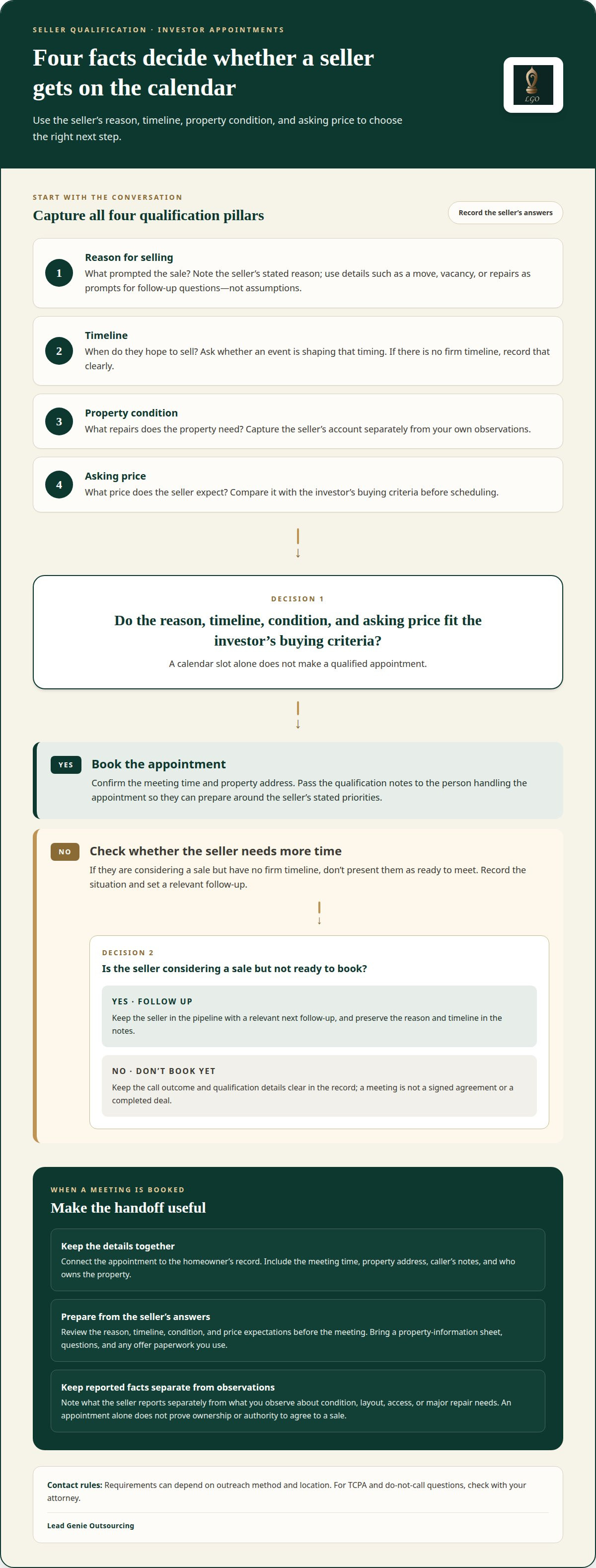
Generate seller leads through targeted outreach, then qualify each conversation before booking. For seller appointments for investors, a calendar slot alone isn’t enough: the seller’s reason for selling, timeline, property condition, and asking price need to fit the investor’s buying criteria. Record those details so the next person can act on them.
Appointment-setting services focus on contacting homeowners and scheduling meetings. Lead-generation services may also identify prospects and qualify them before booking. Compare what is included in the handoff: a useful appointment has the seller’s motivation, timeline, property condition, and price expectations, not just a name and meeting time.
An ISA can ask the same qualification questions on every call, note the answers, and schedule a meeting when the seller’s needs fit the investor’s criteria. A motivated seller may mention a move, a vacant property, or repairs they don’t want to manage. Those details prompt follow-up questions, not assumptions. A four-pillar seller qualification framework keeps the conversation focused.
To qualify a seller lead, capture the reason for selling, the property’s condition, the seller’s asking price, and their timeline. Ask when they hope to sell and whether a particular event is shaping that timing. If they’re considering a sale but have no firm timeline, record that clearly rather than presenting them as ready to meet.
During an appointment, ask what prompted the sale, what repairs the property needs, what price the seller expects, and when they want to move forward. Bring a way to record answers and note who owns the property. Review visible condition, layout, access, and major repair needs. Keep your observations separate from what the seller reports.
Bring a property-information sheet, a list of questions, and any offer paperwork you use. Don’t treat an appointment as proof that a seller owns the property or can agree to a sale. Be cautious about requests for money before basic details are confirmed, and pause if the seller’s account conflicts with the property information.
Improve appointment quality by setting expectations before the meeting, reviewing the qualification notes, and preparing to discuss the seller’s stated priorities. A missed detail can derail a useful conversation. Confirm the meeting time and address, then use the seller’s reason and timeline to guide the discussion instead of delivering the same pitch to every homeowner.
Contact rules can depend on the outreach method and location. For TCPA and do-not-call questions, check with your attorney before calling or texting homeowners. State and local markets also differ in seller expectations, property conditions, and typical deal flow, so tailor questions and appointment planning to the area.
Campaign launch and appointment timelines
A campaign takes planning before the first seller call. Define your target properties, seller profile, and qualification criteria. Then prepare the script, records, appointment handoff, and tracking process. Each part affects what happens after launch. If callers don’t know which property types fit, they may book meetings that don’t match your buying plan.
Investor-agent ads usually go live within about one week of the agent recording them, sometimes within 72 hours. Those are launch windows, not a promise that every campaign follows the same schedule. Recording readiness, campaign setup, and review all shape the path to launch. Plan around the required work, not a hoped-for start date.
Before recording a script, define the audience and the action the campaign should produce. An investor seeking sellers with vacant houses, for example, needs a different opening than one focused on inherited properties. Keep the message direct: explain who’s calling, why they’re reaching out, and what the conversation is about. A clear script gives callers structure without forcing every seller into identical answers.
Once the campaign is live, track progress through clear stages. Record whether a property owner was reached, discussed a sale, or booked an appointment. Add the seller’s reason, timeline, property condition, and asking price to the notes. That handoff lets the investor prepare for the meeting instead of starting discovery from scratch.
- Prepare: Set the target area, seller profile, script, and appointment criteria.
- Record and review: Confirm the message explains the call and invites a useful conversation.
- Launch: Start outreach when the campaign setup and records are ready.
- Review: Check call outcomes and qualification notes, then adjust the message when recurring objections surface.
Review the campaign consistently rather than changing it after one difficult call. Look at the questions sellers ask, the reasons they give, and where conversations stall. If homeowners repeatedly misunderstand the purpose of the call, refine the opening. If they engage but don’t book, review the appointment offer and handoff.
An appointment is a meeting, not a signed agreement or listing. Keep those outcomes separate in the pipeline. Record whether the seller attended, whether the investor made an offer, and what follow-up was agreed. This timeline shows where momentum slows, from first contact through the decision, without treating every booked appointment as a completed deal.
For a view of the campaign workflow, review the cold-calling process. A clear launch plan connects outreach, qualification, and calendar booking. It also gives the team concrete points to inspect when appointment quality needs work.
Appointment scheduling and CRM integration
A booked meeting helps only when the right details reach the right person. Connect each appointment to the homeowner’s record, then add the meeting time, property address, and caller’s notes. Your team can prepare from one view instead of searching call logs, calendar entries, and message threads. Keep the record current if the seller changes the time or shares new information.
Set up CRM fields before calls begin. Create separate entries for the seller’s name, property address, reason for selling, timeline, condition, asking price, decision-maker information, and appointment status. Clear fields make records easier to sort and review. For example, “needs repairs” belongs under condition, while “hopes to sell after relocating” belongs under timeline and motivation.
Map the scheduling process from the first conversation through the meeting. When a seller agrees to talk, the caller should confirm the property, preferred time, and best contact method. The CRM record should show whether the appointment is pending, confirmed, rescheduled, or canceled. This status trail helps teams avoid duplicate calls and missed updates.
Calendar integration should carry the same details as the CRM. Add the seller’s name, property address, meeting format, and key qualification notes to the calendar entry. If an agent covers a different area or time window, assign the appointment to the right calendar before sending confirmation. A mismatch between the CRM owner and calendar invite can leave a qualified lead unattended.
- Before booking: Capture the seller’s preferred time and confirm the property address.
- At booking: Assign the meeting to the agent responsible for that area.
- After booking: Save qualification notes and update the appointment status.
- After a change: Update both the CRM and calendar to keep records aligned.
Keep contract status separate from appointment status. A meeting is not an offer, and an offer is not a signed contract. Use distinct CRM stages such as appointment set, appointment held, offer discussed, and contract signed. This keeps the pipeline accurate and shows where follow-up is needed without treating every scheduled conversation as a deal.
Give each record a clear owner and next action. If a homeowner asks for a call after reviewing repair estimates, note the requested follow-up and assign it to a specific team member. Avoid vague notes such as “check back later.” A useful CRM entry says what happened, what the seller expects next, and who will handle it.
Review the calendar against CRM records at the start of each workday. Resolve duplicate appointments, missing addresses, unassigned records, and outdated times before calls begin. After each meeting, update the result while the details are fresh. This routine connects the appointment to the seller conversation and the next step.
Appointments booked on investors' calendars
A calendar booking starts a conversation, not a deal. The investor needs enough context to decide how to prepare and what to clarify. Include the seller’s name, property address, meeting format, and main reason for considering a sale. If the seller mentions a vacant property or a pending move, record it. That context can guide the meeting without treating the seller’s situation as settled.
Use the calendar entry to make the appointment easy to attend. Confirm whether the seller expects a phone call, video meeting, or property visit. Add access details the seller has shared, such as a gate code or tenant’s schedule. If the seller requests a different format, update the invite before the meeting. Clear logistics reduce avoidable confusion for everyone.
Set a confirmation step after booking. Restate the date, time, location, and meeting format in plain language, and ask whether anything important has changed. A seller may have received a repair estimate or changed their preferred timing. If plans shift, update the calendar and notify the assigned investor so nobody relies on outdated information.
- Before the meeting: Review the seller’s stated priorities and property notes.
- At confirmation: Restate the meeting details and ask about changes.
- When plans change: Update the appointment and notify the assigned investor.
- After the meeting: Record the result and the agreed next action.
Preparation also means knowing which property details are still open. Review the seller’s price expectations and any repair information already shared. Keep estimates separate from confirmed facts. A seller’s rough repair figure, for example, is a starting point for discussion, not a completed inspection. Use the appointment to ask focused questions and note what still needs review.
Don’t treat a calendar slot as evidence of a completed deal. A meeting may lead to another conversation, an offer, or no further action. Record each stage separately. “Meeting held” doesn’t mean an offer was made, and an offer doesn’t mean a contract was signed. Distinct stages keep the pipeline accurate and support useful follow-up.
After the appointment, assign one person to own the next step. If the seller wants time to consider an offer, record that request and the planned follow-up. If the investor needs more property details, note the exact questions. This keeps the path forward visible without overstating the seller’s readiness or the likelihood of an agreement.
Lead Genie Outsourcing reports that 95% of appointments booked by its ISA team show up. That figure can serve as a reference point when reviewing appointment-setting performance, but it does not make any individual meeting certain. Keep the record focused on what the seller confirmed and what happens next.
If a seller doesn’t attend, record that outcome rather than marking the meeting as held. Note any contact afterward and whether the seller wants to reschedule. If the meeting takes place, capture the agreed next action while the discussion is fresh. These details help the assigned investor continue with an accurate view of the appointment and its outcome.
Follow-up for sellers who are not ready to book
A seller who declines an appointment may still consider selling later. Record why they aren’t ready, what could change, and whether they agreed to further contact. “Need to talk with my brother” points to a clear next step. “Maybe later” calls for a respectful clarification before anyone schedules follow-up.
Use the seller’s own timeline to guide contact. Someone waiting for a tenant to move out needs a different check-in from someone comparing repair bids. Ask what needs to happen before they’ll consider a meeting. Save the answer in the CRM along with the seller’s preferred contact method and reason for selling.
Connect every follow-up to the last conversation. Recall the specific detail the homeowner shared, then ask whether anything has changed. If a seller wanted to review a contractor’s estimate, for example, ask whether they received it. Don’t restart the pitch or act as if the earlier conversation never happened.
Real estate agents can keep follow-up useful by recording a clear next action after each conversation:
- Seller needs time: Note what decision they’re considering and when they want to revisit it.
- Seller has a property question: Record the question and assign someone to answer it.
- Seller declines further contact: Record that preference and stop routine follow-up.
- Seller’s plans change: Update the timeline and offer an appointment if they’re ready.
Keep messages plain and specific. “Following up on your repair estimate” gives context; “just checking in” doesn’t. Avoid claiming that a property will sell quickly or that an offer is guaranteed. A useful message respects the seller’s decision and makes the next step easy to understand.
Track each attempt and outcome in the same record. Note whether the seller replied, asked for more time, requested an appointment, or ended the conversation. That history helps another team member pick up the discussion without asking the seller to repeat details. It also keeps outdated assumptions out of the pipeline.
Review open follow-ups by their agreed next action, not by a generic reminder list. A seller waiting on a family decision needs different wording from one preparing a vacant home. If the seller gives no timeline, ask permission to reconnect and record the answer. Don’t invent a date or keep pressing after a clear refusal.
When the seller is ready, confirm their reason, timing, property condition, and asking price before booking. That quick check makes the appointment relevant to the investor and the homeowner. For a practical outreach framework, use this real estate cold-calling guide to shape clear, consistent conversations.
The first 48 hours after a seller signs are critical for follow-up. For someone who is not ready to book, use that period to confirm what they need before meeting and whether they want another conversation. Keep the contact tied to their stated concern, and update the record with any change in readiness or timing.
If a seller still prefers to wait, respect that choice and follow the contact plan they approved. A brief, relevant message can make it easier to resume the discussion when they’re ready.
Lead Genie Outsourcing: Cold calling for real estate investors
Lead Genie Outsourcing handles cold calling for real estate investors and wholesalers who need consistent seller outreach and qualified appointments. Dedicated callers work 40 hours a week, using 10,000 skip-traced, scrubbed records per caller. Each lead is qualified on four pillars: reason for selling, timeline, property condition, and asking price. You also receive the call recording for review.
The appointment guarantee is 30 qualified seller appointments a month, or dialing continues free until the target is met. The LGO CRM is free for 30 days, giving you a place to track appointments and follow-up. This setup fits investors who need a steady calling process and clear lead notes.
Book a free 30-minute call to discuss your seller outreach.
Build a seller pipeline you can act on
Choose one part of your current process to improve first. Clarify what makes a meeting worth booking, assign ownership for each next step, or improve how your team records seller decisions. A focused change is easier to track than a full process overhaul. Review the next outreach period to see whether it makes appointments more useful.
Seller appointments for investors become more actionable when each conversation leads to a clear decision: book a meeting, schedule a follow-up, or close the record. Keep that decision visible to the team. If you want to discuss a practical next step for your outreach, book a free 30-minute call with Lead Genie Outsourcing.
Frequently Asked Questions
What are seller appointments for real estate investors?
Seller appointments are scheduled conversations with property owners who may be considering a sale. The investor uses the meeting to understand the owner’s goals, learn about the property, and decide whether to discuss a potential purchase. For example, an owner weighing what to do with a vacant rental can explain their plans and ask questions before deciding on a next step.
How do real estate investors find and schedule seller appointments?
Investors find potential sellers through outreach, referrals, inbound inquiries, and existing contacts. Start by defining which properties and seller situations fit your buying plan. If an owner responds to an outreach call, confirm their interest, agree on a time and meeting format, and record the context they shared. That gives the investor a useful starting point for the conversation.
Book a free 30-minute call to discuss your seller outreach.
What are common risks and scams involving investor seller appointments?
Be cautious about requests for money before basic details are confirmed. An appointment doesn’t prove the seller owns the property or can agree to a sale. Pause if the seller’s account conflicts with the property information.