

A compliant real estate cold-calling campaign needs more than a clean script. Consent, Do Not Call screening, and state calling limits all matter. A TCPA compliance checklist for real estate cold calling in 2026 should account for each contact method and the rules where the person you’re calling lives.
Florida limits sales calls about the same subject to three per 24 hours and sets a calling window of 8 a.m. to 8 p.m. Maryland also limits calls to the same number to three in 24 hours and prohibits covered calls between 8 p.m. and 8 a.m. Pennsylvania’s telemarketing requirements may affect when sales calls can be made. The details matter before a campaign starts.
This guide explains how consent applies to calls and messages, what federal Do Not Call screening involves, and how Florida, Maryland, and Pennsylvania rules may affect outreach. Use it to identify practical checks for your process, then discuss your specific campaign with your attorney. This is general information, not legal advice, for real estate investors and wholesalers.
Key Takeaways
- Consent requirements can differ for live calls, texts, prerecorded messages, and AI-generated voices. Treat each contact method as its own compliance question.
- According to the Federal Trade Commission, businesses must scrub calling lists against the National Do Not Call Registry at least every 31 days.
- According to the Federal Trade Commission, federal telemarketing rules prohibit calls before 8 a.m. or after 9 p.m. in the recipient’s local time.
- Florida, Maryland, and Pennsylvania have state-specific limits, so the recipient’s location can change when and how often you may call.
- Use the article’s framework to spot key campaign checks, then discuss your specific calling and messaging practices with your attorney.
Consent requirements by calling and messaging method
Consent depends on the contact method, message purpose, and technology used. For real estate investors and wholesalers, a lead form’s wording matters as much as the phone number it collects.
Third-Party Leads and One-to-One Consent
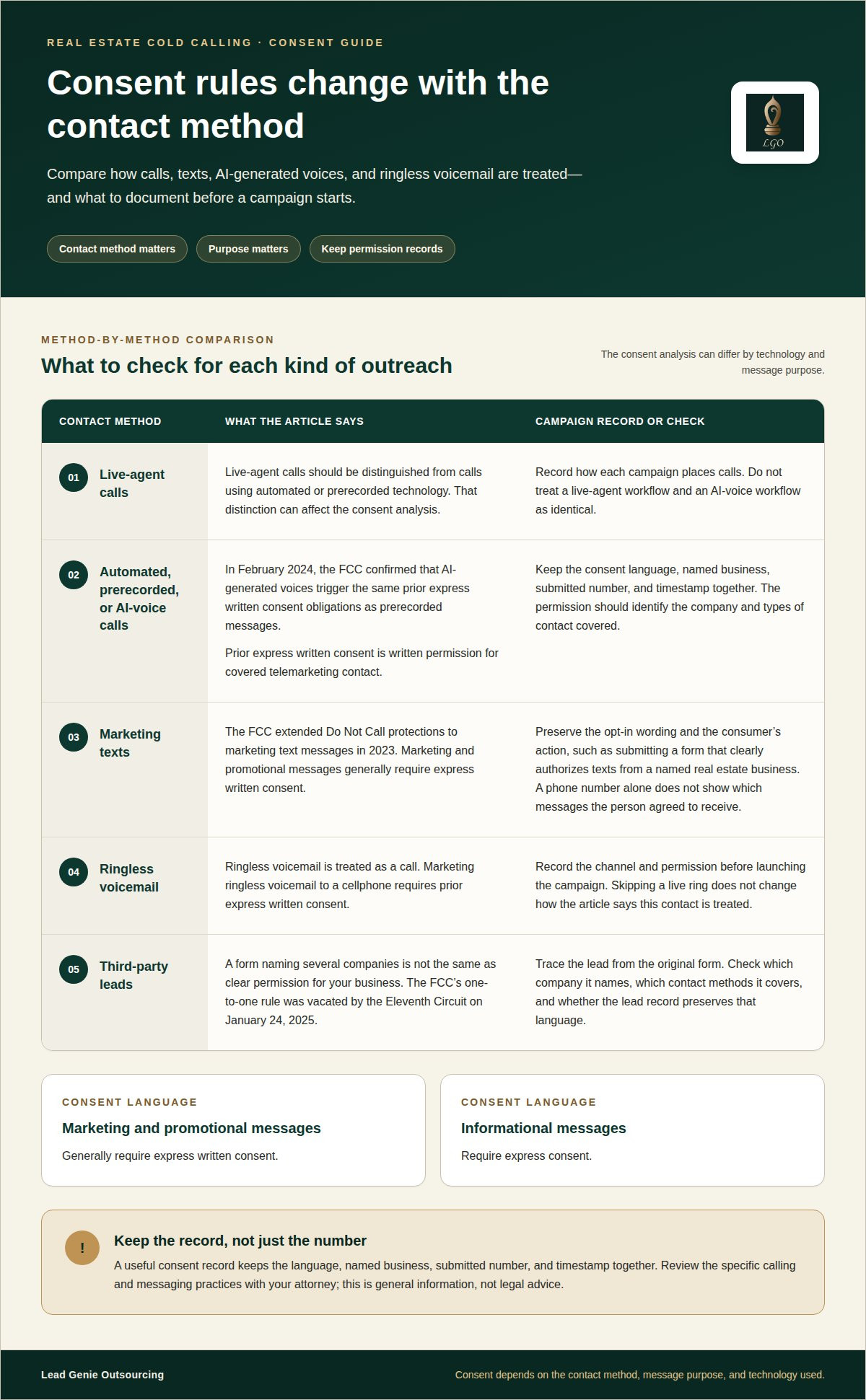
One-to-one consent means a person gives separate permission for each company to contact them, rather than agreeing to hear from a group of businesses. The FCC’s one-to-one rule was vacated by the Eleventh Circuit on January 24, 2025. That history matters when reviewing third-party leads: a form naming several companies is not the same as clear permission for your business.
Written Consent and Documentation
Prior express written consent is written permission for covered telemarketing contact. It should identify the company and the types of contact covered. Marketing and promotional messages generally require express written consent, while informational messages require express consent. Keep the consent language, named business, submitted number, and timestamp together. A record containing only a phone number does not show what the person agreed to.
Separate live-agent calls from calls using automated or prerecorded technology. The distinction can affect the consent analysis, so record how each campaign places calls. In February 2024, the Federal Communications Commission confirmed that AI-generated voices trigger the same prior express written consent obligations as prerecorded messages. A live agent dialing a lead and an AI voice calling that lead should not be treated as identical workflows.
Texting needs its own consent review. The Federal Communications Commission extended Do Not Call protections to marketing text messages in 2023. Keep the opt-in wording and the consumer’s action, such as submitting a form that clearly authorizes texts from a named real estate business. A phone number collected for a property inquiry alone does not explain which messages the person agreed to receive.
Ringless voicemail needs a separate compliance check. It is treated as a call, and marketing ringless voicemail to a cellphone requires prior express written consent. Avoid assuming that skipping a live ring changes how the contact is treated. Record the channel and permission before launching the campaign.
For third-party data, trace the path from the original form to the caller. Confirm which company the form names, which contact methods it covers, and whether the lead record preserves that language. The vacated one-to-one rule does not make vague or missing consent records useful. Ask your attorney how current federal and state requirements apply to your campaign, particularly when calls, texts, and AI-generated voices rely on different permission records.
National Do Not Call Registry scrubbing
Federal registry screening and internal suppression lists serve different purposes. Include both in the calling process for real estate campaigns.
National and Internal List Scrubbing
National scrubbing compares campaign numbers with the federal Do Not Call Registry, while internal scrubbing removes numbers your business has suppressed. According to the Federal Trade Commission, businesses must scrub their calling lists against the National Do Not Call Registry at least every 31 days. Apply both screens before a campaign starts, so a number on either list does not move into the call queue.
Opt-Out Requests and Internal Lists
An internal do-not-call list records numbers whose owners asked your business to stop telemarketing calls. According to the Federal Communications Commission, businesses must honor telemarketing opt-out requests within no more than 10 business days. Route each request into a shared suppression process, then prevent the number from returning through a later list import or campaign upload.
Keep federal and internal screening distinct. The federal registry identifies registered numbers; an internal list records requests made directly to your business. For example, a homeowner may ask an investor to stop calling even if the number is not on the federal registry. Carry that request forward across campaigns and lead sources.
Build a clear handoff for opt-outs. A caller who hears “remove me” should have a way to record the request, and the number should flow to the suppression list before another campaign uses it. The Federal Communications Commission’s 10-business-day limit makes delayed processing a concrete risk, not a back-office detail.
Do Not Call procedures also matter for safe harbor. A real estate business needs a policy for complying with federal Do Not Call rules and regulations to qualify for safe harbor. Specify who screens records, how opt-outs reach the internal list, and how campaign files are checked. Ask your attorney how the policy applies to your calling operation.
Keep records showing how each campaign was screened and managed. The Federal Trade Commission’s Telemarketing Sales Rule requires covered call records to be retained for five years. Preserve relevant list versions, screening dates, and opt-out records with the campaign so the process can be reviewed later.
Use one consistent suppression workflow for agents, campaign managers, and imported lead files. The TCPA and Do Not Call compliance process should account for both registry screening and internal opt-outs.
What Are The TCPA Consent Rules Real Estate Investors and Wholesalers Must Follow?
Federal TCPA rules cover more than live calls. Real estate investors and wholesalers must consider the contact method, marketing purpose, consent, and recipient’s local time.
Federal Rules for Calls and Texts
The Telephone Consumer Protection Act applies to telemarketing calls, text messages, and prerecorded voice messages. That makes a seller campaign’s texts part of the compliance review, not just its phone calls. Federal Trade Commission rules prohibit calls before 8 a.m. or after 9 p.m. in the recipient’s local time. A call schedule should use the person’s time zone, not the investor’s or wholesaler’s office clock.
AI-Generated and Prerecorded Voice Calls
Prerecorded and AI-generated voice calls trigger consent rules that differ from a live caller’s call. The Federal Communications Commission says callers using AI-generated artificial or prerecorded voices must obtain prior express consent, unless an emergency purpose or exemption applies. Its February 2024 Declaratory Ruling confirmed that AI-generated voices carry the same prior express written consent obligations as prerecorded messages. A campaign using either technology needs a distinct consent review.
Review texts according to their purpose. Marketing and promotional messages require express written consent, while informational messages, such as appointment reminders, require express consent. State the message purpose clearly in campaign records. A property offer and a reminder about a scheduled conversation, for example, serve different purposes.
TCPA Definitions and Telemarketing Calls
A telemarketing call is a call or message encouraging the purchase, rental, or investment in property, goods, or services. An investor’s pitch about buying a homeowner’s property can fit that purpose. Because the TCPA covers calls, texts, and prerecorded messages, both the content and delivery method matter. Classify each campaign before choosing its script and technology.
Do not assume a seller-focused message falls outside telemarketing rules because it concerns property rather than a retail product. The stated definition includes encouraging investment in property. A campaign inviting a consumer to consider a real estate transaction should therefore be reviewed based on its actual purpose, channel, and consent record.
Exemptions and Established Business Relationships
An established business relationship may affect whether certain calls are permitted, but it is not blanket permission for every contact method. A purchase-based relationship generally permits calls for up to 18 months after the transaction; an inquiry-only relationship generally permits calls for up to 90 days after an inquiry. Discuss how those limits apply to your campaign with your attorney.
For real estate cold calls, do not automatically treat a purchased lead or old inquiry as an active relationship. Record the underlying transaction or inquiry date and the person’s contact history. The TCPA also prohibits making consent to autodialed or prerecorded contact a condition of purchasing a product or service. Ask your attorney how federal rules and any applicable exemptions relate to your scripts, dialing method, and messages.
Florida, Maryland, and Pennsylvania requirements
State rules can limit when and how often a real estate campaign may call. Set separate dialing limits for each recipient’s state.
Disclosure Language and Opt-In Requirements
Disclosure language tells consumers who is calling and why; opt-in wording records permission for a contact method. For campaigns involving Florida, Maryland, and Pennsylvania, make the caller’s identity, purpose, and consent language clear in scripts and lead records. A homeowner who agreed to texts may not have agreed to a prerecorded voice call.
Do not use one state’s form or script as a universal template. Tie each written consent record to the company, phone number, and authorized contact method. Have your attorney review the disclosure and opt-in process for each state before dialing.
State Calling-Hour Requirements
Calling-hour rules define the permitted window for covered solicitation calls. A time allowed in one state may fall outside another state’s limits. Use the recipient’s local time and apply the narrower state window when scheduling each campaign.
- Florida: Commercial telephone solicitation calls are limited to 8 a.m. through 8 p.m. in the called person’s time zone. Calls about the same subject are limited to three per 24 hours.
- Maryland: Covered calls are prohibited between 8 p.m. and 8 a.m. Calls to the same number are limited to three in 24 hours.
- Pennsylvania: The 2026 telemarketing overhaul bans sales calls on Sundays and outside 9 a.m. to 7 p.m.
Set scheduling rules by state, then check call queues against local time and daily frequency limits. Florida and Maryland leads should not share one unfiltered calling window.
State Mini-TCPA Requirements
State mini-TCPA laws add state-level restrictions to telemarketing, including limits on calling times and frequency. For investors and wholesalers, Florida’s and Maryland’s call caps make repeat attempts a campaign-control issue, while Pennsylvania’s 2026 rules also affect Sunday dialing.
State limits apply alongside federal requirements, so one call pattern may not suit every number on a national list. Tag each record by the recipient’s state, then set the permitted hours, days, and repeat-call controls for that location. Review automated and prerecorded voice campaigns separately because the contact method can affect consent requirements. Ask your attorney how Florida, Maryland, and Pennsylvania rules apply to your scripts, consent records, and dialing setup.
TCPA compliance for real estate cold calling
For real estate campaigns, compliance depends on the full contact path: lead source, consent record, dialing method, and message purpose. Each call or text may raise its own compliance question.
Cold Calling Compliance Considerations
TCPA compliance means matching each consumer contact to its consent, contact method, and campaign purpose. This matters when an investor’s team uses live calls, automated dialing, and texts with the same seller list. Keep those contact types distinct in campaign records. Permission for one type of outreach does not automatically establish permission for another.
A tcpa compliance checklist for real estate cold calling 2026 should connect each record to its source, consent language, and authorized channel. Before launch, map that information to the caller and campaign. Include the original wording, named company, phone number, and contact method. Then connect each call or text to the campaign that sent it.
Review the dialing method as well as the script. A live agent, an automated system, and a prerecorded voice can trigger different consent questions. Keep evidence showing which method the campaign used. The Telephone Consumer Protection Act allows consumers to seek $500 for each violating call or text, increasing to $1,500 for a willful violation. Those figures make contact-level records important.
Use the tcpa compliance checklist for real estate cold calling 2026 as an operating control, not a substitute for legal review. If a consumer revokes consent, route the request into the suppression process before later outreach. The Federal Communications Commission’s opt-out rules are another point to discuss with your attorney, alongside the campaign’s scripts and systems.
Recent FCC and Court Changes
Two 2025 developments affect how real estate operators assess TCPA risk. On January 24, 2025, the Eleventh Circuit vacated the FCC’s one-to-one consent rule. That rule would have required separate consent for each company seeking to use a consumer’s consent. The decision concerned that specific rule, not every consent question for real estate outreach.
In 2025, the U.S. Supreme Court ruled in McLaughlin Chiropractic v. McKesson that federal courts do not have to follow the FCC’s interpretations of the TCPA. That affects how courts may consider agency interpretations; it does not remove the need to assess the campaign’s actual contact practices. Keep the court decision separate from the underlying consent and calling facts.
For 2026 planning, track changes by contact type and campaign. Preserve the consent version, lead source, dialing technology, and opt-out history together. If a vendor supplied leads, retain records showing how consent was collected. Ask your attorney how the 2025 decisions and current FCC rules apply to your scripts, systems, and campaigns in Florida, Maryland, or Pennsylvania.
Lead Genie Outsourcing
Lead Genie Outsourcing supports real estate investors and wholesalers with cold calling and the LGO CRM. It can fit when you want help keeping seller outreach moving while your team manages its consent records, Do Not Call process, and state-specific rules. Cold calling support does not replace legal review or determine whether a particular campaign complies.
Keep your attorney involved in reviewing call scripts, lead sources, and contact methods. This separates legal decisions from the day-to-day work of reaching sellers and tracking conversations.
Book a free 30-minute call with Lead Genie Outsourcing to discuss your real estate cold-calling needs.
Make Compliance Part of the Campaign Plan
Turn your TCPA compliance checklist for real estate cold calling in 2026 into a launch gate, not a document that gets filed away. Assign ownership for reviewing lead sources, scripts, dialing methods, and opt-out handling before each campaign goes live. Keep the workflow visible to everyone involved in seller outreach.
Set a review point whenever a campaign changes. A new lead source, message format, or calling tool may raise new compliance questions. Give your attorney those details so the review reflects how the campaign actually operates.
Book a free 30-minute call with Lead Genie Outsourcing.
Frequently Asked Questions
What Is TCPA Cold Calling Compliance In Real Estate?
It means organizing seller outreach around applicable consent, calling, messaging, and Do Not Call requirements. For example, an investor’s campaign should distinguish a live-agent call from a marketing text or prerecorded message. Keep the lead source, contact method, and permission record connected to each campaign. Have your attorney review how the rules apply to your scripts and systems. This FAQ provides general information, not legal advice.
How Much Can A TCPA Violation Actually Cost You?
A consumer may seek $500 for each violating call or text, or up to $1,500 for a willful violation. Those figures describe potential statutory damages, not a prediction of what a particular dispute will cost. The number and type of contacts matter because each call or text may count separately. If you receive a complaint or demand, preserve the relevant campaign and consent records and contact your attorney.
Do Not Call Rules: Do Offers to Buy a House Count?
An offer to buy a house can fall within telemarketing when the call encourages a consumer to engage in a property transaction. The script’s purpose matters, not just whether the caller is selling a product. Treat seller outreach as a campaign requiring Do Not Call screening, then ask your attorney how the specific offer and calling method should be classified. A cash offer does not itself show that the homeowner agreed to receive calls.
How Should Investors Handle Opt-Outs?
Stop further covered outreach after a consumer asks your business not to contact them, and record the request in a shared suppression process. For example, if someone texts “stop” after a campaign message, the request should reach the team managing future campaign lists. The Federal Communications Commission’s stated deadline for honoring telemarketing opt-outs is no more than 10 business days. Ask your attorney how that rule applies to your channels.
What Are the TCPA Penalties?
Potential TCPA statutory damages are $500 for each violating call or text, rising to $1,500 for a willful violation. The total exposure can therefore depend on the number of contacts at issue, not merely the number of campaigns. A repeated call and a later text may present separate contact-level questions. Keep records that let your attorney identify the campaign, recipient, contact method, and consent history for each disputed contact.
What exactly does the TCPA restrict, and does it cover AI-generated voice calls?
The TCPA covers telemarketing calls, text messages, and prerecorded voice messages. The Federal Communications Commission has said AI-generated artificial or prerecorded voices require prior express consent, unless an emergency purpose or exemption applies. Using an AI voice instead of a human caller, for example, does not remove the need to assess consent. Document the technology used for each campaign and ask your attorney to review its setup.
What happened to the one-to-one consent rule?
The Eleventh Circuit vacated the FCC’s one-to-one consent rule on January 24, 2025. The rule would have required separate prior express written consent for each company seeking to use a consumer’s consent. That decision addressed the specific rule, not every consent question for real estate outreach. Keep the original lead-form language and company identification with the record, then ask your attorney how current requirements apply.
What TCPA rules apply to real estate cold calls in 2026?
Federal and state requirements can both shape a campaign. Federal Trade Commission rules prohibit covered calls before 8 a.m. or after 9 p.m. in the recipient’s local time, and require registry scrubbing at least every 31 days. Florida, Maryland, and Pennsylvania also set state-specific calling limits. Match campaign settings to the recipient’s state and contact method, then have your attorney review the full process.